
Reading the Stars: The Influence of Astrology on Medieval Mental Health Practices


Welcome to Mind Care Guide, a sanctuary for understanding and nurturing your mental well-being. Ever wondered how ancient beliefs shaped our understanding of the human mind? This week, we delve into a fascinating corner of history. Prepare to be captivated as we explore Astrology’s impact on medieval minds, uncovering how celestial interpretations influenced their approaches to mental health. Intrigued? Let's journey back in time and discover the surprising connections...
Reading the Stars: The Influence of Astrology on Medieval Mental Health Practices
- Introduction: Astrology’s Impact on Medieval Minds - A Historical Overview
- The Cosmic Connection: Medieval Beliefs Linking Astrology and Mental Well-being
- Astrology in Medieval Medical Practice: Diagnosis and Treatment
- Case Studies: Examples of Astrological Practices in Medieval Mental Healthcare
- The Role of Astrologers and Physicians in Medieval Mental Healthcare
- Criticisms and Limitations: Questioning Astrology's Effectiveness in the Medieval Period
- The Legacy of Astrology: Its Influence on Modern Mental Health Perspectives
- Conclusion: Astrology's Complex Role in Shaping Medieval Mental Health Practices
-
Frequently Asked Questions
- How prevalent was astrology in medieval mental health practices?
- What specific mental health conditions did medieval practitioners believe were influenced by astrology?
- What astrological factors were considered when diagnosing mental health issues?
- How did medieval medical practitioners use astrological knowledge to treat mental health conditions?
- Was there any skepticism towards astrology in medieval mental health practices?
- Final Reflection: Celestial Echoes in the Medieval Mind
- Unlock Your Inner Astrologer: Exploring Medieval Mental Health
Introduction: Astrology’s Impact on Medieval Minds - A Historical Overview
The Prevalence of Astrology in Medieval Society
During the Middle Ages, spanning roughly from the 5th to the 15th century, astrology was not considered a fringe belief but a respected and integrated part of intellectual and practical life across Europe and the Islamic world. It was taught in universities, consulted by rulers, merchants, and physicians, and its principles permeated various aspects of daily existence.
Astronomical knowledge, which included astrology, was seen as essential for understanding the cosmos and its influence on the sublunar world, including human health and fortune. Many prominent scholars and physicians of the era, such as Albumasar (Jafar ibn Muhammad Abu Mashar al-Balkhi) in the 9th century or Roger Bacon in the 13th century, wrote extensively on astrological theories and their applications, demonstrating its deep roots in the scientific and philosophical framework of the time.
This widespread acceptance meant that understanding the movements of celestial bodies was considered crucial for making informed decisions, from planting crops and undertaking journeys to diagnosing illnesses and predicting personal characteristics or events. Astrologers, often also physicians or scholars, were sought after for guidance on matters great and small.
The notion that the macrocosm (the universe) directly influenced the microcosm (human beings) was a foundational principle, making the study of the stars a logical path to understanding human nature, behavior, and health, including what we now categorize as mental health challenges. Astrology’s impact on medieval minds was thus profound, shaping perceptions of self, destiny, and well-being.
Mental Health in the Middle Ages: A Brief Context
The medieval understanding of mental health differed significantly from modern perspectives. Conditions we might now diagnose as depression, anxiety, or psychosis were often interpreted through a lens combining spiritual, humoral, and sometimes astrological explanations. Madness, melancholy, or 'frenzy' could be attributed to demonic possession, divine punishment, imbalances of the four humors (blood, phlegm, yellow bile, black bile), or, crucially, the influence of celestial bodies. Treatment approaches were consequently varied, ranging from prayer and exorcism to dietary changes, herbal remedies, bloodletting, and astrological consultations.
For instance, melancholy, characterized by symptoms akin to modern depression, was often linked to an excess of black bile. However, medieval physicians also consulted astrological charts to determine if planetary alignments, particularly those involving Saturn (traditionally associated with melancholy), were contributing factors. This holistic, albeit non-scientific by modern standards, approach meant that mental distress was rarely viewed in isolation.
Instead, it was understood as part of a complex interplay between the individual's physical state, spiritual condition, and environmental influences, including the potent and ever-present forces believed to emanate from the stars and planets. The integration of astrology into medical practice was a natural extension of this worldview.
The Cosmic Connection: Medieval Beliefs Linking Astrology and Mental Well-being
Understanding the Medieval Worldview: Planets, Humors, and Temperaments
The medieval worldview was deeply rooted in the concept of correspondence between the cosmos and the human body, often articulated through humoral theory. Popularized by ancient Greek physicians like Hippocrates and Galen, and later synthesized with astrological ideas by figures such as Ptolemy, humoral theory posited that health depended on the balance of four primary fluids: blood (sanguine, associated with air), phlegm (phlegmatic, associated with water), yellow bile (choleric, associated with fire), and black bile (melancholic, associated with earth).
Each humor was linked to specific qualities (hot/cold, wet/dry) and temperaments. Medieval scholars meticulously connected these humors and temperaments to the planets and zodiacal signs.
For example, Jupiter and Venus were often associated with the sanguine temperament, promoting cheerfulness and sociability. Mars was linked to the choleric temperament, associated with anger and impulsivity. The Moon and Venus were sometimes connected to the phlegmatic temperament, suggesting calmness or sluggishness.
Most significantly for mental health, Saturn was strongly associated with the melancholic temperament, believed to cause sadness, fear, and contemplation. Each planet was thought to exert a specific 'quality' or influence that affected the balance of humors within an individual, thereby shaping their physical health and mental disposition. This intricate system of correspondences formed the theoretical bedrock of astrology’s impact on medieval minds concerning health.
How Celestial Events Influenced Mental States: A Core Belief
Medieval thinkers firmly believed that specific celestial events – the position of planets in zodiacal signs, their aspects (angles between them), and eclipses – could directly trigger changes in a person's humoral balance and, consequently, their mental state. An individual born under a strong Saturnine influence, for instance, might be predisposed to melancholy throughout their life. However, even those with a balanced temperament could be temporarily affected by unfavorable transits or conjunctions. A difficult aspect involving Saturn and the Moon, for example, might be blamed for a sudden onset of sadness or irrational fears.
Texts like the Centiloquium attributed to Ptolemy (though likely a later compilation) contain aphorisms linking planetary positions to specific mental characteristics or vulnerabilities. For instance, it might state that the Moon afflicted by Saturn in a person's birth chart indicates a propensity for depression or mental instability.
Furthermore, the position of the Moon was considered particularly important due to its perceived influence on fluids (like tides and bodily humors) and its rapid movement, which could cause frequent shifts in mood or mental clarity. Physicians and astrologers would consult ephemerides (tables of planetary positions) and astrological almanacs to understand the potential celestial influences on their patients, viewing the cosmos as a dynamic system constantly interacting with human physiology and psychology.
Astrology in Medieval Medical Practice: Diagnosis and Treatment
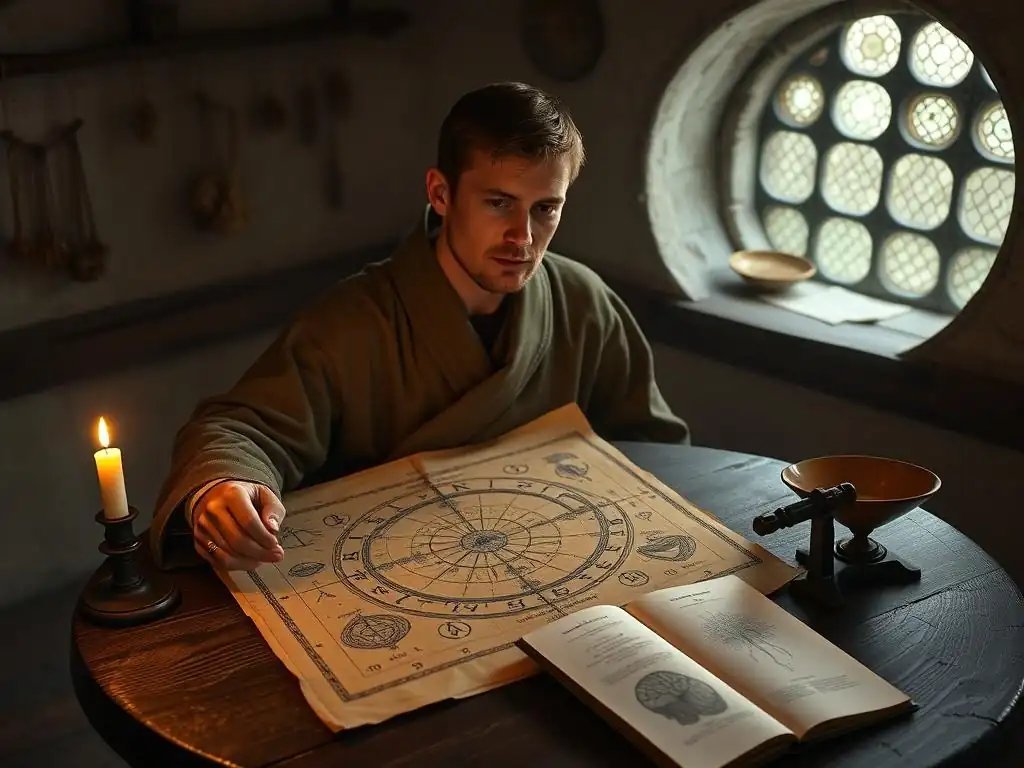
Astrological Charts for Mental Health Assessment
A cornerstone of medieval medical astrology was the creation and interpretation of astrological charts, particularly the natal chart (a map of the heavens at the moment of a person's birth) and horary charts (charts cast for the specific moment a question was asked, such as "Will this patient recover?"). For mental health assessment, the natal chart was crucial.
Astrologers would analyze the positions of the Moon (often linked to the mind and emotions), Mercury (associated with reason and communication), and Saturn (the planet of melancholy and restriction) within the zodiacal signs and houses of the chart. They would also examine the aspects between these planets and the Ascendant (the sign rising on the eastern horizon at birth), which represented the individual's physical body and temperament.
For example, a natal chart showing the Moon in a 'watery' sign (Cancer, Scorpio, Pisces) in a difficult aspect to Saturn in the 6th house (traditionally associated with illness) might be interpreted as indicating a lifelong predisposition to melancholy or emotional instability. Conversely, a well-aspected Mercury in an 'airy' sign (Gemini, Libra, Aquarius) might suggest a clear and rational mind.
Physicians used these interpretations to understand the root causes of a patient's mental distress, viewing the birth chart as a blueprint of their inherent strengths and vulnerabilities. This diagnostic step was often the first before deciding on a course of treatment, highlighting astrology’s impact on medieval minds not just in belief, but in practical application.
Planetary Influences on Specific Mental Ailments
Medieval astrological texts often linked specific planets or configurations to particular mental ailments. Melancholy, as mentioned, was strongly associated with Saturn. De Melancholia, a medieval treatise, might describe how Saturn's cold and dry nature increased black bile, leading to symptoms like fear, suspicion, and obsessive thoughts. Lunacy, or madness characterized by periodic episodes, was explicitly linked to the Moon ( luna), hence the term 'lunatic'. It was believed that the Moon's phases directly affected the severity of the condition, with symptoms worsening around the full moon.
Other planets were also implicated. Mars, with its hot and dry nature, was sometimes associated with 'frenzy' or mania, characterized by agitation, anger, and irrational behavior, believed to be caused by an excess of yellow bile. Mercury, despite its link to reason, could, when afflicted, be blamed for nervousness, erratic thought processes, or even delirium. Venus, associated with pleasure and love, could be linked to lovesickness or 'erotomania'. These associations provided a framework for medieval practitioners to categorize and understand mental suffering within their cosmic model, offering explanations that felt rational and consistent with their understanding of the universe.
Herbal Remedies and Astrological Timing
Treatment for mental ailments in the Middle Ages often involved administering herbal remedies, dietary changes, or procedures like bloodletting or purging. Crucially, the efficacy of these treatments was often believed to be enhanced by performing them at astrologically propitious times.
Medieval medical texts, such as the Regimen Sanitatis Salernitanum, a widely influential work from the School of Salerno, and numerous astrological-medical manuscripts, provided guidance on the best times to gather herbs, prepare medicines, or perform medical procedures based on the phase of the Moon, the position of the planets in the zodiac, and their relationship to the patient's birth chart.
For instance, gathering herbs associated with the Moon (like moonwort) or Mercury (like dill) for treating mental conditions might be recommended when the Moon or Mercury was strong and well-placed in the sky. Bloodletting, a common treatment for humoral imbalances, was often advised against when the Moon was in the sign ruling the body part being bled (e.g., Aries rules the head, so avoid bleeding the head when the Moon is in Aries).
A physician treating melancholy might prescribe a Saturnine herb like hellebore but administer it only when Saturn was favorably positioned or when the Moon was in a sign conducive to purging black bile. This meticulous attention to astrological timing underscores the deep integration of celestial considerations into the practical application of medieval mental healthcare.
Case Studies: Examples of Astrological Practices in Medieval Mental Healthcare
The Case of Charles VI of France: Royal Madness and Astrological Intervention
One of the most famous historical examples involving mental illness and astrological consultation is the case of Charles VI of France (reigned 1380-1422), known as Charles the Mad ( Charles le Fol). From 1392 onwards, Charles suffered from recurring bouts of psychosis, characterized by delusion, memory loss, and aggressive behavior. His condition baffled physicians and plunged the kingdom into crisis. While various explanations were offered, including poisoning and divine wrath, astrological factors were also seriously considered and consulted upon.
Royal physicians and advisors, many of whom were also skilled astrologers, examined Charles's birth chart and the transits occurring during his episodes. They sought to understand if unfavorable planetary alignments, perhaps involving Saturn or Mars, were triggering his madness.
While the specific astrological interpretations and proposed interventions are not fully documented in surviving records, the fact that astrologers were part of the consultative process highlights the belief that celestial influences could cause or exacerbate even severe mental derangement in the highest echelons of society. This case illustrates the practical application of astrology’s impact on medieval minds regarding royal health and stability.
The "Tacuinum Sanitatis" and its Astrological Prescriptions for Mental Well-being
The Tacuinum Sanitatis (derived from the Arabic Taqwim al-sihha, meaning "Tables of Health") is a medieval handbook on health and well-being, popular in Europe during the 14th and 15th centuries. While primarily focused on the six essential factors for health (air, food and drink, movement and rest, sleep and wakefulness, excretion and retention, and the affections of the mind), many versions included astrological considerations, particularly regarding timing. These beautifully illustrated manuscripts offered advice on maintaining humoral balance and preventing illness, including mental distress.
For example, entries might discuss the properties of certain foods or activities and recommend consuming them or undertaking them at specific times of the year or under particular planetary influences to optimize their benefit for a particular temperament. While not solely an astrological text, the Tacuinum often referenced the influence of seasons (linked to humors and zodiac signs) and sometimes included explicit astrological charts or diagrams indicating favorable times for various health-related activities, including those aimed at moderating the 'affections of the mind' like joy, anger, or sadness.
This integration demonstrates how astrological timing was considered relevant even in general health guides aimed at a broader, albeit still elite, audience.
The Role of Astrologers and Physicians in Medieval Mental Healthcare
The Collaboration Between Astrologers and Physicians
In the medieval period, the lines between physician and astrologer were often blurred. Many learned individuals practiced both disciplines, believing that a thorough understanding of the heavens was essential for effective medical practice. Physicians trained in universities typically received instruction in astronomy/astrology as part of the medical curriculum, as outlined in the works of figures like Avicenna (Ibn Sina), whose Canon of Medicine incorporated astrological principles. Astrologers, in turn, were frequently consulted by physicians, especially in complex or puzzling cases, including those involving mental or emotional disturbances.
This collaboration usually involved the physician examining the patient's physical symptoms and humoral state, while the astrologer would cast and interpret a relevant chart (natal or horary) to identify potential celestial causes or influences. The diagnosis and prognosis would then be formulated based on a synthesis of both humoral and astrological findings. Treatment plans, including the timing of interventions, would also be jointly determined or heavily influenced by astrological considerations. This symbiotic relationship underscores the significant, though often complex, role astrology played alongside traditional medicine in medieval healthcare, including approaches to mental health.
The Training and Expertise of Medieval Astrologers
Becoming a competent astrologer in the Middle Ages required extensive education and skill. Training typically involved years of studying astronomy, mathematics, and classical texts on astrology by authors such as Ptolemy, Albumasar, and later European commentators. Access to accurate astronomical tables (ephemerides) and instruments like the astrolabe was essential for calculating planetary positions. Astrologers also needed a deep understanding of humoral theory, medical principles, and philosophical concepts that linked the cosmos to human life.
Many prominent astrologers were associated with universities, serving as professors of astronomy or medicine. Others were attached to royal courts or wealthy households, providing consultations to elites. Their expertise was highly valued, and they were often compensated handsomely for their services. While some charlatans undoubtedly existed, the respected astrologers of the era were learned individuals operating within the accepted scientific framework of their time. Their role in mental healthcare, therefore, was not merely that of mystics but of trained practitioners applying recognized (though now superseded) principles to diagnose and advise on conditions affecting the mind.
Criticisms and Limitations: Questioning Astrology's Effectiveness in the Medieval Period
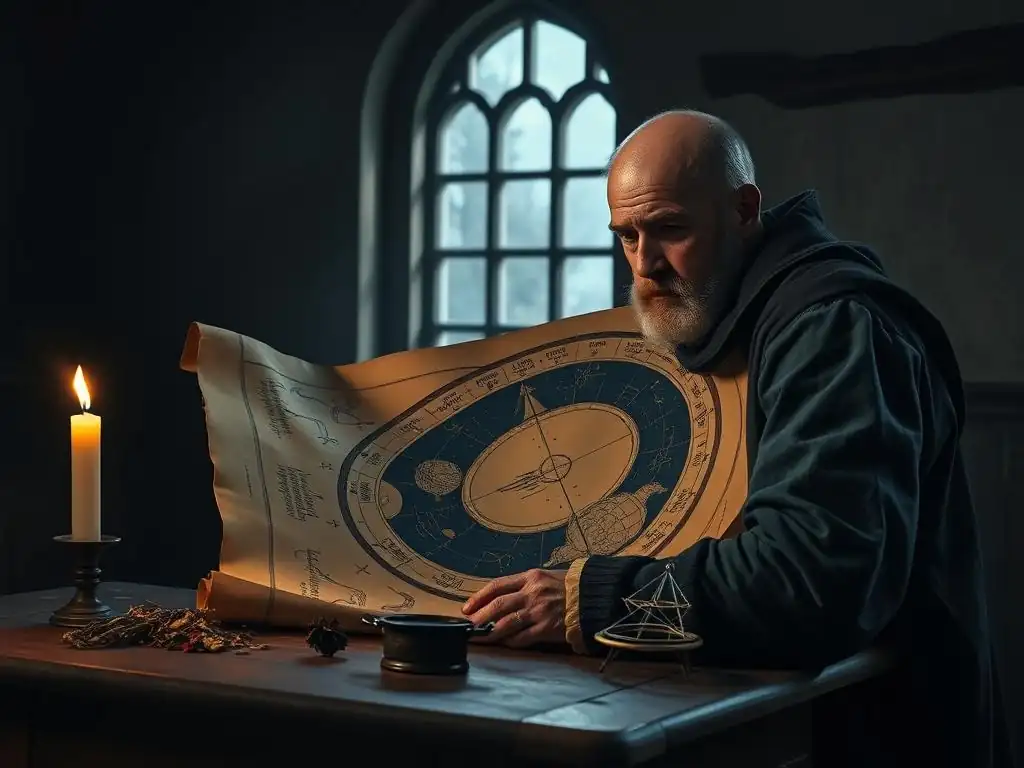
Skepticism towards Astrology among Medieval Scholars
Despite its widespread acceptance, astrology was not without its critics in the Middle Ages. Theological objections often questioned whether planetary influence negated free will or encroached upon divine providence. Scholarly skepticism, particularly from figures like Thomas Aquinas in the 13th century, focused on the deterministic aspects of astrology, arguing that while celestial bodies might influence physical temperament and predispositions, they could not compel the rational soul or determine individual choices. Aquinas, while acknowledging some potential physical influence on the body and thus indirectly on emotions, maintained that the wise person ruled their stars, not the other way around.
Other criticisms arose from practical observations. Inaccurate predictions or failures of astrologically timed treatments led some to question the reliability of the art. While not necessarily leading to outright rejection of astrology, these doubts encouraged a more cautious approach among some physicians and intellectuals. The inherent difficulty in proving direct causal links between celestial events and complex human conditions, including mental states, meant that while the belief in astrology’s impact on medieval minds was strong, definitive proof of its efficacy remained elusive, even within the medieval framework of understanding.
The Challenges of Empirical Evidence
The medieval scientific method, where it existed, differed significantly from modern empirical standards. Observations were often interpreted through pre-existing theoretical frameworks (like humoral theory and astrological correspondences) rather than used to rigorously test hypotheses. While physicians observed patient outcomes, attributing success or failure solely to astrological timing or diagnosis was challenging, given the multitude of other factors involved (diet, herbs, spiritual interventions, natural course of illness). There was no systematic collection of data or controlled trials as understood today.
Consequently, while proponents could point to instances where astrologically guided treatments seemed to align with recovery, critics could counter with failures or argue that recovery was due to other factors. The lack of a robust method for gathering and analyzing empirical evidence made it difficult to definitively prove or disprove astrology's effectiveness in treating mental health issues. This reliance on tradition, authority, and theoretical coherence over empirical verification was a significant limitation of medieval medical astrology, a challenge that would eventually contribute to its decline in medical practice centuries later.
The Legacy of Astrology: Its Influence on Modern Mental Health Perspectives
The Decline of Astrology's Prominence in Modern Medicine
The Scientific Revolution, beginning in the 16th and 17th centuries, marked a turning point in the relationship between astrology and medicine. Advances in astronomy (like the heliocentric model proposed by Copernicus and later supported by Kepler and Galileo) fundamentally altered the understanding of the cosmos. Simultaneously, the development of more empirical and mechanistic views of the human body, championed by figures like Vesalius in anatomy and Harvey in physiology, began to erode the foundations of humoral theory and the macrocosm-microcosm correspondence.
As medicine increasingly focused on observable physical causes and quantifiable data, astrological explanations for illness, including mental illness, became less tenable within the scientific framework. By the 18th century, astrology had largely been relegated from university curricula and mainstream medical practice, becoming associated more with popular almanacs and fortune-telling than serious diagnosis and treatment. The scientific method, with its emphasis on testable hypotheses and empirical verification, offered alternative, more reliable ways to understand the body and mind, leading to the gradual fading of astrology’s impact on medieval minds as a medical force.
Lasting Impact: Psychological Archetypes and Symbolic Understanding
While astrology is no longer considered a medical science, some scholars suggest its historical role may have left a subtle, perhaps symbolic, legacy. The archetypal associations of planets and signs – Saturn with melancholy, the Moon with emotions, Mercury with intellect – resonate with certain psychological concepts. Carl Jung, the Swiss psychiatrist, explored these correspondences, viewing astrological symbols not as causal forces but as archetypal images reflecting patterns in the collective unconscious that can manifest in personality and psychological states.
From this perspective, the historical framework of astrology, while lacking empirical validity for diagnosis or treatment, provided a rich symbolic language for describing human temperaments and emotional experiences. The medieval understanding of astrology’s impact on medieval minds, though rooted in a different paradigm, highlights a historical human attempt to find meaning, order, and external influence in complex internal states. It serves as a reminder of the diverse ways societies have sought to understand and address mental distress throughout history, reflecting a fundamental human need to contextualize suffering within a larger framework, whether cosmic, spiritual, or biological.
Conclusion: Astrology's Complex Role in Shaping Medieval Mental Health Practices
Summarizing Astrology’s Impact on Medieval Minds
Astrology played a complex and significant role in shaping medieval mental health practices. Far from being a marginal belief, it was deeply integrated into the scientific, philosophical, and medical frameworks of the era. Medieval thinkers and practitioners believed that celestial bodies exerted tangible influences on human beings, affecting their humoral balance, temperament, and susceptibility to mental ailments. Astrological charts were used for diagnosis, planetary positions were linked to specific conditions like melancholy and lunacy, and astrological timing was considered crucial for the efficacy of treatments, particularly herbal remedies.
This pervasive belief system meant that understanding astrology was deemed essential for understanding the human constitution and its vulnerabilities. Astrology’s impact on medieval minds extended from scholarly debate and royal courts down to the practical advice offered in medical handbooks. It provided a coherent, albeit ultimately flawed, framework for explaining the often mysterious and frightening phenomena of mental distress, offering both diagnostic insights and guidelines for intervention within the prevailing cosmic worldview.
Reflecting on the Historical Significance of Astrological Beliefs in Mental Healthcare
Reflecting on the historical significance of astrological beliefs in mental healthcare offers valuable insights into the evolution of human understanding of the mind. It demonstrates how societies construct explanatory models for illness based on their available knowledge and dominant worldviews. While the specific astrological-medical theories of the Middle Ages have been superseded by modern neuroscience and psychology, the medieval period's integration of cosmic and bodily influences highlights a historical attempt at a holistic understanding of health, where internal states were seen as inseparable from external forces.
Studying astrology’s impact on medieval minds reminds us that approaches to mental well-being are culturally and historically contingent. It underscores the long-standing human desire to find patterns and meaning in suffering and to develop systematic methods, however imperfect, for diagnosis and healing. While we no longer look to the stars for medical guidance, the medieval reliance on astrology in mental healthcare is a fascinating chapter in the history of medicine, illustrating how profoundly cosmology and cultural beliefs can shape our understanding and treatment of the human mind.
Frequently Asked Questions
How prevalent was astrology in medieval mental health practices?
Astrology held a significant influence in medieval times. It was deeply interwoven with medical and psychological thought, shaping diagnoses and treatments.
What specific mental health conditions did medieval practitioners believe were influenced by astrology?
Conditions believed to be affected included melancholia (depression), mania, and various personality imbalances. Planetary alignments were thought to directly impact humoral balance, affecting mental state.
What astrological factors were considered when diagnosing mental health issues?
The position of planets at birth (natal charts) was crucial. Also, the current planetary transits were compared to the natal chart to identify potential stressors and vulnerabilities.
How did medieval medical practitioners use astrological knowledge to treat mental health conditions?
Treatments were often tailored to planetary influences. This might involve herbal remedies aligned with specific planets, or scheduling treatments during auspicious astrological times for maximum efficacy.
Was there any skepticism towards astrology in medieval mental health practices?
While dominant, there were scholarly debates and some skepticism. Some questioned the extent of astrology's influence and advocated for more empirical observations alongside astrological insights.
Final Reflection: Celestial Echoes in the Medieval Mind
The enduring fascination with astrology, far from being a relic of the past, offers a crucial lens through which to understand the complexities of medieval mental health. Its influence wasn't merely a superstitious quirk; it profoundly shaped perceptions of illness, healing, and the human condition itself, leaving an undeniable mark on our understanding of history and the mind.
The pervasive nature of astrological belief in the medieval period underscores the deep-seated human need to find meaning and order in a chaotic world. This search for patterns, for connections between the celestial and the terrestrial, resonates even today. We still grapple with questions of fate, destiny, and the influence of external forces on our lives. The heavens themselves, the planets, and this centre observed, may unfold significant and important truths.
This quote, though not directly from the medieval period, encapsulates the enduring power of the belief that the cosmos holds answers to our deepest questions. The ways in which medieval individuals sought solace and understanding through the stars speaks volumes about the human spirit's persistent quest for meaning.
Consider the implications of this historical perspective on your own life. How do you navigate uncertainty and find meaning in the face of the unknown? What role do external factors play in your own self-perception and understanding of your well-being?
This article is not just a historical account; it's an invitation to reflect on the enduring human need to connect with something larger than ourselves, to find patterns and purpose in the seemingly random events of life. Let the celestial echoes of the medieval past inspire you to explore your own relationship with the cosmos and the search for meaning within yourself.
Unlock Your Inner Astrologer: Exploring Medieval Mental Health
Thanks for delving into the fascinating world of medieval mental health practices and their surprising connection to astrology! You’ve gained valuable insights into a little-known aspect of history. Now, let’s turn those insights into action:
- Dive deeper: Explore further resources on the intersection of astrology and medieval medicine – research online or visit your local library for more illuminating texts. This is your chance to become a true expert!
- Share your thoughts: What surprised you most about the role of astrology in medieval mental healthcare? Share your reflections in the comments below; let's spark a discussion!
- Consider a creative project: Try writing a short story or poem inspired by the astrological influences on medieval healing practices – unleash your inner artist!
Ready to uncover even more secrets from the past? What other historical healing practices intrigue you, and how do you think they relate to modern approaches?