
Bounce Back Stronger: Building Mental Resilience with Qigong Movements


Welcome to Mind Care Guide, a safe space dedicated to nurturing your mental well-being. Feeling overwhelmed? Perhaps you're searching for a way to cultivate inner strength and resilience. Discover how ancient practices can offer a surprising path forward. Dive into our latest article and explore how Qigong movements boost mental resilience, offering a powerful and accessible tool to help you bounce back stronger from life's challenges. Intrigued? Let's begin your journey to a more resilient you.
Bounce Back Stronger: Building Mental Resilience with Qigong Movements
- Introduction: Understanding Qigong and Mental Resilience
- Qigong Movements for Enhanced Mental Resilience: A Practical Guide
- The Science Behind Qigong and Mental Health
- Integrating Qigong into Your Daily Routine for Lasting Resilience
- Overcoming Challenges and Maintaining Motivation
- Advanced Qigong Practices for Deepening Mental Resilience
- Qigong Movements: A Natural Way to Increase Psychological Resilience
- Conclusion: Embracing Qigong for a More Resilient and Fulfilling Life
-
Frequently Asked Questions
- How exactly do Qigong movements contribute to mental resilience?
- What types of Qigong movements are most effective for improving mental well-being?
- How frequently should I practice Qigong to experience noticeable improvements in my mental resilience?
- Can Qigong movements be used in conjunction with other mental health treatments?
- Are there any specific Qigong movements that are particularly helpful for managing anxiety or depression?
- Final Reflection: Cultivating Inner Strength Through Movement
- Unleash Your Inner Strength: Start Your Qigong Journey Today!
Introduction: Understanding Qigong and Mental Resilience
The Growing Need for Mental Resilience in Today's World
In our fast-paced, ever-connected world, navigating the complexities of daily life often presents significant challenges. From work-related stress and financial pressures to relationship dynamics and global uncertainties, the demands on our mental and emotional resources are constant. This persistent pressure highlights an increasing need for mental resilience – the ability to adapt well in the face of adversity, trauma, tragedy, threats, or significant sources of stress. Without adequate resilience, individuals are more susceptible to burnout, anxiety, depression, and other mental health issues.
The World Health Organization (WHO) reports that depression is a leading cause of disability worldwide, affecting millions of people. Anxiety disorders are also incredibly prevalent. Building mental resilience is not about avoiding difficulties, but rather about developing the internal strength and coping mechanisms to navigate them effectively, recover more quickly, and even grow from the experience. This capacity is not something you're simply born with; it can be cultivated and strengthened through conscious effort and practice, making the exploration of tools like Qigong movements to boost mental resilience particularly relevant today.
What is Qigong and How Can It Enhance Mental Well-being?
Qigong, an ancient Chinese mind-body practice, involves slow, gentle movements, controlled breathing techniques, and focused intention. The term "Qigong" translates roughly to "cultivating vital energy" or "working with life force." Unlike more strenuous forms of exercise, Qigong is accessible to most people, regardless of age or physical condition. Its core principle is to harmonize the body's energy (Qi) flow, which is believed to support physical health, emotional balance, and mental clarity.
Regular engagement in Qigong practices has been shown to significantly enhance mental well-being. By integrating movement, breath, and mindfulness, Qigong helps to calm the nervous system, reduce the production of stress hormones, and promote a sense of inner peace. The deliberate, flowing movements require focus, drawing attention away from anxious thoughts and anchoring the practitioner in the present moment. This mindful presence, combined with gentle physical activity, creates a powerful synergy that directly supports the development of mental resilience.
Connecting Qigong Movements to Emotional Regulation
Qigong movements are intrinsically linked to emotional regulation. Traditional Chinese medicine views emotions as connected to the body's organs and energy pathways (meridians). Stagnation or imbalance in Qi flow is thought to contribute to emotional distress, such as anger, worry, or sadness. Qigong practices, through their gentle, flowing nature, aim to clear these blockages and promote smooth energy circulation, thereby helping to release stored emotional tension.
Specific Qigong movements and breathing techniques can be used to address particular emotional states. For instance, movements that involve expanding the chest and arms can help alleviate feelings of sadness or grief, while grounding postures can soothe anxiety and worry. The rhythmic breathing used in Qigong activates the parasympathetic nervous system, counteracting the "fight or flight" response and promoting a state of relaxation. By consciously moving the body and regulating the breath, practitioners learn to observe their emotional responses without being overwhelmed by them, fostering greater emotional flexibility and the capacity for Qigong movements boost mental resilience.
Qigong Movements for Enhanced Mental Resilience: A Practical Guide
Grounding Techniques: Strengthening Your Foundation for Resilience
Grounding is a fundamental concept in Qigong, referring to establishing a stable connection with the earth. This physical connection is mirrored internally by a sense of stability, presence, and security. In the context of mental resilience, grounding helps to anchor you during turbulent times, preventing you from being swept away by stress or anxiety. It builds a solid foundation from which you can face challenges with greater composure.
Grounding techniques in Qigong often involve standing postures with feet firmly planted, focusing on the sensation of gravity and the connection to the ground beneath you. These practices cultivate present-moment awareness and help dissipate scattered energy or anxious thoughts. By regularly practicing grounding, you train your nervous system to find calm and stability even when external circumstances feel chaotic, directly contributing to how Qigong movements boost mental resilience.
Qigong Grounding Postures for Stability and Focus
Standing postures like "Wu Ji" (Emptiness) or "Holding the Ball" are classic examples of grounding Qigong movements. In Wu Ji, you stand with feet shoulder-width apart, knees slightly bent, arms relaxed at your sides. The focus is on feeling the weight distributing through your feet, the connection to the earth, and the natural settling of your body. This seemingly simple posture requires subtle adjustments to find balance and stillness, encouraging a deep sense of physical presence.
"Holding the Ball" involves similar foot placement but with hands held softly in front of the abdomen, as if holding a large, energetic ball. This posture combines grounding with gentle arm activation and subtle weight shifts, further engaging the body's core stability. Practicing these postures for even a few minutes can help quiet a busy mind, reduce feelings of being overwhelmed, and build a felt sense of inner stability, crucial components for building mental resilience with Qigong movements.
Breathing Exercises for Calming the Nervous System
Deep, regulated breathing is integral to all Qigong practices and is a powerful tool for calming the nervous system. Stress often leads to shallow, rapid breathing, which perpetuates the stress response. Qigong breathing emphasizes slow, deep inhalations and exhalations, often coordinated with movements. A common technique is abdominal or diaphragmatic breathing, where you focus on expanding the abdomen on the inhale and drawing it in on the exhale.
This type of breathing stimulates the vagus nerve, which is a key component of the parasympathetic nervous system responsible for the "rest and digest" state. By activating the parasympathetic system, deep Qigong breathing counteracts the effects of stress hormones like cortisol, lowers heart rate, and reduces muscle tension. Incorporating just a few minutes of conscious, deep breathing into your day can significantly reduce anxiety and promote a sense of calm, demonstrating a direct way Qigong movements boost mental resilience by regulating physiological stress responses.
Cultivating Inner Strength: Qigong for Self-Empowerment
Inner strength is a vital aspect of mental resilience. It's the feeling of capability, confidence, and personal agency that allows you to face challenges head-on rather than feeling like a victim of circumstances. Qigong practices can cultivate this inner strength by connecting you with your body's inherent vitality and power, fostering a sense of self-mastery and empowerment. The deliberate, controlled nature of the movements builds physical and mental discipline.
Many Qigong sequences involve movements that feel expansive and powerful, such as extending the arms or rising onto the toes. These movements, performed with intention and coordinated breath, can evoke feelings of strength and confidence. Over time, consistent practice builds not only physical strength and balance but also a deep-seated sense of personal capability and resilience, empowering you to navigate life's difficulties with greater fortitude.
Empowering Qigong Sequences to Build Confidence
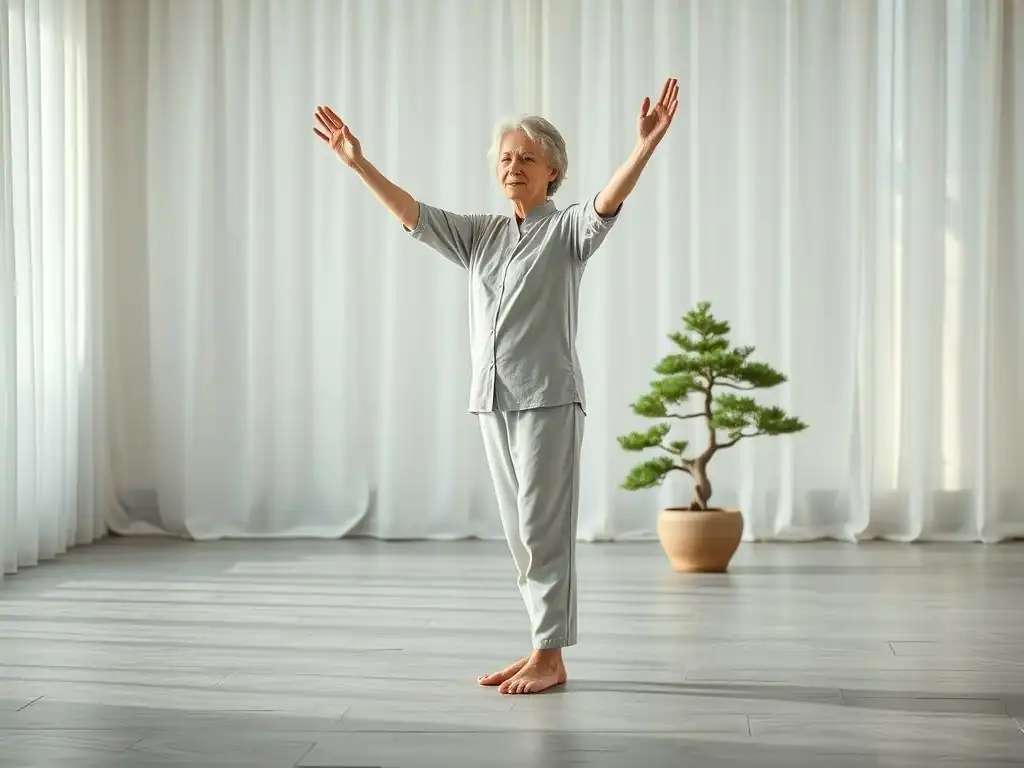
Sequences like the Eight Brocades (Ba Duan Jin) or the Five Animal Frolics (Wu Qin Xi) contain movements that specifically cultivate inner strength and confidence. For example, in the Eight Brocades, the movement "Holding Up the Heavens" involves lifting the arms slowly overhead while standing tall, stretching the spine, and expanding the chest. This posture embodies a feeling of uplifting and reaching, promoting a sense of openness and strength.
Another empowering movement is "Drawing the Bow to Shoot the Eagle," which involves adopting a stable stance, extending one arm forward as if holding a bow, and drawing the other arm back as if pulling the string. This movement requires focus, balance, and controlled tension, building physical power and mental determination. Regularly practicing these movements, feeling the strength in your body and the clarity in your intention, can significantly boost self-confidence and contribute to building mental resilience with Qigong movements.
Visualizations and Affirmations to Reinforce Resilience
Visualization and affirmation are often integrated into Qigong practice to enhance its mental and emotional benefits. While performing movements, practitioners might visualize positive energy flowing through their body, releasing tension, or strengthening their internal resources. This mental imagery reinforces the physical practice and directs intention towards specific outcomes, such as feeling more grounded, calm, or strong.
For instance, while practicing grounding postures, you might visualize roots extending from your feet deep into the earth, drawing up stability and nourishment. While performing expansive movements, you could visualize your energy expanding outward, filling you with confidence and vitality. Combining these visualizations with positive affirmations, such as "I am strong," "I am calm," or "I can handle this," further reinforces a resilient mindset. This integration of mind and body through Qigong movements boosts mental resilience by actively shaping your internal landscape.
Enhancing Emotional Flexibility: Adapting to Life's Challenges with Qigong
Emotional flexibility is the ability to experience, express, and tolerate a range of emotions, and to adapt your emotional responses to different situations. Resilience isn't about suppressing negative emotions, but about being able to process them and return to a state of balance. Qigong, with its emphasis on flow and release, directly supports the development of this flexibility, helping you move through emotional states without getting stuck.
The fluid, continuous nature of many Qigong movements encourages a similar fluidity in your emotional life. Just as energy flows through the body, emotions are seen as temporary states that can be acknowledged and released. Qigong provides tools to gently work with difficult emotions, preventing them from becoming stagnant or overwhelming, thereby enhancing your capacity to adapt and bounce back.
Fluid Qigong Movements for Emotional Release
Movements that involve gentle swaying, twisting, or circular motions are particularly effective for releasing emotional tension. For example, the movement "Waving Hands Like Clouds" involves slow, continuous circular motions of the arms and body, coordinated with shifting weight from one leg to the other. This flowing, repetitive motion is deeply calming and can help to dissolve physical and emotional rigidity.
Another releasing movement might involve gentle shaking or tapping of the limbs and torso, intended to loosen up stagnant energy and tension held in the body. These practices provide a safe and gentle way to allow emotions to surface and dissipate without judgment. By physically releasing tension through these fluid Qigong movements, you facilitate emotional release and cultivate a greater capacity for emotional flexibility, a key component of how Qigong movements boost mental resilience.
Cultivating Acceptance and Letting Go through Qigong
Many Qigong practices subtly encourage acceptance and the ability to let go. The emphasis on non-forcing, moving within your comfortable range, and simply observing sensations without judgment mirrors the attitude needed to accept difficult circumstances or emotions. The practice of letting go of physical tension during movements translates into an ability to let go of mental and emotional burdens.
Some practices specifically involve movements or meditations focused on releasing the past or letting go of worries about the future. For instance, a movement might involve a sweeping motion outwards, symbolizing the release of negativity. The mindful presence cultivated in Qigong helps you observe thoughts and feelings without getting entangled in them, making it easier to accept what is and gently let go of what no longer serves you. This conscious practice of acceptance and release, facilitated by Qigong movements, strengthens your ability to adapt and fosters mental resilience.
The Science Behind Qigong and Mental Health
How Qigong Impacts the Nervous System and Stress Response
The benefits of Qigong for mental health are increasingly supported by scientific understanding, particularly concerning its impact on the nervous system. Qigong's combination of slow movement, deep breathing, and focused intention helps to regulate the autonomic nervous system (ANS), which controls involuntary bodily functions like heart rate, breathing, and digestion. The ANS has two main branches: the sympathetic nervous system (responsible for the "fight or flight" response) and the parasympathetic nervous system (responsible for the "rest and digest" state).
Chronic stress leads to an overactivation of the sympathetic nervous system. Qigong practice, especially through slow movements and deep abdominal breathing, stimulates the vagus nerve, a major component of the parasympathetic nervous system. This stimulation helps shift the ANS towards a more balanced state, reducing the physiological markers of stress. Research using measures like heart rate variability (HRV) has shown that Qigong can increase HRV, indicating a healthier and more flexible ANS, which is strongly linked to improved stress resilience. This physiological regulation is a core mechanism by which Qigong movements boost mental resilience.
Qigong and the Regulation of Cortisol Levels
Cortisol, often called the "stress hormone," is released by the adrenal glands in response to stress. While essential for short-term survival, chronically elevated cortisol levels can have detrimental effects on both physical and mental health, contributing to anxiety, depression, sleep problems, and impaired cognitive function. Practices that effectively reduce the stress response can help lower cortisol levels.
Studies investigating the effects of Qigong on stress markers have often measured cortisol levels in participants. While specific figures vary between studies, many have reported a significant reduction in salivary or serum cortisol levels after consistent Qigong practice. For example, some studies have shown reductions in cortisol levels ranging from approximately 15% to 30% in individuals practicing Qigong regularly compared to control groups. This reduction in a key stress hormone provides a biological explanation for how Qigong movements boost mental resilience by mitigating the harmful effects of chronic stress on the body and mind.
Research Supporting the Benefits of Qigong for Mental Resilience
A growing body of research supports the positive impact of Qigong on various aspects of mental health and resilience. Systematic reviews and meta-analyses have compiled findings from multiple studies, indicating promising results across different populations. For instance, research published in journals like the Journal of Alternative and Complementary Medicine and Evidence-Based Complementary and Alternative Medicine has explored Qigong's effects on anxiety, depression, stress, and overall psychological well-being.
One meta-analysis, for example, concluded that Qigong practice showed moderate-to-large effect sizes in reducing symptoms of depression and anxiety. Another review focusing on stress management highlighted Qigong's effectiveness in reducing perceived stress levels and improving coping abilities. While more large-scale, high-quality studies are always beneficial, the existing evidence strongly suggests that consistent engagement with Qigong movements can be a valuable tool for enhancing mental resilience and improving psychological health outcomes. The cumulative findings underscore the potential of Qigong movements to boost mental resilience effectively.
Integrating Qigong into Your Daily Routine for Lasting Resilience
Simple Qigong Practices You Can Do Anywhere
One of the greatest advantages of Qigong is its adaptability. Many practices are simple enough to be done anywhere, requiring no special equipment or clothing. Integrating short bursts of Qigong into your daily routine can provide moments of calm and recentering, helping to manage stress throughout the day and build cumulative resilience. Even 5-10 minutes can make a difference.
Simple practices include standing postures like Wu Ji while waiting in line, performing gentle arm swings during a break at work, or practicing abdominal breathing while sitting on public transport. A basic sequence like "Separating Heaven and Earth" (part of the Eight Brocades), which involves extending one arm up and the other down, can be done standing or even seated, helping to stretch the body and regulate breath. These accessible Qigong movements boost mental resilience by offering immediate tools for stress reduction and focus, regardless of your location.
Creating a Personalized Qigong Routine for Mental Well-being
Building mental resilience with Qigong movements is most effective when the practice is consistent and tailored to your needs. Consider what time of day works best for you – some prefer morning practice to start the day centered, while others find evening Qigong helpful for unwinding. Think about how much time you can realistically commit, whether it's a dedicated 20-30 minute session or shorter, interspersed practices.
A personalized routine might include a mix of grounding postures to start, followed by some flowing movements for energy circulation, and concluding with breathing exercises or a short meditation. If you are dealing with specific challenges like anxiety, you might emphasize grounding and calming breaths. If you feel low in energy, more active, expansive movements could be beneficial. Experiment with different movements and timings to discover what resonates most with you and supports your specific mental well-being goals, making your Qigong movements boost mental resilience in a way that feels right for you.
Tips for Staying Consistent with Your Qigong Practice
Consistency is key to reaping the full benefits of Qigong for mental resilience. Life can be busy, but there are strategies to help maintain a regular practice.
- Start Small: Even 5 minutes daily is better than nothing. Build up gradually as you feel comfortable.
- Schedule It: Treat your Qigong time like any other important appointment. Put it on your calendar.
- Link It to Habits: Practice before breakfast, after brushing your teeth, or during your lunch break.
- Create a Dedicated Space: Find a quiet corner in your home that you associate with your practice.
- Be Patient and Kind to Yourself: Some days will be easier than others. If you miss a day, don't dwell on it; just start again the next day.
- Track Your Progress: Notice how you feel after practicing. Acknowledging the positive impact can be highly motivating and reinforces how Qigong movements boost mental resilience over time.
Overcoming Challenges and Maintaining Motivation
Addressing Common Obstacles in Your Qigong Journey
Embarking on a Qigong practice for mental resilience can present challenges. Common obstacles include lack of time, feeling self-conscious about the movements, difficulty concentrating, or not seeing immediate results. It's important to remember that these are normal parts of the process. Lack of time can often be addressed by breaking practice into shorter segments throughout the day. If you feel self-conscious, practice in the privacy of your home or find an online class.
Difficulty concentrating is a common experience, especially when first starting. Qigong practice itself is a tool for improving focus; simply noticing when your mind wanders and gently bringing it back to the breath or movement is part of the training. Patience is crucial when building mental resilience with Qigong movements; the effects are often cumulative and subtle at first, deepening over time. Acknowledging these potential hurdles upfront can help you navigate them more effectively and stay committed to your practice.
Staying Motivated and Inspired to Practice Qigong
Motivation can ebb and flow. To stay inspired, connect with the reasons you started practicing Qigong for mental resilience in the first place. Remind yourself of your goals – perhaps reducing stress, feeling more balanced, or improving your ability to handle challenges.
- Revisit the observed benefits: Do you sleep better? Feel calmer in stressful situations? Have more energy?
- Explore new aspects: Learn about the philosophy behind Qigong or try different sequences.
- Read inspiring materials: Books or articles about Qigong and resilience can deepen your understanding and commitment.
- Set small, achievable goals: Focus on consistency (e.g., practice 4 times this week) rather than perfection.
- Celebrate progress: Acknowledge how far you've come, even small improvements in focus or calmness.
Finding ways to keep the practice fresh and meaningful helps maintain motivation and ensures that your Qigong movements continue to boost mental resilience as an ongoing journey.
Finding a Qigong Community for Support and Growth
While solo practice is valuable, connecting with others who share an interest in Qigong can provide significant support and enhance your growth. A community can offer encouragement, shared learning, and a sense of belonging. This is particularly helpful when using Qigong for mental health, as connecting with others is itself a resilience-building activity.
Look for local Qigong classes, workshops, or online communities. Practicing with a group can be motivating and allows you to receive feedback and guidance from instructors or more experienced practitioners. Sharing experiences and challenges with others on a similar path can normalize difficulties and provide valuable insights. Being part of a Qigong community reinforces your commitment and provides a supportive environment for continuing to build mental resilience with Qigong movements.
Advanced Qigong Practices for Deepening Mental Resilience

Exploring Different Styles of Qigong for Specific Mental Health Needs
Just as there are different forms of exercise, there are numerous styles of Qigong, each with its own emphasis and techniques. Exploring different styles can help you find practices that resonate most deeply with your specific mental health needs and preferences. Some styles, like the Eight Brocades, are more focused on physical conditioning and energy circulation, which can be grounding for anxiety. Others, like some forms of medical Qigong, might target specific organ systems traditionally associated with certain emotions.
For example, Five Animal Frolics mimics the movements of animals (tiger, deer, bear, monkey, bird) and can be very expressive and playful, helping to release tension and cultivate a sense of ease. Tai Chi, often considered a form of Qigong, is known for its complex, flowing sequences that deeply integrate mind and body, offering profound benefits for balance and mental calmness. Exploring these variations can deepen your understanding and practice, allowing your chosen Qigong movements to boost mental resilience in more targeted ways.
Working with a Qualified Qigong Instructor for Personalized Guidance
While many basic Qigong practices can be learned from books or videos, working with a qualified instructor can significantly deepen your practice and ensure you are performing movements correctly and safely. An instructor can provide personalized guidance based on your physical condition, mental health goals, and specific challenges. They can offer corrections to your posture and movements, ensuring you gain the maximum benefit and avoid potential strain.
A good instructor can also introduce you to more advanced techniques, such as specific visualizations, sound healing (using vocalizations with movements), or deeper meditative states. They can help you understand the underlying principles of Qigong and how they apply to your journey of building mental resilience. Personalized guidance from an expert ensures that your Qigong practice is not just a series of movements but a profound tool tailored to help your Qigong movements boost mental resilience effectively.
The Role of Mindfulness and Meditation in Enhancing Qigong's Benefits
Mindfulness and meditation are intrinsically linked with Qigong and play a crucial role in enhancing its benefits for mental resilience. Qigong is often described as "moving meditation" because it cultivates a state of present-moment awareness through focused attention on the body, breath, and movement. This mindful aspect is what elevates Qigong beyond mere physical exercise.
Integrating dedicated seated or standing meditation practices alongside your Qigong routine can further deepen your capacity for focus, emotional regulation, and acceptance. Mindfulness helps you become more aware of your internal states – thoughts, feelings, and sensations – without judgment. This awareness is foundational to resilience, allowing you to recognize stress or difficult emotions early and respond constructively. By consciously cultivating mindfulness and incorporating meditation, you amplify the power of your Qigong movements to boost mental resilience by training both the body and the mind to be present, calm, and adaptable.
Qigong Movements: A Natural Way to Increase Psychological Resilience
Qigong for Anxiety and Stress Reduction: Finding Inner Peace
Anxiety and stress are pervasive challenges that significantly impact mental well-being and diminish resilience. Qigong offers a natural and effective approach to mitigating these states. The slow, rhythmic movements, combined with deep, regulated breathing, directly counter the physiological effects of anxiety. By activating the parasympathetic nervous system, Qigong helps lower heart rate, reduce muscle tension, and quiet the racing mind.
Specific Qigong movements that emphasize grounding, gentle stretching, and fluid transitions are particularly beneficial for anxiety. Practices like standing meditation (Wu Ji) or slow walking Qigong help anchor the mind in the present moment, interrupting worry cycles. The focus required to coordinate breath and movement serves as a form of active meditation, providing a break from anxious thoughts and fostering a sense of inner peace. Consistent practice of these Qigong movements boosts mental resilience by training the body and mind to access a state of calm even amidst external pressures.
Qigong for Improved Mood and Emotional Balance: Cultivating Happiness
Beyond reducing negative states like anxiety, Qigong also helps cultivate positive emotional states and improve overall mood. By promoting the smooth flow of Qi throughout the body, Qigong is believed to release stagnant energy that can contribute to feelings of sadness, frustration, or lethargy. The gentle physical activity also releases endorphins, natural mood elevators.
Movements that open the chest and upper body, such as those involving arm extensions or gentle backbends, are thought to help lift the spirit and alleviate feelings of depression. Practices that emphasize flowing, graceful movements can evoke feelings of joy and ease. By consciously engaging the body in harmonious movement and focusing on positive intention, practitioners can actively influence their emotional state, cultivating greater balance and even happiness. This capacity to shift mood is a key aspect of how Qigong movements boost mental resilience, allowing individuals to navigate emotional landscapes with greater ease.
Qigong for Enhanced Focus and Concentration: Sharpening the Mind
Mental resilience is not just about managing emotions; it also involves cognitive aspects like focus, concentration, and mental clarity. Stress and anxiety can significantly impair these functions, making it difficult to think clearly or stay focused. Qigong practice inherently trains the mind to concentrate. The precise coordination of movement, breath, and intention requires focused attention, drawing the mind away from distractions.
Many Qigong forms involve intricate sequences that must be learned and remembered, providing a gentle cognitive workout. The emphasis on present-moment awareness during practice strengthens the ability to stay focused on the task at hand, a skill that translates directly into daily life. By regularly engaging the mind in this focused way, Qigong helps to sharpen concentration, improve mental clarity, and enhance cognitive resilience, further illustrating the comprehensive ways Qigong movements boost mental resilience across emotional and cognitive domains.
Conclusion: Embracing Qigong for a More Resilient and Fulfilling Life
The Transformative Power of Qigong in Building Mental Strength
Qigong movements offer a powerful and holistic approach to building mental resilience. By integrating gentle physical movement, conscious breathing, and focused intention, Qigong addresses the interconnectedness of the body and mind. It provides practical tools to regulate the nervous system, reduce stress hormones like cortisol, improve emotional regulation, cultivate inner strength, and enhance cognitive function. The evidence, both anecdotal and increasingly scientific, points towards Qigong as an effective practice for navigating life's challenges with greater ease and strength.
Embracing Qigong means committing to a practice that nurtures your entire being. It's about learning to listen to your body, calm your mind, and cultivate a deep sense of inner peace and stability. The gentle discipline of consistent practice gradually builds the capacity to face adversity not with dread, but with a quiet confidence and adaptability. This transformative power lies in its ability to empower individuals to actively participate in their own healing and growth journey.
Qigong: A Path to Sustainable Mental Well-being
Ultimately, Qigong is more than just a set of exercises; it is a path towards sustainable mental well-being. Unlike quick fixes, Qigong offers a lifelong practice that deepens with time and dedication. It equips you with internal resources that are always available, regardless of external circumstances. By making Qigong a regular part of your life, you invest in your long-term mental health and resilience.
The journey of building mental resilience with Qigong movements is one of self-discovery and gentle cultivation. It is accessible, adaptable, and profoundly effective. As you continue to practice, you will find that you not only bounce back from difficulties but also approach life with greater presence, balance, and joy. Qigong movements boost mental resilience not just for surviving challenges, but for thriving in a complex world, leading to a more fulfilling and resilient life.
Frequently Asked Questions
How exactly do Qigong movements contribute to mental resilience?
Qigong movements combine physical postures, breathing techniques, and focused intention to regulate the nervous system. This helps reduce stress hormones and promote a sense of calm, ultimately building mental resilience against challenges.
What types of Qigong movements are most effective for improving mental well-being?
Movements that emphasize grounding, balance, and gentle stretching are generally beneficial. Specific examples include Eight Brocades Qigong and Five Element Qigong, known for their holistic approach to mind-body connection.
How frequently should I practice Qigong to experience noticeable improvements in my mental resilience?
Consistency is key. Aim for at least 15-30 minutes of practice most days of the week. Even short, regular sessions can have a significant impact on stress management and emotional regulation.
Can Qigong movements be used in conjunction with other mental health treatments?
Yes, Qigong can be a complementary therapy alongside traditional treatments like therapy or medication. It's important to discuss with your healthcare provider to ensure it aligns with your overall mental health plan.
Are there any specific Qigong movements that are particularly helpful for managing anxiety or depression?
Certain movements that focus on opening the chest and promoting deep breathing can be beneficial for anxiety. For depression, movements that encourage energy flow and a sense of vitality may be more helpful.
Final Reflection: Cultivating Inner Strength Through Movement
The practice of Qigong, with its gentle yet powerful movements, offers a potent antidote to the stresses of modern life. In a world increasingly characterized by anxiety and burnout, the ability to cultivate mental resilience is not a luxury, but a necessity. This article explored how specific Qigong movements can directly impact our mental well-being, fostering a sense of calm, focus, and inner strength. This is not just a fleeting trend; it's a pathway to a more balanced and fulfilling existence.
The profound impact of Qigong on my own mental state has been nothing short of transformative. I've witnessed firsthand how the mindful movement and breathwork can quiet the incessant chatter of the mind and reconnect me to the present moment. This journey of self-discovery through Qigong has reinforced the importance of integrating mindful practices into daily life, not just as a means of stress reduction, but as a foundation for cultivating lasting mental well-being. The body benefits from movement, and the mind benefits from stillness.
– Sakyong Mipham. This quote perfectly encapsulates the essence of Qigong's power to harmonize the physical and mental aspects of our being.
Now, it's your turn. Consider incorporating even a few minutes of Qigong practice into your daily routine. Start small, perhaps with just one or two of the movements discussed in this article. Observe the subtle shifts in your energy, your mood, and your overall sense of well-being. Remember, building mental resilience is a journey, not a destination. Embrace the process, be patient with yourself, and allow the gentle power of Qigong to guide you towards a stronger, more resilient you.
Unleash Your Inner Strength: Start Your Qigong Journey Today!
Thanks for taking the time to explore the power of Qigong for building mental resilience! We hope you gained valuable insights into how these gentle movements can transform your well-being. Now it's time to put that knowledge into practice.
- Begin your Qigong practice today: Even 5 minutes of daily practice can make a significant difference. Start with the beginner's sequence outlined in the article and feel the positive shift in your energy.
- Share your experience: Connect with others on their Qigong journey by sharing this article or your personal reflections on social media. Let's build a supportive community!
- Explore further: Research different Qigong styles and find a local instructor or online class to deepen your understanding and practice.
Ready to unlock your inner strength and cultivate lasting mental resilience? What small step will you take this week to incorporate Qigong into your daily routine?