
Buckwheat vs. Kapok: Choosing the Right Fill for Your Meditation Cushion

Welcome to Mind Care Guide, a sanctuary for your mental well-being.
Feeling overwhelmed by the choices when creating your perfect meditation space? We understand. Finding the right tools for mindfulness can be a journey. That's why we're diving deep into a crucial element: your meditation cushion. Unsure which fill is best for you? Explore our Meditation Cushion Fill Guide and discover the difference between buckwheat and kapok, unlocking a deeper, more comfortable meditation experience. Let's find your perfect fit together...
Buckwheat vs. Kapok: Choosing the Best Meditation Cushion Fill for Your Practice
- Meditation Cushion Fill Guide: Buckwheat vs. Kapok
- Buckwheat Hull Meditation Cushions: Benefits and Considerations
- Kapok Fiber Meditation Cushions: Exploring Softness, Lightness, and Breathability
- Buckwheat vs. Kapok: A Detailed Comparison
- Selecting the Ideal Meditation Cushion Fill
- Enhancing Your Meditation with the Right Cushion
-
Frequently Asked Questions
- What are the two most common types of fill used in meditation cushions?
- What are the key benefits of using buckwheat hulls as a meditation cushion fill?
- What are the advantages of using kapok fiber for a meditation cushion?
- How do buckwheat hulls and kapok fiber differ in terms of firmness and support?
- How does the fill material impact the overall comfort and longevity of a meditation cushion?
- Final Reflection: Finding Your Perfect Meditation Seat
- Unleash Your Inner Peace: Find Your Perfect Meditation Cushion
Meditation Cushion Fill Guide: Buckwheat vs. Kapok
Understanding Meditation Cushion Fill and its Impact on Comfort and Posture
Choosing the right meditation cushion fill is a crucial step in establishing a comfortable and sustainable meditation practice. The internal material of your cushion directly influences the support it provides to your hips, spine, and legs, which in turn affects your ability to maintain a stable posture for extended periods. An improperly supported posture can lead to discomfort, numbness, or even pain, becoming a significant distraction that pulls your focus away from your meditation.
Finding the ideal cushion fill helps you achieve better spinal alignment, allowing the body to relax while the mind remains alert. This foundational comfort is essential for deepening your practice and making it a more enjoyable and consistent part of your routine.
Beyond mere comfort, the meditation cushion fill plays a vital role in promoting proper ergonomic positioning during seated meditation. Different fills offer varying degrees of firmness, malleability, and height adjustment. For instance, a fill that allows the hips to be elevated above the knees facilitates a natural forward tilt of the pelvis, encouraging the spine to lengthen and reducing strain on the lower back.
Without this appropriate support and tilt, the spine may round, leading to slouching, restricted breathing, and discomfort. This meditation cushion fill guide explores two popular options, buckwheat hulls and kapok fiber, highlighting how their unique properties impact your ability to find and maintain a balanced, effortless posture throughout your meditation session.
Buckwheat Hull Meditation Cushions: Benefits and Considerations
Buckwheat Hulls: Origin and Properties
Buckwheat hulls, also known as荞麦壳 (qiáo mài ké) in Chinese, are the hard outer casings of buckwheat seeds. Buckwheat itself is not a true cereal grain but a pseudocereal, cultivated for centuries across Asia, Europe, and more recently, North America. The hulls are a byproduct of processing buckwheat groats for food. Traditionally, these hulls have been used for various purposes, including filling pillows and cushions, valued for their unique properties. Environmentally conscious meditators often appreciate that buckwheat hulls are a renewable resource, typically sourced from sustainable farming practices.
When you hold a handful of buckwheat hulls, you'll notice they are small, irregularly shaped, and somewhat pyramidal or conical. They are lightweight individually but become substantial when packed together. Unlike synthetic fills or even some natural fibers, buckwheat hulls don't compress into a solid block. Instead, they retain their individual shape and structure, allowing them to shift and conform precisely to the contours of the body. This inherent property is what gives buckwheat cushions their distinctive blend of firm support and adaptive comfort, making them a popular choice in the meditation cushion fill guide.
Benefits of Buckwheat Hull Fill: Support, Adjustability, and Longevity
One of the primary benefits of buckwheat hull fill is the exceptional support it provides, particularly for spinal alignment. The dense, granular nature of the hulls creates a firm base that elevates the hips, allowing the knees to drop below, which is crucial for maintaining a comfortable and stable cross-legged or kneeling posture. This elevation helps tilt the pelvis forward naturally, promoting the spine's natural curve and reducing the likelihood of back strain or discomfort during longer sits. Users often report feeling a solid, grounded connection with the cushion that helps them maintain their posture without excessive effort.
Furthermore, buckwheat hull cushions offer excellent adjustability, allowing you to customize the loft and firmness. Most buckwheat cushions feature a zippered cover and an inner casing, enabling you to add or remove hulls to achieve your desired height and density. For instance, someone with very tight hips might remove a cup or two of hulls to slightly lower the cushion, while someone needing more height might add more.
This personalization ensures the cushion perfectly fits your body type and meditation style, contributing to greater comfort and longer, more focused meditation sessions. Properly maintained, buckwheat hulls are incredibly durable and can last for many years, often a decade or more before needing replacement or significant replenishment, making them a long-term investment in your practice.
Drawbacks of Buckwheat Hull Fill: Noise, Weight, and Potential Allergies
While offering superior support, buckwheat hull fill does have some potential drawbacks. One common consideration is the sound the hulls make when shifting. As you adjust your position on the cushion, the hulls inside rustle and shift against each other. For some individuals, this sound can be a minor distraction, particularly during quiet meditation sessions. While the noise is generally subtle and many meditators quickly become accustomed to it, those who are highly sensitive to sound might find it noticeable.
Another factor to consider is the weight of buckwheat hull cushions. Due to the density of the packed hulls, these cushions are significantly heavier than those filled with lighter materials like kapok. A standard zafu-style buckwheat cushion can easily weigh between 5 and 8 pounds (approximately 2.3 to 3.6 kg).
This weight might be a consideration if you plan to travel with your cushion frequently or need to move it around your home often. While not excessive for home use, it makes them less portable than some alternatives. Additionally, while buckwheat hulls are generally hypoallergenic, individuals with severe allergies to buckwheat pollen or dust might experience sensitivities, though reactions to the processed hulls are relatively uncommon.
Kapok Fiber Meditation Cushions: Exploring Softness, Lightness, and Breathability
Kapok Fiber: Origin and Characteristics
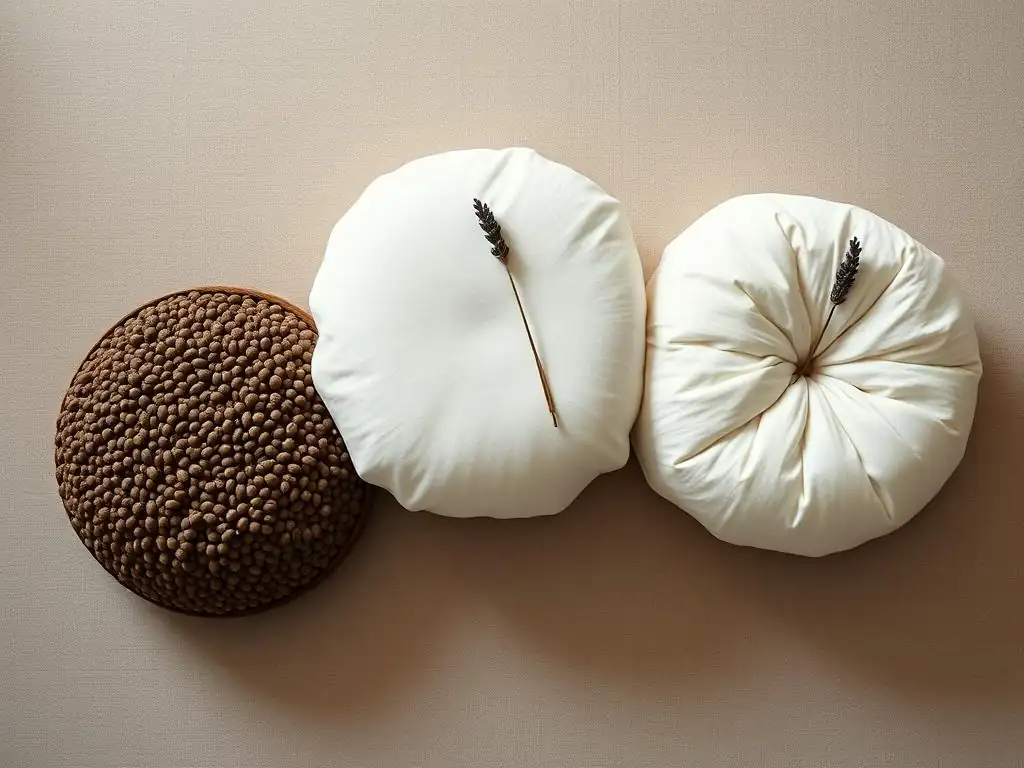
Kapok fiber, also known as Java cotton or silk cotton, is a natural, fluffy fiber harvested from the seed pods of the Kapok tree ( Ceiba pentandra), which is native to tropical regions like Southeast Asia, Central America, and parts of Africa. The trees produce large pods filled with seeds surrounded by this fine, buoyant fiber. Harvesting is typically done by hand, and the fiber requires minimal processing, making it a relatively sustainable natural resource. Historically, kapok has been used for stuffing mattresses, pillows, and life preservers due to its buoyancy and water resistance.
The kapok fiber itself is incredibly light, silky, and airy. It has a slightly waxy coating, which makes it somewhat resistant to water and gives it a smooth feel. Unlike cotton, the fibers are too smooth to spin into thread easily, which is why they are primarily used as a filling material. When used in meditation cushions, kapok creates a soft, yielding surface. While it doesn't offer the granular shifting support of buckwheat hulls, it provides a gentle cushioning that conforms somewhat to the body's shape, offering a different kind of comfort experience in a meditation cushion fill guide.
Benefits of Kapok Fill: Softness, Lightness, and Breathability
The most notable benefit of kapok fill is its exceptional softness and lightweight nature. Kapok-filled meditation cushions feel much softer to the touch compared to the firm density of buckwheat. This can be particularly appealing for individuals who prefer a more yielding surface to sit on or who find the hardness of buckwheat uncomfortable. The cushion provides a plush feel that gently cradles the body. Crucially, kapok is significantly lighter than buckwheat. A kapok-filled zafu of comparable size might weigh only 1 to 2 pounds (approximately 0.5 to 0.9 kg), making it incredibly easy to transport and store.
Furthermore, kapok fiber is naturally breathable and non-absorbent due to its waxy coating. This breathability helps to regulate temperature, preventing the cushion from becoming overly warm during long meditation sessions. The fibers allow air to circulate, which can contribute to a more comfortable sitting experience, especially in warmer climates.
The non-absorbent quality also means it's less likely to harbor moisture and potentially resist mold or mildew compared to some other natural fibers, though proper care is still important. This combination of softness, lightness, and breathability makes kapok a comfortable and convenient choice for many practitioners seeking meditation cushion fill guidance.
Drawbacks of Kapok Fill: Compression, Support, and Maintenance
One significant drawback of kapok fill is its tendency to compress over time. Unlike buckwheat hulls which retain their shape, kapok fibers can pack down and lose their loft with regular use. This compression means the cushion may become flatter and less supportive over months or years, potentially requiring refluffing or adding more fill to maintain the desired height and firmness. While initial compression might be minimal, consistent pressure will eventually cause a noticeable reduction in cushion height and density.
Related to compression is the level of support offered by kapok. While soft and comfortable, kapok does not provide the same firm, stable base as buckwheat hulls. It offers a more yielding support that conforms to the body but doesn't actively promote pelvic tilt or spinal alignment in the same way.
For individuals who need significant elevation to maintain a comfortable posture, or those with hip or knee issues requiring precise positioning, kapok might not offer sufficient or consistent support. Additionally, while somewhat moisture-resistant, if kapok does get wet, it can take a long time to dry completely, and improper drying can lead to clumping or loss of loft, requiring careful maintenance.
Buckwheat vs. Kapok: A Detailed Comparison
Comfort and Support: Finding the Right Fit
When comparing buckwheat and kapok meditation cushion fill based on comfort and support, the difference is quite distinct. Buckwheat hulls provide a firm, stable, and highly supportive base. They conform around your body, creating a solid foundation that elevates the hips and encourages proper spinal alignment. This type of support is often preferred by individuals seeking a cushion that helps them maintain a specific posture with minimal effort, particularly those who sit cross-legged or require significant height to keep their knees below their hips. It feels solid and grounded.
Kapok fiber, on the other hand, offers a softer, more yielding comfort. It conforms to your body, providing gentle cushioning rather than rigid support. This can feel more comfortable initially for some users, especially those who find firm surfaces uncomfortable, or who prefer kneeling postures where less rigid hip support is needed.
However, it may not offer sufficient elevation or stability for all body types or sitting styles, particularly for individuals with limited hip flexibility attempting cross-legged positions. The choice between the two often comes down to personal preference and the specific support needs dictated by your physical structure and meditation posture. This is a key consideration in any meditation cushion fill guide.
Durability and Longevity: Which Fill Lasts Longer?
In terms of durability and longevity, buckwheat hulls generally have a clear advantage over kapok fiber. Buckwheat hulls are remarkably resilient and do not break down or compress significantly under normal use. A well-made buckwheat cushion can maintain its shape and support for ten years or even longer with minimal need for maintenance beyond occasional airing. While some hulls might eventually break down into dust over many years, the vast majority retain their structure, providing consistent support for a very long time.
Kapok fiber, while durable in its own right, is prone to compression over time. With regular use, the fibers will compact, causing the cushion to lose height and become firmer. This means a kapok cushion may need to be refluffed periodically to regain its loft.
Depending on the frequency of use and the user's weight, a kapok cushion might require refluffing every few months or years. While the fiber itself doesn't degrade quickly, its functional lifespan as a supportive cushion fill before needing replenishment or replacement is typically shorter than that of buckwheat hulls. This difference in longevity is an important factor when considering the value and sustainability of your meditation cushion fill.
Weight and Portability: Choosing a Cushion for Travel or Home
Weight and portability are significant distinguishing factors between buckwheat and kapok filled meditation cushions. Buckwheat cushions are notably heavy due to the density of the hulls. A standard zafu can weigh anywhere from 5 to 8 pounds, and larger cushions or bolsters can weigh even more. This makes them less ideal for travel or for users who need to move their cushion frequently. They are best suited for a dedicated meditation space at home where they can remain in place.
Kapok cushions, in stark contrast, are exceptionally lightweight. A comparable kapok zafu typically weighs between 1 and 2 pounds, making them significantly easier to carry. This makes kapok cushions an excellent choice for meditators who attend classes or retreats, travel often, or simply prefer a cushion that is easy to pick up and move around their home. While they may require more maintenance in terms of refluffing, their ease of transport is a major benefit for those on the go, providing a convenient option in the search for the best meditation cushion fill.
Price and Availability: Budget-Friendly Options
When considering price and availability, both buckwheat and kapok meditation cushions are widely available, but their cost can vary. Generally, buckwheat hull fill itself is a relatively inexpensive material, being a byproduct. However, the weight and volume of the hulls required to fill a cushion mean that the overall cost of a finished buckwheat cushion can be slightly higher than a kapok cushion of similar size, mainly due to shipping weight and the sheer volume of material. Prices for a standard buckwheat zafu typically range from $40 to $80, depending on the cover material and brand.
Kapok fiber can also be cost-effective, and because it is much lighter, the shipping costs for raw fiber or finished cushions tend to be lower. Kapok cushions are often found at a slightly lower price point than their buckwheat counterparts, with standard zafus often ranging from $30 to $70. However, specialized kapok cushions or those from premium brands may fall within a similar price range as buckwheat options. Both types are readily available from online retailers and physical yoga or meditation supply stores, offering plenty of options for finding the right meditation cushion fill guide choice within your budget.
Selecting the Ideal Meditation Cushion Fill

Meditation Style and Posture: Matching Fill to Your Practice
Your preferred meditation style and posture are perhaps the most important factors in selecting the ideal meditation cushion fill. If you primarily sit in a cross-legged posture like Sukhasana (easy pose), half lotus, or full lotus, a buckwheat hull cushion is often recommended. The firm, adjustable height of buckwheat allows you to significantly elevate your hips above your knees, creating the necessary pelvic tilt for a straight, comfortable spine. This firm support helps maintain the posture effortlessly for longer periods.
For those who prefer kneeling postures, such as Seiza (sitting on heels), or who use a meditation bench, the need for hip elevation is less critical. In these cases, a kapok cushion can provide comfortable cushioning under the knees, ankles, or for sitting on a bench.
If you have physical limitations that make firm pressure uncomfortable, or if you prefer a softer feel even in cross-legged postures, kapok might be more suitable, though you may need a taller kapok cushion or additional support to achieve proper alignment. Understanding how each fill supports different postures is key to making an informed meditation cushion fill guide choice.
Personal Preferences: Comfort, Support, and Sensory Needs
Beyond posture, personal preferences regarding comfort, support, and sensory experience play a significant role in choosing your meditation cushion fill. Some individuals simply prefer the feeling of firm, stable support that buckwheat provides, finding it grounding and conducive to focus. Others find firm surfaces uncomfortable and prefer the softer, more yielding feel of kapok, which can feel more gentle on the body.
Consider your sensory sensitivities as well. If you are easily distracted by subtle sounds, the slight rustling of buckwheat hulls might be disruptive, making a quiet kapok cushion a better choice. If you are sensitive to weight or need to move your cushion often, the lightness of kapok is a clear advantage.
Conversely, if you find cushions that compress or lose shape frustrating, the long-lasting firmness of buckwheat might be more appealing. Trying out cushions with different fills, if possible, is the best way to determine which feel truly resonates with your personal comfort and sensory needs, helping you decide on the best meditation cushion fill for you.
Top Meditation Cushion Recommendations by Fill Type
For those seeking a highly supportive and durable option, numerous excellent buckwheat hull cushions are available. Look for cushions with sturdy cotton or hemp covers and a separate zippered inner liner for easy fill adjustment. Popular choices often come in classic zafu (round) or zabuton (square mat) styles, providing a stable base. When exploring options, consider brands known for quality stitching and durable fabrics that can withstand the weight and shifting of the hulls over time.
If softness, lightness, and portability are your priorities, explore kapok fiber meditation cushions. These are often found in various shapes, including zafus, bolsters (round or rectangular), and crescent shapes. A well-filled kapok cushion should feel plush but still offer enough density to provide some lift. Seek out cushions with tightly packed fill that feels substantial when new, as this indicates it will compress less quickly. Brands specializing in natural fibers often provide high-quality kapok options with breathable covers. Evaluating these types based on their fill is part of creating your personal meditation cushion fill guide.
Enhancing Your Meditation with the Right Cushion
Choosing the right meditation cushion fill, whether it's the firm, supportive buckwheat hulls or the soft, lightweight kapok fiber, is a deeply personal decision that can significantly impact the quality and consistency of your meditation practice. We've explored how buckwheat excels in providing stable, adjustable support ideal for promoting proper spinal alignment, while kapok offers a lighter, softer alternative that prioritizes comfort and portability.
Ultimately, the best meditation cushion fill is the one that helps you sit comfortably and attentively, free from physical distraction. Consider your meditation style, your preferred posture, your body's unique needs, and your sensory preferences. The journey to finding the ideal cushion is part of nurturing your self-care practice. Taking the time to choose a cushion that truly supports you can deepen your meditation experience, allowing you to settle more easily into stillness and presence. Invest in a cushion that feels right for you, and notice the difference it can make in your practice.
Frequently Asked Questions
What are the two most common types of fill used in meditation cushions?
The two most common types are buckwheat hulls and kapok fiber. Each offers a unique feel and level of support for your meditation practice.
What are the key benefits of using buckwheat hulls as a meditation cushion fill?
Buckwheat hulls provide excellent support and conformability. They're also renewable and sustainable, making them an eco-friendly choice.
What are the advantages of using kapok fiber for a meditation cushion?
Kapok is incredibly lightweight and soft, offering a comfortable and plush feel. It also provides good insulation, keeping you warm during meditation.
How do buckwheat hulls and kapok fiber differ in terms of firmness and support?
Buckwheat provides a firmer and more supportive base. Kapok is softer and less dense, offering a more relaxed and cushioning experience.
How does the fill material impact the overall comfort and longevity of a meditation cushion?
The fill material dictates the level of support and comfort, influencing your posture during meditation. Durable fills like buckwheat can also improve the cushion's lifespan.
Final Reflection: Finding Your Perfect Meditation Seat
The quest for the ideal meditation cushion is more than just a search for comfort; it's a journey towards finding the perfect support for your inner peace. Choosing between buckwheat and kapok fills, as explored in this guide, highlights the crucial role physical comfort plays in establishing a consistent and effective meditation practice. The right cushion isn't just a luxury; it's an investment in your well-being.
The subtle differences between buckwheat and kapok, their unique textures and supportive properties, underscore the importance of mindful consideration in even the seemingly smallest aspects of our spiritual journey. This exploration has reminded me of the interconnectedness of mind and body – a truth often emphasized in meditation itself. The body is your temple. Keep it pure and clean for the soul to reside in.
This quote, though not directly about meditation cushions, perfectly encapsulates the importance of paying attention to the details that contribute to our overall well-being, including the comfort and support we provide ourselves during meditation.
Now, consider your own practice. What kind of support do you need to cultivate inner stillness and focus? Take the time to reflect on your preferences, your body's needs, and the qualities you value most in a meditation cushion. Don't just settle for any cushion; choose the one that best supports your journey towards a deeper, more fulfilling meditation experience. The path to enlightenment begins with a comfortable seat.
Unleash Your Inner Peace: Find Your Perfect Meditation Cushion
Thanks for exploring the world of meditation cushions with us! We hope you now feel confident in understanding the unique benefits of both buckwheat and kapok fillings. Ready to deepen your practice?
- Choose your perfect cushion: Consider your preferred firmness and support needs – now that you know the differences, select the filling that best suits your body and meditation style. Think about how you'll feel sitting on your new cushion.
- Share your experience: Let us know which filling you chose and why! Share your thoughts in the comments below – your insights could help other meditators find their perfect match.
- Enhance your practice: Explore our other articles on meditation techniques and mindful living to create a truly enriching experience.
What unique benefits are you most excited to experience with your new meditation cushion?