
The Path to Equanimity: Cultivating Balance with Vipassana

Welcome to Mind Care Guide, a sanctuary for your mental well-being.
Feeling overwhelmed by anxiety? You're not alone. In today's fast-paced world, finding inner peace can seem like an impossible task. But what if there was a time-tested technique that could help you navigate the storms of your mind? Our latest article delves into the transformative power of Vipassana meditation for anxiety, offering practical guidance and insightful perspectives. Discover how this ancient practice can help you cultivate equanimity and find lasting relief. Intrigued? Let's begin your journey to a calmer, more centered you.
The Path to Equanimity: Cultivating Balance with Vipassana
- Understanding Vipassana Meditation: An Introduction to Insight
- Vipassana Meditation for Anxiety Relief: A Practical Guide
- Getting Started with Vipassana Meditation: A Step-by-Step Approach
- Deepening Your Vipassana Practice: Techniques and Tips
- Benefits of Vipassana Meditation: Beyond Anxiety Reduction
- Common Challenges in Vipassana Meditation and How to Overcome Them
- Vipassana Retreats: Immersive Experiences for Deeper Learning
- Vipassana and Mental Health: Considerations and Precautions
- Resources for Learning More About Vipassana Meditation
- Conclusion: Embracing Equanimity through Vipassana Meditation for a Calmer Life.
-
Frequently Asked Questions
- What is Vipassana meditation, and how does it differ from other meditation techniques?
- How can Vipassana meditation specifically help with anxiety?
- Is Vipassana meditation suitable for everyone, including those with pre-existing mental health conditions?
- How long and how often should I practice Vipassana meditation to experience its benefits for anxiety?
- Where can I learn Vipassana meditation, and are there any resources available to help me get started?
- Final Reflection: Finding Peace in the Present Moment
- Unlock Your Inner Peace: Start Your Vipassana Journey Today
Understanding Vipassana Meditation: An Introduction to Insight
What is Vipassana Meditation and its Origins?
Vipassana meditation, often translated as "insight meditation," is one of India's most ancient techniques of meditation. It was rediscovered by Gautama Buddha more than 2500 years ago and taught by him as a universal remedy for universal ills, an art of living. The technique involves observing reality as it is, not as one wishes it to be, through the systematic observation of the self.
This observation typically begins with focusing on the natural breath to calm the mind, then moves to observing the subtle physical sensations throughout the body. The core idea is to understand the impermanent nature of all phenomena, including thoughts, feelings, and physical sensations.
This practice originated in ancient India and was preserved primarily in the Theravada Buddhist tradition. While rooted in Buddhist teachings, Vipassana as taught in many modern centers is presented as a non-sectarian technique applicable to anyone seeking to understand their own mind and suffering. S.N. Goenka played a significant role in bringing this tradition to a wider audience in the 20th century, establishing centers globally where the technique is taught in intensive ten-day residential courses. The method emphasizes direct experience over intellectual understanding, guiding practitioners to witness the arising and passing away of all mental and physical states.
The Core Principles of Vipassana: Mindfulness and Equanimity
At the heart of Vipassana meditation lie two fundamental principles: mindfulness (sati) and equanimity (upekkha). Mindfulness in this context is the practice of paying attention to the present moment without judgment. It involves observing internal and external phenomena—thoughts, feelings, sensations, sounds, sights—as they are, simply noting their presence. This non-judgmental awareness is cultivated through focused attention, initially on the breath, then expanding to encompass the entire physical and mental landscape. The aim is to see things clearly, with insight.
Equanimity is the balanced state of mind that arises from this mindful observation. As one observes the constant flux of reality—the arising and passing of pleasant, unpleasant, and neutral sensations and mental states—the tendency to react with craving or aversion gradually diminishes. Instead of being swept away by emotions or sensations, the practitioner learns to observe them with calmness and balance.
This cultivated equanimity is not indifference but a deep understanding that all phenomena are impermanent. It's this balanced perspective that is particularly relevant when using Vipassana meditation for anxiety, as it helps detach from overwhelming anxious thoughts and feelings.
Vipassana Meditation vs. Other Meditation Techniques
Vipassana meditation differs from some other popular meditation techniques in its primary focus on developing insight into the nature of reality, particularly impermanence (anicca), suffering (dukkha), and non-self (anatta), through body sensations. While many meditation practices, such as concentration meditation (samatha), aim to calm the mind by focusing on a single object (like breath or a mantra) to achieve a state of tranquility, Vipassana uses concentration as a tool to sharpen awareness for the purpose of insight. The goal is not just a peaceful mind, but understanding the root causes of suffering.
Another distinction lies in the object of observation. While some mindfulness practices might focus broadly on thoughts and feelings, Vipassana places significant emphasis on observing subtle physical sensations as the primary gateway to understanding mental states. The teaching posits that all mental states, including anxiety, manifest as physical sensations. By observing these sensations with equanimity, one can work through the underlying mental patterns. Unlike some guided visualizations or loving-kindness meditations which cultivate specific positive states, Vipassana's core practice is the bare observation of reality, allowing positive states like peace and compassion to arise naturally from understanding.
Vipassana Meditation for Anxiety Relief: A Practical Guide
Can Vipassana Help with Anxiety? Exploring the Connection
Anxiety is often characterized by excessive worry, fear, and physical symptoms like restlessness or increased heart rate. These experiences are deeply intertwined with our thoughts and physical sensations, which Vipassana meditation specifically addresses. By training the mind to observe thoughts and physical feelings without immediate reaction, Vipassana helps to create a space between the anxious stimulus (a thought, a sensation) and the habitual anxious response. This pause allows for a conscious choice in how to react, rather than being automatically overwhelmed.
Numerous studies and anecdotal reports support the effectiveness of mindfulness-based practices, including Vipassana, in reducing anxiety symptoms. For instance, research indicates that participants engaging in regular mindfulness meditation programs often report a significant decrease in perceived stress and anxiety levels, sometimes comparable to or complementing traditional therapeutic approaches. The ability to witness anxious thoughts as transient mental events, rather than absolute truths, is a powerful tool cultivated through consistent Vipassana practice, directly addressing the cognitive patterns underlying anxiety.
How Vipassana Reduces Anxiety: The Science Behind Mindfulness
The mechanisms by which Vipassana meditation can help reduce anxiety are increasingly supported by scientific research. Neuroimaging studies have shown that regular mindfulness practice can lead to structural and functional changes in the brain regions associated with emotional regulation and stress response. For example, studies suggest an increase in gray matter density in areas like the prefrontal cortex, associated with executive functions and emotional control, and a decrease in the amygdala, the brain's fear center.
Furthermore, Vipassana training can impact the body's physiological stress response. Research has indicated that mindfulness practitioners may exhibit lower levels of stress hormones like cortisol. By learning to observe physical sensations associated with anxiety—such as tightness in the chest, butterflies in the stomach, or shallow breathing—without reacting with fear or aversion, individuals can dampen the fight-or-flight response. The practice teaches acceptance of these physical manifestations of anxiety, which paradoxically can reduce their intensity and duration over time. This scientific backing strengthens the case for Vipassana meditation for anxiety management.
Specific Vipassana Techniques for Managing Anxiety Symptoms
While the core Vipassana technique involves observing sensations throughout the body, specific approaches within the practice can be particularly helpful for anxiety. When experiencing acute anxiety, the practice of focusing on the breath can be an immediate anchor. Paying close attention to the natural inflow and outflow of air, perhaps noticing the sensation at the nostrils or the rise and fall of the abdomen, can help ground the mind in the present moment and interrupt the cycle of anxious thoughts. This is often the initial step in Vipassana.
Another key technique for anxiety is the systematic scanning of the body, observing whatever sensations are present—pressure, vibration, heat, coolness, tingling, or even the absence of sensation—with equanimity. When an area of intense or unpleasant sensation arises, perhaps linked to anxiety, the instruction is simply to observe it without judgment or reaction, noting its impermanent nature ( Anicca, Anicca). By repeatedly doing this, the practitioner learns that even intense discomfort, physical or emotional, is temporary and will eventually pass. This direct experience of impermanence weakens the fear associated with unpleasant sensations and makes Vipassana meditation for anxiety a powerful personal tool.
Getting Started with Vipassana Meditation: A Step-by-Step Approach
Preparing for Your First Vipassana Session: Setting the Stage
Embarking on your first Vipassana meditation session requires minimal preparation, focusing mainly on creating a conducive environment and setting an intention. Find a quiet space where you are unlikely to be disturbed for the duration of your practice, whether it's 10 minutes or longer. Ensure the room is at a comfortable temperature and that any potential distractions, like phones, are silenced or removed. The time of day is less important than consistency; choose a time you can realistically commit to daily.
Consider what you will sit on. A firm cushion (zafu) on a mat (zabuton) is traditional and can help maintain posture, but a straight-backed chair where your feet can rest flat on the floor is perfectly acceptable, especially for beginners or those with physical discomfort. Wear loose, comfortable clothing that doesn't restrict circulation or breathing. Before you begin, you might take a moment to set a simple intention, such as "I will observe my breath and body sensations with awareness and equanimity for this period," without attachment to specific outcomes like feeling relaxed or anxiety-free.
The Basic Vipassana Posture and Breathing Techniques
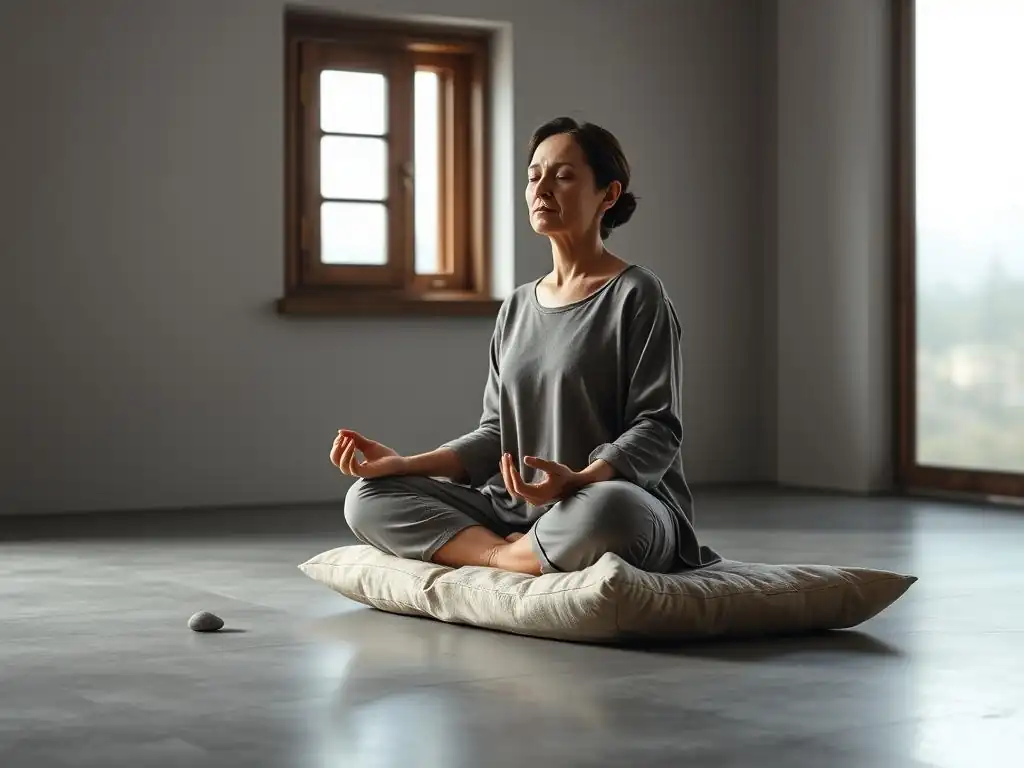
Finding a stable and comfortable posture is crucial for sustained meditation. The goal is to keep the body still without tension, allowing the mind to become calm and alert. If sitting on the floor, cross your legs comfortably (full lotus, half lotus, or Burmese style are options, but simple cross-legged is fine), ensuring your knees are lower than your hips if possible, using cushions for support.
Keep your spine erect but not rigid, shoulders relaxed, and hands resting comfortably in your lap or on your knees. If using a chair, sit towards the front with your back straight and feet flat on the floor, uncrossed.
Begin by gently closing your eyes. The initial focus in Vipassana is often on the breath. Simply observe the natural breath as it is, without trying to control or change it. Notice the sensation of the breath entering and leaving the body.
This sensation might be most prominent at the nostrils, the upper lip, or the rise and fall of the abdomen. Stay with this sensation, gently bringing your attention back whenever the mind wanders. This initial stage, sometimes called Anapana meditation (awareness of breath), helps to quiet the mind and develop concentration before moving to the broader observation of sensations characteristic of pure Vipassana.
Guided Vipassana Meditation for Beginners
For those new to Vipassana, starting with guided meditations can be very helpful. A guide can provide instructions, remind you of the technique, and help you navigate common difficulties like mind-wandering. Many resources offer guided Vipassana sessions, often starting with shorter durations, perhaps 10 or 20 minutes. These guides will typically lead you through finding a posture, focusing on the breath, and then gradually expanding awareness to body sensations.
A typical guided session might start with several minutes of breath awareness, followed by instructions to scan the body mentally, moving attention from the top of the head down to the toes, pausing to notice any sensations in each area. The guide will often remind you to observe these sensations objectively, without labeling them as "good" or "bad," and to note their impermanent nature. This structured approach can make the technique feel less daunting and provide a framework for your practice, especially when learning Vipassana meditation for anxiety, as the guidance offers reassurance and direction.
Deepening Your Vipassana Practice: Techniques and Tips
Working with Difficult Emotions During Vipassana
Encountering difficult emotions, such as fear, sadness, or anger, is a common experience in Vipassana practice, especially when using Vipassana meditation for anxiety. The Vipassana approach is not to suppress or analyze these emotions, but to observe their manifestation through physical sensations. For instance, anxiety might manifest as tightness in the chest, a churning in the stomach, or restlessness. The technique is to bring mindful attention to these sensations, observing them as physical phenomena without getting lost in the accompanying thoughts or narratives.
The instruction is to observe these sensations with equanimity, understanding that they are impermanent. By witnessing the arising and passing away of these physical manifestations of emotion, the practitioner learns that the emotion itself is also transient. This process gradually disentangles the individual from being consumed by the emotion, fostering a capacity to experience difficult feelings without being overwhelmed. It requires patience and persistence, returning gently to the observation of sensations whenever the mind gets caught in the emotional story.
Cultivating Equanimity: Responding to Sensations with Balance
Cultivating equanimity is a central pillar of Vipassana and is particularly vital for managing anxiety. Equanimity means observing all sensations—pleasant, unpleasant, and neutral—with a balanced mind, without craving for the pleasant ones to stay or aversion towards the unpleasant ones to leave. When practicing Vipassana meditation for anxiety, unpleasant sensations (like panic-related physical feelings) are often prominent. The natural inclination is to react with fear or a desire for them to stop.
Vipassana teaches the opposite: to simply observe these sensations as energy or vibration, noting their characteristics (intensity, location, quality) but refraining from adding mental commentary or reaction. This non-reactive observation, based on the understanding of impermanence, weakens the habit patterns of craving and aversion that fuel suffering, including anxiety. It's through this repeated practice of observing the rise and fall of sensations without reaction that the capacity for equanimity strengthens, allowing for a more stable and peaceful response to life's challenges.
Maintaining Consistency: Integrating Vipassana into Daily Life
Consistency is key to realizing the profound benefits of Vipassana meditation, particularly in managing chronic conditions like anxiety. While attending a ten-day retreat provides an intensive foundation, integrating the practice into daily life is essential for sustained progress. Aim for regular, even short, daily sessions—perhaps 20 minutes in the morning and 20 minutes in the evening. This regularity helps to keep the mind sharp and the principles of observation and equanimity alive.
Beyond formal sitting practice, the principles of Vipassana can be applied throughout the day. This is often called "applying Vipassana in daily life." It involves bringing mindful awareness to everyday activities like walking, eating, or even engaging in conversations. When challenging situations arise, or when anxiety begins to surface, the learned ability to pause, observe the physical sensations and thoughts without immediate reaction, and remember impermanence can be immensely helpful. This continuous application reinforces the formal sitting practice and solidifies its positive impact on reducing anxiety over time.
Benefits of Vipassana Meditation: Beyond Anxiety Reduction
Improved Focus and Concentration through Vipassana
While Vipassana's ultimate goal is insight, a significant side effect of the practice is a marked improvement in concentration and focus. The initial stage of Vipassana, focusing on the breath (Anapana), is specifically designed to train the mind to stay on a single object. By repeatedly bringing the wandering mind back to the sensation of the breath, the capacity for sustained attention is strengthened. This is akin to exercising a muscle; the more you practice focusing, the stronger your concentration becomes.
This enhanced focus extends beyond the meditation cushion into daily activities. Tasks that previously felt fragmented or difficult to concentrate on can become more manageable. Whether working, studying, or even engaging in simple chores, the ability to remain present and focused improves. This increased concentration can also indirectly help with anxiety, as a scattered mind is often fertile ground for worries to proliferate. A more focused mind is less likely to get lost in anxious rumination.
Enhanced Self-Awareness and Emotional Regulation
Vipassana meditation significantly deepens self-awareness. Through the systematic observation of physical sensations and mental phenomena, practitioners gain a clearer understanding of their own patterns of thought, emotion, and reaction. They begin to see the habitual ways the mind responds to pleasant and unpleasant experiences, often with craving or aversion. This insight into one's own mental conditioning is the first step towards changing those patterns.
This heightened self-awareness directly contributes to improved emotional regulation. By observing emotions as transient phenomena arising with specific physical sensations, one learns not to identify solely with them or be controlled by them. Instead of reacting impulsively out of anger, fear, or sadness, the practitioner develops the capacity to pause, observe the emotion, and choose a more skillful response. This ability to navigate the emotional landscape with greater awareness and balance is a powerful benefit, particularly for individuals seeking Vipassana meditation for anxiety management.
Stress Reduction and Overall Mental Well-being
Beyond its specific impact on anxiety, Vipassana meditation is widely recognized for its profound effects on general stress reduction and overall mental well-being. The practice systematically addresses the root causes of stress and suffering, which are seen in Vipassana as arising from craving and aversion. By observing the impermanent nature of all experiences, including stressors, the mind becomes less reactive and more resilient.
Regular practice helps to calm the nervous system and foster a sense of inner peace that is not dependent on external circumstances. Many practitioners report feeling calmer, more centered, and less overwhelmed by the demands of daily life. This cumulative effect of reduced reactivity, increased equanimity, and deeper self-understanding contributes to a significant improvement in overall mental health and a greater capacity to navigate life's challenges with grace. The benefits of Vipassana meditation for anxiety are thus part of a broader positive impact on one's psychological landscape.
Common Challenges in Vipassana Meditation and How to Overcome Them
Dealing with Mind-Wandering and Distractions
One of the most common challenges faced by anyone beginning meditation, including Vipassana, is mind-wandering. The mind is naturally active and will frequently drift into thoughts about the past, future, or unrelated topics. This can be frustrating, especially when trying to focus or observe sensations. It's important to understand that mind-wandering is not a failure; it's simply what the mind does. The practice lies not in stopping thoughts entirely, but in recognizing when the mind has wandered and gently bringing it back to the object of attention, whether it's the breath or body sensations.
The key to working with distractions is patience and persistence. Each time you notice your mind has wandered, acknowledge it without judgment ("Thinking," or "Planning," for example), and gently redirect your attention back to the present moment and the technique. This act of redirection is the actual practice. Over time, with consistent effort, the periods of focused attention will gradually lengthen, and the mind will become less prone to incessant wandering. Think of it as training a puppy; you guide it back gently countless times.
Managing Physical Discomfort During Meditation
Sitting still for extended periods can often bring up physical discomfort, such as aching knees, a sore back, or restlessness. This is another significant challenge in Vipassana, particularly during longer sittings or retreats. The Vipassana approach to physical pain is similar to working with emotions: observe it with equanimity. Instead of immediately shifting position or being consumed by aversion to the pain, the instruction is to bring your awareness to the sensation itself.
Observe the location, intensity, and quality of the pain. Is it throbbing, dull, sharp, tingling? Does it stay constant, or does it fluctuate? By observing the sensation objectively, without labeling it as "pain" and reacting with aversion, you often find that the sensation changes, moves, or even disappears. This direct experience reinforces the understanding of impermanence. If the discomfort is genuinely unbearable or could cause injury, it's wise to adjust your posture mindfully, minimizing movement and doing so with awareness, but the initial instruction is always to observe first.
Overcoming Resistance to Regular Practice
Establishing and maintaining a regular Vipassana practice can be challenging due to various forms of resistance. This resistance might manifest as procrastination, feeling too busy, boredom during practice, or the discomfort of facing one's own mind and sensations, especially when trying to use Vipassana meditation for anxiety. It's easier to avoid the discomfort than to sit with it. Recognizing this resistance is the first step.
To overcome resistance, try to cultivate discipline and make meditation a non-negotiable part of your routine, even if only for a short duration initially. Start small, perhaps 10-15 minutes daily, and gradually increase the time as you become more comfortable. Connect with the motivation behind your practice – perhaps the desire for less anxiety, greater peace, or deeper self-understanding.
Remembering the benefits you seek can provide the impetus to sit down even when you don't feel like it. Finding a meditation buddy or joining a local group can also provide support and accountability, helping you stay committed to the path.
Vipassana Retreats: Immersive Experiences for Deeper Learning
What to Expect at a Vipassana Retreat: A Detailed Overview
A typical Vipassana retreat, especially in the tradition taught by S.N. Goenka, is an intensive, residential ten-day course. The structure is rigorous and designed to provide a deep immersion in the practice. Days begin early, often around 4:00 AM, and involve approximately ten hours of serious meditation throughout the day, broken up by meal and rest periods. Participants observe a strict code of discipline, including noble silence (no talking, gesturing, or eye contact with fellow students), separation of sexes, and abstaining from reading, writing, or using electronic devices.
The technique is taught step-by-step over the ten days. The first three and a half days are dedicated to Anapana meditation (awareness of breath) to calm the mind and develop concentration. From day four onwards, the technique of Vipassana proper is introduced: systematically scanning the body and observing sensations with equanimity. There are daily evening discourses explaining the theory behind the practice and interviews with the teacher for guidance. The environment is simple, providing only basic necessities to minimize distractions and facilitate inward focus.
Preparing for a Vipassana Retreat: Physical and Mental Preparation
Preparing for a Vipassana retreat involves both practical arrangements and mental conditioning. Practically, ensure you can commit to the full duration without external responsibilities. Inform family and work contacts that you will be incommunicado. Pack simple, comfortable clothing suitable for sitting for long periods, covering the body modestly. Bring any necessary personal items, but avoid bringing anything that could be a distraction (books, journals, elaborate snacks, etc.). Most centers provide basic accommodation and meals.
Mentally, prepare for a period of intense self-reflection and potential discomfort, both physical and mental. The strict schedule and noble silence can be challenging initially. Understand that the purpose is deep introspection, not a holiday. Be prepared to face your own mind, including difficult thoughts, emotions, and physical sensations, with courage and patience. Approaching the retreat with an open mind and a strong determination to follow the instructions precisely is the best mental preparation for this immersive experience aimed at cultivating insight.
The Benefits of Attending a Vipassana Retreat: Intensive Practice and Guidance
Attending a Vipassana retreat offers several unique benefits that are difficult to replicate through home practice alone. Firstly, the intensive schedule allows for prolonged periods of deep meditation, enabling the mind to settle and awareness to sharpen in a way that shorter daily sittings might not achieve initially. This immersion accelerates the process of developing concentration and sensitivity to subtle sensations.
Secondly, the presence of qualified teachers provides invaluable guidance. Teachers are available for individual questions regarding the technique and can offer support in navigating challenges that arise during intensive practice. The evening discourses provide essential theoretical understanding that illuminates the practical experience. The environment of noble silence and the absence of external distractions create optimal conditions for turning attention inward. This intensive, guided experience is particularly beneficial for those serious about using Vipassana meditation for anxiety at a deeper level or establishing a strong foundation for lifelong practice.
Vipassana and Mental Health: Considerations and Precautions
Is Vipassana Suitable for Everyone? Assessing Your Mental Health
While Vipassana can be profoundly beneficial for many aspects of mental well-being, including using Vipassana meditation for anxiety, it is not a substitute for professional medical or psychological treatment, and it may not be suitable for everyone, especially those with certain severe mental health conditions. The intensive nature of the practice, particularly during retreats, involves prolonged periods of introspection and confronting difficult mental content, which could potentially be overwhelming for individuals experiencing acute episodes of conditions like severe depression, psychosis, or trauma-related disorders without appropriate support structures.
It is crucial to assess your current mental health state honestly before embarking on intensive Vipassana practice, especially a retreat. If you have a history of significant mental health issues, it is highly recommended to consult with your mental health professional (therapist, psychiatrist) beforehand. They can help you determine if now is a suitable time and discuss any potential considerations or necessary precautions. Many Vipassana centers also ask about mental health history during the application process for retreats to ensure the safety and well-being of all participants.
Vipassana as a Complementary Therapy: Working with Mental Health Professionals
Vipassana meditation can serve as a powerful complementary therapy when used in conjunction with professional mental healthcare. For individuals managing conditions like anxiety, depression, or PTSD, integrating a regular Vipassana practice alongside therapy and/or medication, under the guidance of both a meditation teacher and a mental health professional, can be highly effective. Therapy provides a space to process thoughts and emotions verbally and develop coping strategies, while Vipassana offers a direct experiential tool for observing the mind-body connection and cultivating equanimity in the face of difficult states.
Many therapists are increasingly incorporating mindfulness techniques into their practice, recognizing their value. Discussing your Vipassana practice with your therapist can help integrate the insights gained during meditation into your overall treatment plan. For example, if Vipassana practice brings up difficult memories or intense emotions, your therapist can help you process these experiences in a safe and supportive environment. Viewing Vipassana as a tool that complements, rather than replaces, professional care is key to its safe and effective application for mental health.
Potential Challenges and Risks of Vipassana Meditation
While generally safe and beneficial, Vipassana meditation, like any intensive self-exploration practice, can present potential challenges or risks for some individuals. As mentioned, it can sometimes bring suppressed emotions or traumatic memories to the surface. Without adequate preparation or support, this could be distressing. The physical discomfort of prolonged sitting can also be a challenge for some.
For a small number of individuals, particularly those with pre-existing vulnerabilities, intensive meditation could potentially exacerbate certain psychological states, though this is uncommon when centers have appropriate screening processes. The structured environment and strict rules of a retreat might also be difficult for some personalities. Awareness of these potential challenges, honest self-assessment of one's mental health, consultation with professionals when necessary, and choosing reputable centers with experienced teachers are important precautions to mitigate risks and ensure a safe and beneficial experience with Vipassana meditation for anxiety and overall well-being.
Resources for Learning More About Vipassana Meditation
Recommended Books on Vipassana and Mindfulness
Exploring literature can provide valuable context and deepen understanding of Vipassana meditation principles before or alongside practice. A foundational text often recommended is "Mindfulness, Bliss, and Beyond: A Mediator's Handbook" by Ajahn Brahm, which offers clear guidance on both concentration and insight practices. For understanding the application of mindfulness in modern life, "Wherever You Go, There You Are" by Jon Kabat-Zinn is a highly accessible choice, though it presents a broader view of mindfulness than traditional Vipassana.
S.N. Goenka's discourses, often compiled into books like "The Art of Living: Vipassana Meditation as Taught by S.N. Goenka," offer a direct explanation of the technique and philosophy as taught in his retreats. Another insightful read is "Seeking the Heart of Wisdom: The Journey into Insight Meditation" by Joseph Goldstein and Jack Kornfield, pioneers in bringing Vipassana to the West, offering detailed instructions and explorations of common experiences in practice. These resources can provide a solid theoretical framework for using Vipassana meditation for anxiety and personal growth.
Online Vipassana Meditation Courses and Communities
For those unable to attend a residential retreat immediately or who prefer starting more gradually, numerous online resources offer introductions to Vipassana and mindfulness. Many centers and teachers offer guided meditations available online, often for free, ranging from short daily sittings to longer sessions. Websites dedicated to specific Vipassana traditions (like the one associated with S.N. Goenka) often have extensive audio and video materials explaining the technique.
Online communities and forums dedicated to Vipassana and mindfulness practice can also provide support, allow for sharing experiences, and offer a sense of connection with fellow practitioners. While online resources cannot fully replicate the immersive experience and personal guidance of a retreat, they serve as valuable tools for learning the basics, maintaining consistency in home practice, and exploring the potential benefits of Vipassana meditation for anxiety and daily life.
Finding Qualified Vipassana Teachers and Centers
Learning Vipassana meditation, especially the traditional technique, is best done under the guidance of a qualified teacher. Reputable centers offer structured courses that ensure the technique is taught accurately and progressively. The tradition taught by S.N. Goenka has centers globally, and their courses are offered free of charge, relying on donations from old students. Information about these centers and course schedules is available on their official website.
Other Vipassana traditions also have centers and teachers, particularly in the Insight Meditation Society lineage in the West. When seeking a teacher or center, look for those with a clear lineage, experienced teachers who have undergone rigorous training themselves, and a structured curriculum. Attending a retreat or course at a recognized center provides the necessary foundation and guidance to practice Vipassana meditation effectively and safely, particularly when addressing specific concerns like anxiety.
Conclusion: Embracing Equanimity through Vipassana Meditation for a Calmer Life.
Frequently Asked Questions
What is Vipassana meditation, and how does it differ from other meditation techniques?
Vipassana meditation is an ancient Indian technique that focuses on observing reality as it is, without judgment. Unlike some meditations that focus on visualization or mantra repetition, Vipassana emphasizes mindful awareness of breath and bodily sensations to cultivate insight.
How can Vipassana meditation specifically help with anxiety?
Vipassana helps with anxiety by teaching you to observe anxious thoughts and feelings without getting carried away by them. This practice allows you to develop a sense of detachment from your anxieties and respond more calmly.
Is Vipassana meditation suitable for everyone, including those with pre-existing mental health conditions?
While Vipassana can be beneficial, it's essential to consult with a mental health professional before starting, especially if you have a pre-existing mental health condition. They can help determine if it's appropriate and provide guidance on integrating it with other treatments.
How long and how often should I practice Vipassana meditation to experience its benefits for anxiety?
Consistency is key. Aim for at least 10-20 minutes of daily practice to start experiencing benefits. Longer sessions or intensive retreats can deepen your practice and accelerate progress in managing anxiety.
Where can I learn Vipassana meditation, and are there any resources available to help me get started?
You can learn Vipassana through guided meditations, online courses, or by attending a Vipassana retreat. Websites like Mind Care Guide and organizations like Dhamma.org offer resources and information to help you begin your practice.
Final Reflection: Finding Peace in the Present Moment
The practice of Vipassana meditation, once a niche spiritual pursuit, is rapidly gaining recognition as a powerful tool for managing anxiety in our increasingly frenetic world. Its ability to ground us in the present moment, fostering self-awareness and acceptance, offers a potent antidote to the relentless anxieties of modern life. This is not simply a trend; it's a vital response to a growing need for accessible and effective mental health strategies.
The profound impact of Vipassana on my own life, and the lives of countless others I've witnessed, underscores its transformative potential. It's not about escaping our anxieties, but about learning to relate to them differently – with compassion and understanding. As the Buddha himself wisely stated, Holding on to anger is like grasping a hot coal with the intent of throwing it at someone else; you are the one who gets burned.
This simple yet profound truth lies at the heart of Vipassana's effectiveness: by observing our thoughts and emotions without judgment, we begin to loosen their grip on us.
Now, consider your own journey. What anxieties weigh on your mind? What areas of your life could benefit from the stillness and self-awareness that Vipassana offers? I invite you to explore this ancient practice, not as a quick fix, but as a path toward cultivating lasting equanimity.
Begin with just a few minutes each day, focusing on your breath and the sensations in your body. Allow yourself to simply be, without judgment or expectation. The journey to inner peace begins with a single breath, a single moment of mindful awareness. Embrace the path, and discover the transformative power of presence within yourself.
Unlock Your Inner Peace: Start Your Vipassana Journey Today
Thanks for taking the time to explore the path to equanimity through Vipassana meditation with us! We hope you found valuable insights into this transformative practice. Now it’s time to put these learnings into action.
Here’s how you can continue your journey:
- Begin your daily Vipassana practice: Even 10 minutes a day can make a significant difference. Start small, be consistent, and watch your inner peace blossom. This is the core action we encourage you to take.
- Explore guided Vipassana meditations: Many free resources are available online to assist your practice and deepen your understanding.
- Share your experience: Let us know in the comments how you're finding your path to equanimity! Inspiring others is a powerful part of the journey.
What small step will you take today to cultivate more balance in your life?