
Quick Mindfulness Exercises for Anxiety Spirals


Welcome to Mind Care Guide, a sanctuary for your mental well-being.
Are you caught in a whirlwind of anxious thoughts? You're not alone. Discover how mindfulness exercises reduce anxiety spirals and reclaim your inner peace. This is just the beginning of your journey to a calmer, more centered you. Explore further to unlock practical tools and compassionate guidance to help you navigate life's challenges with greater resilience.
Quick Mindfulness Exercises for Anxiety Spirals: A Mind Care Guide
- Understanding Anxiety Spirals and the Power of Mindfulness
- Simple Mindfulness Exercises to Calm Anxiety
- Integrating Mindfulness into Your Daily Routine for Long-Term Anxiety Management
- Overcoming Challenges in Mindfulness Practice for Anxiety
-
Frequently Asked Questions
- What are anxiety spirals and how can mindfulness help?
- How quickly can mindfulness exercises provide relief from an anxiety spiral?
- What are some examples of quick mindfulness exercises I can use during an anxiety spiral?
- Are there any risks or downsides to using mindfulness exercises for anxiety?
- How often should I practice mindfulness to effectively reduce anxiety spirals in the long term?
- Final Reflection: Finding Calm in the Chaos
- Unleash Your Inner Calm: Start Practicing Mindfulness Today!
Understanding Anxiety Spirals and the Power of Mindfulness
What is an Anxiety Spiral? Recognizing the Signs
An anxiety spiral is a rapid escalation of anxious thoughts and feelings, often starting with a single worry that quickly multiplies into a cascade of worst-case scenarios. It feels like being caught in a whirlwind of fear, where each thought feeds the next, making it increasingly difficult to break free. Common signs include racing thoughts, a sense of impending doom, physical symptoms like a pounding heart, shortness of breath, or dizziness, and an overwhelming feeling of being trapped by your own mind.
For instance, a minor worry about a work deadline might spiral into fears of failure, losing your job, and being unable to pay bills, all within minutes. Recognizing these early signs – the initial thought, the physical tension, the quickening pace of worries – is the first crucial step in managing an anxiety spiral.
These spirals are often triggered by specific events or even internal thoughts, but once they start, they can feel automatic and unstoppable. The intensity can range from mildly distressing to completely debilitating, impacting your ability to think clearly or function. It's like a snowball rolling downhill, gathering speed and size rapidly.
Understanding that this is a process – a spiral of thoughts and physical reactions – rather than a fixed state, empowers you to identify entry points and potential interruptions. Pinpointing the moment the initial worry starts to expand, or when physical symptoms begin to manifest, provides an opportunity to intervene before the spiral reaches its peak intensity.
How Mindfulness Can Help Break the Cycle of Anxiety
Mindfulness offers a powerful antidote to the rapid descent of an anxiety spiral by bringing you back to the present moment. Anxiety spirals are inherently future-oriented ("What if this terrible thing happens?") and past-focused ("Remember the last time something went wrong? "), pulling you away from what is happening now. Mindfulness exercises reduce anxiety spirals by training your attention to observe thoughts and feelings without getting entangled in them. Instead of being swept away by the current of catastrophic thinking, mindfulness teaches you to notice the thoughts simply as thoughts, transient mental events, rather than absolute truths.
By practicing mindfulness techniques, you cultivate the ability to pause and create space between the anxious thought and your reaction to it. This pause is critical. It allows you to step off the hamster wheel of spiraling worries.
For example, instead of a thought like "I'm going to fail" immediately leading to intense fear and physical distress, mindfulness helps you notice, "Ah, there is the thought 'I'm going to fail.'" This simple act of non-judgmental observation weakens the thought's power and prevents it from triggering the full anxiety response. Regular mindfulness exercises reduce anxiety spirals over time, building resilience and a greater capacity to stay grounded when triggers arise.
The Science Behind Mindfulness and Anxiety Reduction
Scientific research provides compelling evidence for how mindfulness exercises reduce anxiety spirals. Studies using fMRI scans have shown that regular mindfulness practice can lead to measurable changes in brain structure and function, particularly in areas associated with stress and emotion regulation. For instance, the amygdala, often called the brain's fear center, tends to show reduced activity and reactivity in experienced meditators.
This means that the initial "alarm" response to potential threats, which often kicks off an anxiety spiral, may be less intense. Simultaneously, the prefrontal cortex, responsible for executive functions like planning and conscious decision-making, shows increased activity and connectivity.
Furthermore, mindfulness practice has been linked to changes in the body's stress response system, particularly the hypothalamic-pituitary-adrenal (HPA) axis. Chronic stress and anxiety can lead to dysregulation of the HPA axis and elevated levels of cortisol, the primary stress hormone. Research indicates that mindfulness interventions can help lower cortisol levels and improve heart rate variability, indicators of a more balanced and less reactive stress response.
A study published in Health Psychology in 2013, involving a mindfulness-based stress reduction (MBSR) program, found significant reductions in anxiety symptoms and improvements in stress biomarkers among participants compared to control groups. These physiological and neurological changes underscore the tangible ways mindfulness exercises reduce anxiety spirals at a fundamental level.
Simple Mindfulness Exercises to Calm Anxiety
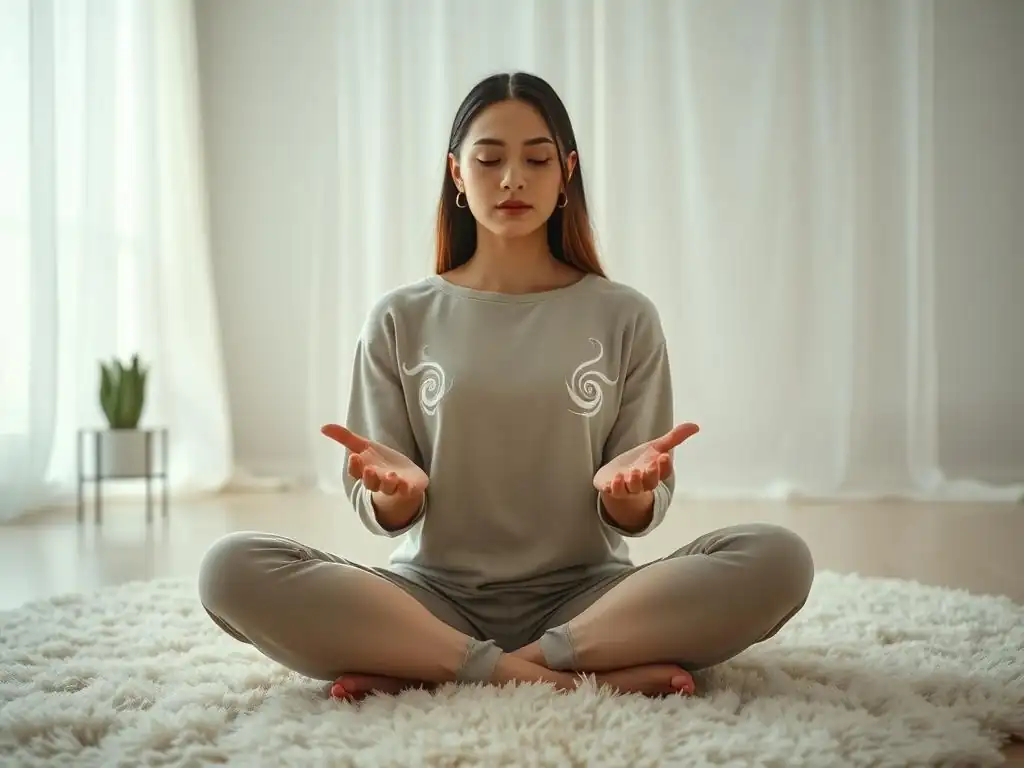
5-Minute Mindful Breathing Exercise for Anxiety Relief
When an anxiety spiral begins, focusing on your breath can be an immediate anchor to the present moment. This simple yet powerful technique requires no special equipment or location and can be done anywhere, anytime. Dedicating just five minutes to conscious, mindful breathing can interrupt the racing thoughts and help regulate the physical symptoms of anxiety. It shifts your attention away from the internal chaos and towards a steady, predictable rhythm – your breath. This focused attention prevents the mind from jumping from one anxious thought to the next, effectively slowing down the spiral.
The goal isn't necessarily to eliminate anxiety entirely in these five minutes, but to create space, find a sense of calm in the midst of the storm, and regain a feeling of control over your internal state. Even a small reduction in the intensity of the spiral can make a significant difference. This exercise trains your brain to focus, a skill that counteracts the scattered, frantic nature of an anxiety spiral. Consistent practice builds this capacity over time, making it easier to access this calm focus when you need it most.
Step-by-Step Guide to Mindful Breathing
Here is a simple way to practice mindful breathing when you feel anxiety rising:
- Find a comfortable position: Sit or lie down. If possible, close your eyes gently.
- Bring attention to your breath: Don't try to change it initially. Just notice the natural rhythm of your inhale and exhale. Where do you feel it most strongly? Perhaps in your nostrils, chest, or abdomen?
- Deepen your breath slightly: If comfortable, gently deepen and slow down your breath. Inhale slowly through your nose, feeling your belly or chest rise. Exhale slowly through your mouth or nose, feeling your belly or chest fall.
- Count your breaths: To help maintain focus, count each exhale. Count from 1 to 4 or 5, and then start over. If your mind wanders (which it will! ), simply notice the thought without judgment and gently bring your attention back to your breath and the counting.
- Continue for 5 minutes: Set a timer if you like, or just estimate the time. Focus purely on the sensation of breathing and the counting.
Task List:
- [x] Find comfortable position
- [x] Bring attention to breath
- [x] Gently deepen breath
- [x] Count exhales (1-4 or 5)
- [x] Continue for 5 minutes
Benefits of Deep Breathing for Anxiety
Deep, mindful breathing has immediate physiological benefits that help counteract the body's anxiety response. When you're anxious, your breathing often becomes shallow and rapid, which can exacerbate physical symptoms like dizziness and hyperventilation. Slowing down and deepening your breath activates the body's parasympathetic nervous system, often called the "rest and digest" system. This system works in opposition to the sympathetic nervous system ("fight or flight") which is dominant during anxiety. Activating the parasympathetic system helps to lower heart rate, reduce blood pressure, and promote a sense of calm.
Beyond the immediate physiological effects, focusing on the breath provides a mental anchor, diverting attention away from the anxious thoughts that fuel a spiral. It gives the restless mind a single, simple object of focus. This deliberate shift in attention disrupts the automatic chain reaction of worry. Regularly incorporating mindful breathing exercises reduce anxiety spirals by strengthening your ability to consciously regulate your physiological state and redirect your mental focus away from distressing thoughts. It's a foundational skill for managing anxiety.
Body Scan Meditation: A Quick Anxiety Release Technique
A quick body scan is another effective mindfulness exercise for anxiety spirals. It involves systematically bringing your attention to different parts of your body, noticing any sensations present without judgment. This practice helps to ground you in the physical reality of the present moment, pulling your awareness out of the abstract, future-focused world of anxious thoughts. Anxiety often manifests as physical tension – clenched jaw, tight shoulders, upset stomach. A body scan allows you to identify these areas of tension and, often, the simple act of noticing them with gentle awareness can begin to release them.
This technique helps interrupt the mental loop of worry by giving your mind a concrete, present-moment task: observing physical sensations. Instead of being lost in the "what ifs," you are focused on the "what is" – the feeling of your feet on the floor, the weight of your body on the chair, the temperature of the air on your skin. By anchoring your awareness in the physical body, you make it harder for the mind to race ahead into hypothetical future scenarios, thereby helping mindfulness exercises reduce anxiety spirals.
Performing a Quick Body Scan for Stress Reduction
To perform a quick body scan when feeling anxious, find a comfortable seated or lying position. Close your eyes if you feel safe doing so, or soften your gaze. Take a few slightly deeper breaths to settle yourself. Then, bring your awareness to your feet. Simply notice any sensations there – warmth, coolness, tingling, pressure. You don't need to change anything, just observe. Gently move your attention up your body: your ankles, lower legs, knees, thighs, hips, and pelvis.
Continue moving your awareness up your torso: your abdomen, lower back, chest, upper back, shoulders. Notice if you are holding any tension in your shoulders and gently invite them to soften. Move your attention down your arms to your hands and fingers. Finally, bring your awareness to your neck, jaw (often a place where tension hides), face, and the top of your head.
Spend a few moments noticing the overall feeling of your body. If your mind wanders to anxious thoughts, simply notice that it has wandered and gently guide your attention back to the part of the body you were scanning. A quick scan can be done in just 3-5 minutes.
Focusing on Sensations to Ease Anxiety
The core of the body scan's effectiveness in easing anxiety lies in its focus on direct physical sensation. Anxiety often involves a disconnect from the physical self, as the mind is consumed by abstract worries. By intentionally bringing awareness to physical feelings – whether pleasant, unpleasant, or neutral – you anchor yourself firmly in the present. This is a form of grounding, using the body as a tool to stay connected to reality rather than getting lost in mental narratives.
When you notice tension during a body scan, you're not trying to force it away. You are simply acknowledging its presence with curiosity and acceptance. This non-judgmental awareness can itself be therapeutic, allowing the body to relax naturally. For example, if you notice tightness in your chest, you might simply think, "Ah, there is tightness in my chest," rather than interpreting it as a sign of impending doom. This detachment from interpretation helps to prevent physical sensations from triggering further anxious thoughts, thus supporting how mindfulness exercises reduce anxiety spirals.
Mindful Observation: Detaching from Anxious Thoughts
Mindful observation of thoughts is a technique specifically aimed at the mental component of anxiety spirals. It involves stepping back from your thoughts and noticing them as objects passing through your mind, much like clouds drift across the sky. The natural tendency during an anxiety spiral is to get completely absorbed by each thought, believing it, reacting to it, and letting it pull you deeper into the spiral. Mindful observation teaches you that you are not your thoughts; you are the awareness that notices the thoughts.
This practice cultivates metacognitive awareness – the ability to think about your thinking. When you can observe a thought like "I'm going to fail" and label it internally as "a thought about failure," you create a crucial distance. This distance is where freedom from the compulsive grip of the anxiety spiral begins. You learn that you have a choice about whether to engage with a thought or let it pass, a vital skill for stopping the rapid escalation of worries.
Observing Thoughts Without Judgment
To practice observing thoughts without judgment, find a quiet moment to sit comfortably. Close your eyes or soften your gaze. Bring your attention to your breath for a few moments to settle. Then, turn your attention to the thoughts arising in your mind. Imagine you are sitting beside a stream, and your thoughts are leaves floating by on the water. Your task is simply to watch the leaves as they appear and float away.
Do not try to hold onto the thoughts, analyze them, or push them away. Just notice them. You might mentally label them ("worry thought," "planning thought," "memory"). The key is to observe them with curiosity and acceptance, without getting caught up in their content or judging yourself for having them. If a particularly sticky or anxious thought arises, acknowledge it ("Here is an anxious thought") and gently return your attention to the stream of thoughts or back to your breath. This non-judgmental stance is fundamental to detaching from the intensity of the anxiety spiral.
Using Mindful Observation to Interrupt Negative Thought Patterns
Anxiety spirals are characterized by repetitive, negative thought patterns. Mindful observation directly targets these patterns. By practicing observing thoughts, you become more adept at recognizing the start of a negative loop. For example, you might notice the same worry about a future event cycling through your mind. With mindful observation, you can identify this as a recurring pattern ("Ah, this thought about the meeting again") rather than getting lost in the content ("What if I say the wrong thing? ").
This recognition allows you to interrupt the pattern. Instead of automatically following the thought down the spiral, you can choose to redirect your attention – perhaps back to your breath, to a physical sensation, or to the present environment. This conscious redirection is the core mechanism by which mindful observation helps interrupt negative thought patterns and prevents them from escalating into full-blown anxiety spirals. It empowers you to step out of the mental hamster wheel.
Grounding Techniques: Anchoring Yourself in the Present Moment
Grounding techniques are specific mindfulness exercises designed to pull you out of your head and anchor you firmly in the present physical reality when anxiety or panic strikes. They are particularly useful during intense anxiety spirals or panic attacks, when you feel disconnected or overwhelmed. The aim is to engage your senses or focus on concrete, external details to interrupt the internal focus on anxious thoughts and feelings.
These techniques work because they require your attention. By deliberately focusing on sensory input from the environment or specific physical actions, you divert mental resources away from the abstract worries that are fueling the spiral. They provide a tangible connection to the "here and now," counteracting the feeling of being lost in a whirlwind of fear. Grounding exercises are quick, discreet, and highly effective tools to immediately reduce the intensity of an anxiety spiral.
The 5-4-3-2-1 Grounding Exercise for Immediate Anxiety Relief
The 5-4-3-2-1 technique is a popular and effective grounding exercise that uses your five senses to bring you back to the present:
- 5: Look for 5 things you can see.: Notice details like colors, shapes, textures. For example, "I see the blue wall, the brown table, the pattern on the rug, the light from the window, the dust motes in the air."
- 4: Touch 4 things you can feel.: Notice the sensations of touch. For example, "I feel my feet on the floor, the fabric of my clothes, the smooth surface of the table, the texture of my hair."
- 3: Listen for 3 things you can hear.: Tune into sounds around you. For example, "I hear the clock ticking, the hum of the refrigerator, the birds outside."
- 2: Smell 2 things you can smell.: Notice any scents in your environment. For example, "I smell my coffee, the scent of hand lotion." If you can't find two distinct smells, focus on one smell for two breaths.
- 1: Name 1 thing you can taste.: Notice any taste in your mouth, or perhaps take a sip of water and focus on its taste. For example, "I taste the lingering flavor of toothpaste."
Task List:
- [x] See 5 things
- [x] Feel 4 things
- [x] Hear 3 things
- [x] Smell 2 things
- [x] Taste 1 thing
Connecting with Your Senses to Reduce Anxiety
Connecting with your senses is a direct pathway out of the abstract world of anxious thoughts and into the concrete reality of the present moment. When anxiety spirals, the mind creates hypothetical scenarios that feel real but are not happening now. By deliberately focusing on sensory input – what you see, hear, feel, smell, and taste in this very moment – you pull your attention away from the "what ifs" and ground yourself in the "what is."
This sensory focus provides an immediate distraction from the anxious narrative. It requires your brain to engage with external stimuli rather than solely focusing inward on worries. This shift in attention can disrupt the momentum of the spiral. Moreover, engaging the senses can have a calming effect. Focusing on the warmth of a cup, the smooth texture of a stone, or the sound of gentle rain can be inherently soothing. Regularly using these sensory-based mindfulness exercises reduce anxiety spirals by training your mind to find refuge in the present reality when worries threaten to overwhelm you.
Mindful Walking: A Calming Exercise for Body and Mind
Mindful walking combines the benefits of gentle movement with focused awareness, offering a dynamic way to interrupt anxiety spirals. When you're feeling anxious, sitting still can sometimes feel difficult or even intensify the feeling of being trapped. Walking provides an outlet for restless energy while the mindfulness component keeps your mind anchored in the present moment, preventing it from racing into anxious territory.
This practice shifts your focus from internal worries to the physical sensations of walking and the external environment you are moving through. It allows you to literally walk away from the grip of an anxiety spiral, using the rhythmic motion of your body as a moving anchor. It's a versatile technique that can be adapted to a short walk around the block or simply pacing in a room.
How to Practice Mindful Walking
To practice mindful walking, find a place where you can walk undisturbed for a few minutes – perhaps a park, a quiet street, or even a hallway. Begin by simply noticing the sensation of your feet making contact with the ground. Pay attention to the lifting of one foot, its movement through the air, and the feeling as it lands again. Notice the rhythm of your steps.
Expand your awareness to include other physical sensations: the swing of your arms, the movement in your hips, the feel of the air on your skin. You can also gently bring your awareness to the sights and sounds around you, noticing them without judgment. If your mind wanders to anxious thoughts (which it will! ), simply acknowledge the thought ("worry about X") and gently bring your attention back to the physical sensation of walking or the sights and sounds around you. The duration can be anywhere from 5 to 20 minutes, depending on what feels comfortable and available.
Combining Movement and Mindfulness for Anxiety
Combining movement with mindfulness is particularly effective for anxiety because it addresses both the mental and physical aspects of the condition. Anxiety often manifests physically as restlessness, tension, or excess energy. Gentle walking provides a healthy way to discharge this energy. Simultaneously, the mindful focus on the sensations of walking or the environment prevents the mind from fixating on anxious thoughts.
This dual approach helps to break the cycle where physical tension feeds mental worry, and mental worry increases physical tension. The rhythmic nature of walking can also be naturally calming, similar to the effect of deep breathing. By engaging both the body and mind in a present-moment activity, mindful walking helps to interrupt the momentum of an anxiety spiral and restore a sense of calm and control. It's a practical example of how integrating simple mindfulness exercises reduce anxiety spirals through active engagement.
Integrating Mindfulness into Your Daily Routine for Long-Term Anxiety Management

Creating a Mindfulness Schedule
While quick mindfulness exercises are excellent for managing anxiety spirals in the moment, integrating mindfulness into your daily routine is crucial for long-term anxiety management. Consistency builds the mental muscle needed to catch anxiety before it spirals out of control. Creating a schedule, even a flexible one, helps turn mindfulness from an occasional coping mechanism into a regular practice. This doesn't require hours of meditation each day; even short, intentional moments can make a significant difference.
Consider starting with small, manageable commitments. This could be 5-10 minutes of mindful breathing or meditation first thing in the morning, a mindful walk during your lunch break, or a body scan before bed. You can also weave mindfulness into existing activities, such as mindful eating during a meal or mindful listening during a conversation.
The key is to find moments throughout your day to pause, bring awareness to the present, and practice observing your thoughts and sensations without judgment. Studies show that consistent mindfulness practice, even for just 10-15 minutes daily over several weeks, can lead to sustained reductions in anxiety symptoms.
Utilizing Mindfulness Apps and Resources
In today's digital age, numerous apps and online resources can support your journey in integrating mindfulness into your daily life. These tools offer guided meditations, body scans, breathing exercises, and reminders that can make starting and maintaining a regular practice much easier, especially when you're feeling overwhelmed by anxiety. Many apps offer short, specific exercises designed for anxiety relief or for integrating mindfulness into everyday activities.
Examples of helpful resources include meditation apps (like Headspace, Calm, or Insight Timer), websites with free guided practices, or books on mindfulness and anxiety. These resources can provide structure, guidance, and a variety of practices to keep things interesting. They can also offer tracking features to help you monitor your practice consistency, which can be motivating. Utilizing these tools can make it more accessible to consistently engage in the mindfulness exercises reduce anxiety spirals over time, building your capacity for calm and resilience.
The Importance of Consistency in Mindfulness Practice
Consistency is arguably the most vital element in using mindfulness for long-term anxiety management. Think of mindfulness as training for your brain. Just as you wouldn't expect to build physical strength with a single workout, you can't expect to develop robust mental resilience against anxiety spirals with only occasional practice. Regular engagement, even in short bursts, gradually strengthens the neural pathways associated with calm, focus, and non-reactivity.
Over time, consistent practice of mindfulness exercises reduces anxiety spirals by retraining your brain's response to stress and worry. You become more adept at recognizing the early signs of a spiral, pausing before reacting, and choosing a mindful response. This cumulative effect builds your capacity to handle life's challenges with greater ease and less reactivity. Even on days when you feel you don't have time, a minute or two of mindful breathing is better than skipping practice entirely. It's the regular effort that yields the most significant benefits.
Overcoming Challenges in Mindfulness Practice for Anxiety
Dealing with Distractions During Mindfulness Exercises
One of the most common challenges people face when starting mindfulness practice, especially when dealing with anxiety, is dealing with distractions. The mind is naturally prone to wandering, and when you're anxious, it might feel like your thoughts are racing even faster. It's easy to get discouraged and think you're "doing it wrong" if your mind doesn't become instantly quiet. However, recognizing and gently returning from distractions is a core part of mindfulness practice. The goal is not an empty mind, but a mind that is aware of where its attention is.
When you notice your mind has wandered during a mindfulness exercise (whether it's to an anxious thought, a to-do list item, or something else), simply acknowledge it without judgment. You might mentally note, "thinking," or "planning," or "worry." Then, gently but firmly, guide your attention back to your chosen anchor – whether it's the breath, body sensations, or the sounds around you. This act of returning is the "bicep curl" for your attention muscle. The more you practice gently redirecting your attention, the stronger your ability to focus becomes, which directly helps in interrupting anxiety spirals.
Staying Patient and Persistent with Mindfulness
Learning to use mindfulness exercises reduce anxiety spirals effectively takes time, patience, and persistence. You are essentially learning a new way of relating to your thoughts and feelings, which is a significant shift. There will be days when practice feels easy and calming, and other days when it feels difficult, frustrating, or even seems to amplify your anxiety temporarily. This is completely normal. It's important not to get discouraged by challenging sessions or perceived lack of progress.
View each practice session, regardless of how it felt, as valuable. Simply showing up and making the effort is progress. Be kind to yourself. If you miss a day or a week, don't dwell on it; just start again. Remember that the benefits of mindfulness accumulate gradually. While you might experience immediate relief from quick exercises during a spiral, the deeper changes in your brain's anxiety response happen with consistent, patient effort over weeks and months. Trust the process and remain persistent, knowing that you are building a powerful skill for managing your well-being.
Seeking Professional Guidance for Anxiety Management
While mindfulness is a powerful tool, it is not a substitute for professional medical or psychological treatment, especially for significant or persistent anxiety. If you are experiencing severe anxiety spirals, panic attacks, or if your anxiety is significantly impacting your daily life, it is important to seek help from a qualified mental health professional. Therapists, psychologists, and psychiatrists can provide diagnosis, therapy (such as Cognitive Behavioral Therapy or Exposure Therapy), and potentially medication if needed.
Mindfulness can be a wonderful complement to professional treatment. Many therapists incorporate mindfulness techniques into their practice, and they can help you learn how to use these tools effectively alongside other therapeutic approaches. A professional can also help you understand the root causes of your anxiety and develop a comprehensive treatment plan tailored to your specific needs. Do not hesitate to reach out for support; seeking help is a sign of strength and a crucial step towards managing anxiety effectively and reducing the frequency and intensity of anxiety spirals.
Frequently Asked Questions
What are anxiety spirals and how can mindfulness help?
Anxiety spirals are escalating patterns of negative thoughts and feelings. Mindfulness helps by bringing awareness to the present moment, interrupting these spirals by focusing on sensory experiences rather than thoughts.
How quickly can mindfulness exercises provide relief from an anxiety spiral?
While results vary, some people experience noticeable relief within just a few minutes of practicing mindfulness. Regular practice can lead to long-term benefits and improved anxiety management.
What are some examples of quick mindfulness exercises I can use during an anxiety spiral?
Simple exercises include focusing on your breath, paying attention to your senses (like feeling your feet on the ground), or doing a body scan meditation. These techniques can ground you in the present.
Are there any risks or downsides to using mindfulness exercises for anxiety?
Mindfulness is generally safe, but some individuals may initially experience increased awareness of uncomfortable feelings. It's important to start slowly and consider guidance from a mental health professional if needed.
How often should I practice mindfulness to effectively reduce anxiety spirals in the long term?
Consistent practice is key. Aim for at least 5-10 minutes daily, even when not experiencing an anxiety spiral. This builds mental resilience and makes it easier to access mindfulness during moments of crisis.
Final Reflection: Finding Calm in the Chaos
The pervasive nature of anxiety in our modern world demands accessible tools for coping, and quick mindfulness exercises offer precisely that: a readily available antidote to the debilitating effects of anxiety spirals. These simple techniques, explored throughout this article, aren't just fleeting solutions; they represent a powerful shift towards proactive mental health management, empowering individuals to regain control in moments of overwhelming stress.
The impact of incorporating mindfulness into daily life extends far beyond the immediate relief from anxiety. It cultivates a deeper self-awareness, fostering a more compassionate relationship with oneself and the world around us. Mindfulness isn't about escaping life; it's about finding freedom within it.
This quote perfectly encapsulates the transformative power of these practices, moving beyond symptom management to cultivate a more resilient and peaceful inner landscape. The ongoing normalization of mindfulness techniques in our culture signifies a growing recognition of its profound benefits, a trend I find deeply encouraging.
You now possess the tools to navigate anxiety's grip. Don't let this knowledge remain dormant. Choose one exercise from this article, commit to practicing it daily, and observe the subtle shifts in your perception and emotional responses. Remember, the journey towards inner peace is a continuous process, marked by small, consistent steps. Embrace the power of mindfulness, and discover the calm that awaits within.
Unleash Your Inner Calm: Start Practicing Mindfulness Today!
Thanks for taking the time to explore practical mindfulness techniques with us! We hope you gained valuable tools to manage anxiety. Now, let's put those tools into action.
- Prioritize your breath: Try the 5-minute breathing exercise from the article – even just once today can make a difference. Notice how your body feels before and after.
- Share your experience: Tell us – or a friend – about your experience with one of the exercises. Sharing your journey can strengthen your practice.
- Explore a guided meditation: Many free guided meditations are available online. Try a short one and see how it integrates with your day.
Ready to cultivate more moments of calm in your life? What small step will you take today to prioritize your mental wellbeing?