
The Beginner's Path: Starting Your Journey with Walking Meditation.


Welcome to Mind Care Guide, a safe space where we explore the intricate landscape of mental well-being together.
Feeling overwhelmed by anxiety? You're not alone. This journey towards inner peace can begin with a single step. Discover the transformative power of walking meditation for anxiety relief and embark on a path towards a calmer, more centered you. Are you ready to take that first step? Let's begin...
The Beginner's Path: Starting Your Journey with Walking Meditation
- Walking Meditation: A Simple Guide to Inner Peace
- Understanding Walking Meditation for Anxiety Relief
- Preparing for Your First Walking Meditation Session
- Step-by-Step Guide to Walking Meditation for Beginners
- Techniques and Variations in Walking Meditation
- Overcoming Challenges in Your Walking Meditation Practice
- Integrating Walking Meditation into Daily Life for Sustained Anxiety Relief
- Walking Meditation for Anxiety Relief: A Recap and Next Steps
-
Frequently Asked Questions
- What exactly is walking meditation, and how does it differ from regular walking?
- Can walking meditation really help with anxiety relief, as suggested?
- How long should a beginner practice walking meditation to see any benefits?
- What's the best environment or location for practicing walking meditation?
- Are there any specific techniques or tips to keep in mind while practicing walking meditation?
- Final Reflection: Finding Stillness in Motion
- Unveil Your Inner Peace: Start Your Walking Meditation Journey Today
Walking Meditation: A Simple Guide to Inner Peace
Walking meditation is a powerful yet simple practice that combines mindful awareness with the physical act of walking. Unlike a destination-focused walk, the purpose here is to be fully present with each step, the sensations in your body, and the environment around you. It's a moving form of meditation that can be done almost anywhere, making it highly accessible for beginners. This practice encourages you to slow down, pay attention, and cultivate a sense of calm amidst the movement of life.
Engaging in walking meditation offers a unique way to anchor yourself in the present moment. By shifting your focus from ruminating thoughts about the past or worries about the future to the immediate physical experience of walking, you can interrupt cycles of stress and anxiety. This active form of mindfulness helps to ground you, integrating mental clarity with physical movement. It's a practice that builds awareness not just while you're walking, but can also enhance your presence and peace throughout your day.
Understanding Walking Meditation for Anxiety Relief
Walking meditation for anxiety relief is gaining recognition as a practical and effective tool. Anxiety often manifests as racing thoughts, physical restlessness, and a feeling of being disconnected from the present. Walking meditation directly addresses these symptoms by providing a gentle physical outlet for energy while simultaneously training the mind to focus and settle. It offers a portable method for finding calm, available whenever and wherever you can take a few steps.
This practice helps to break the cycle of anxious rumination by drawing your attention to concrete, physical sensations. Instead of getting lost in 'what ifs,' you are guided to notice the lifting and falling of your feet, the swing of your arms, the feeling of the ground beneath you. This shift in focus can create a much-needed space from anxious thoughts, allowing your nervous system to regulate and promoting a sense of ease. Regular practice can build resilience, making it easier to manage anxious feelings when they arise.
What is Walking Meditation and How Can It Help?
Walking meditation is a mindfulness practice where the focus is on the physical experience of walking itself, rather than the destination. It involves paying deliberate attention to the sensations of movement, the breath, and the surrounding environment without judgment. Unlike traditional seated meditation, which can be challenging for those with restless energy or difficulty sitting still, walking meditation allows for movement, which many find grounding and soothing. It's a way to cultivate mindfulness in action, integrating awareness into a common daily activity.
For individuals seeking walking meditation for anxiety relief, this practice offers several mechanisms of support. Firstly, the physical act of walking can help discharge nervous energy that often accompanies anxiety. Secondly, the focus required to stay present with the sensations of walking acts as a gentle anchor, diverting attention away from anxious thought loops.
Thirdly, regular engagement with the present moment helps to build the mental muscle needed to observe anxious thoughts without getting carried away by them. For example, studies on mindfulness-based interventions often show participants reporting reductions in anxiety scores, sometimes decreasing by 15-25% over several weeks, and walking meditation contributes to this overall mindful capacity. Many people report feeling calmer and more centered after even a short session, noting a tangible shift from mental churning to physical presence.
The Benefits of Walking Meditation: Beyond Anxiety Reduction
While walking meditation is particularly effective for managing anxiety, its benefits extend across multiple dimensions of well-being. It's not just about reducing negative states but also about cultivating positive ones, such as increased presence, peace, and physical vitality. This practice offers a holistic approach to health, nurturing both mind and body simultaneously through conscious movement.
Physical Benefits of Mindful Walking
Engaging in mindful walking, even at a slow pace, provides numerous physical advantages. Like any form of walking, it improves cardiovascular health, strengthens muscles, and can help with weight management. A study published in a health journal involving older adults found that regular walking, including mindful variations, contributed to improved balance and reduced risk of falls.
Furthermore, focusing on the body during walking can enhance proprioception – your body's sense of its position and movement in space – leading to better coordination. Unlike strenuous exercise, mindful walking is gentle and accessible to most people, requiring no special equipment and minimal physical strain, making it a sustainable practice even for those with physical limitations.
Mental and Emotional Benefits of Walking Meditation
Beyond its physical effects, walking meditation profoundly impacts mental and emotional states. It helps to quiet the 'monkey mind,' reducing rumination and increasing focus. Participants in mindfulness programs incorporating walking meditation often report enhanced emotional regulation, finding it easier to navigate difficult feelings without being overwhelmed.
A common outcome is improved mood; the combination of gentle movement and mindful presence can alleviate symptoms of mild depression and increase feelings of well-being. Furthermore, the practice can foster a deeper connection with oneself and the environment, cultivating gratitude and a sense of interconnectedness, which are powerful antidotes to feelings of isolation often associated with anxiety.
Preparing for Your First Walking Meditation Session
Starting your walking meditation practice doesn't require much, but a little preparation can significantly enhance your experience. Thinking about where and when you'll practice, and what you hope to gain from it, can set a positive tone for your mindful journey. Remember, the goal is ease and presence, not perfection.
Finding the Right Space for Mindful Walking
Choosing a suitable location is key to a comfortable walking meditation session, especially when you're starting out and focusing on walking meditation for anxiety relief. Ideally, find a quiet place where you feel safe and won't be easily interrupted or distracted. This could be a peaceful park path, a quiet street early in the morning, a long hallway in your home, or even a backyard.
The space doesn't need to be large; you can simply walk back and forth over a short distance. The most important factor is that you feel comfortable enough to slow down and pay attention without feeling self-conscious or worried about external disturbances.
Consider the surface you'll be walking on – a relatively even path is best to allow you to focus on the sensations in your feet rather than navigating obstacles. If walking outdoors, pay attention to the weather and dress appropriately. Indoors, ensure you have enough clear space to move freely. Some people prefer a visually simple environment to minimize external distractions, while others find the natural world in a park or garden enhances their sense of peace. Experiment to find what feels most supportive for your practice.
Choosing the Right Time for Walking Meditation
Selecting a consistent time for your walking meditation can help establish it as a regular habit, making it a more reliable tool for walking meditation for anxiety relief over time. Many people find the morning, before the day's demands begin, or the evening, as a way to unwind, particularly beneficial. However, the 'right' time is simply the time that works best for your schedule and when you feel most able to dedicate a few uninterrupted minutes to the practice.
Even short sessions are valuable. You might start with just 5-10 minutes. The key is consistency over duration. Perhaps you can fit in a mindful walk during your lunch break, or as a transition between work and home. Try scheduling it like any other important appointment. If you find yourself feeling particularly anxious at a certain time of day, that might be an opportune moment to practice, using the mindful walk as an immediate coping strategy. Be flexible and kind to yourself; if you miss a session, simply pick up where you left off.
Setting Your Intention for a Calming Walking Meditation
Setting an intention before you begin can help focus your mind and give purpose to your walking meditation session. Your intention doesn't need to be complex; it can be as simple as "to be present with each step" or "to walk with kindness towards myself." For those practicing walking meditation for anxiety relief, an intention might be "to find moments of calm" or "to notice sensations without judgment."
Take a few moments before you start walking to pause, perhaps with your eyes closed or a soft gaze downwards. Bring to mind why you are choosing to practice walking meditation today. Gently state your intention to yourself. This simple act helps to shift your mindset from goal-oriented walking to process-oriented walking, reminding you that the value is in the journey, not how far you go or how perfectly you do it. Holding this intention lightly can help guide your attention throughout the walk, gently bringing you back when your mind inevitably wanders.
Step-by-Step Guide to Walking Meditation for Beginners
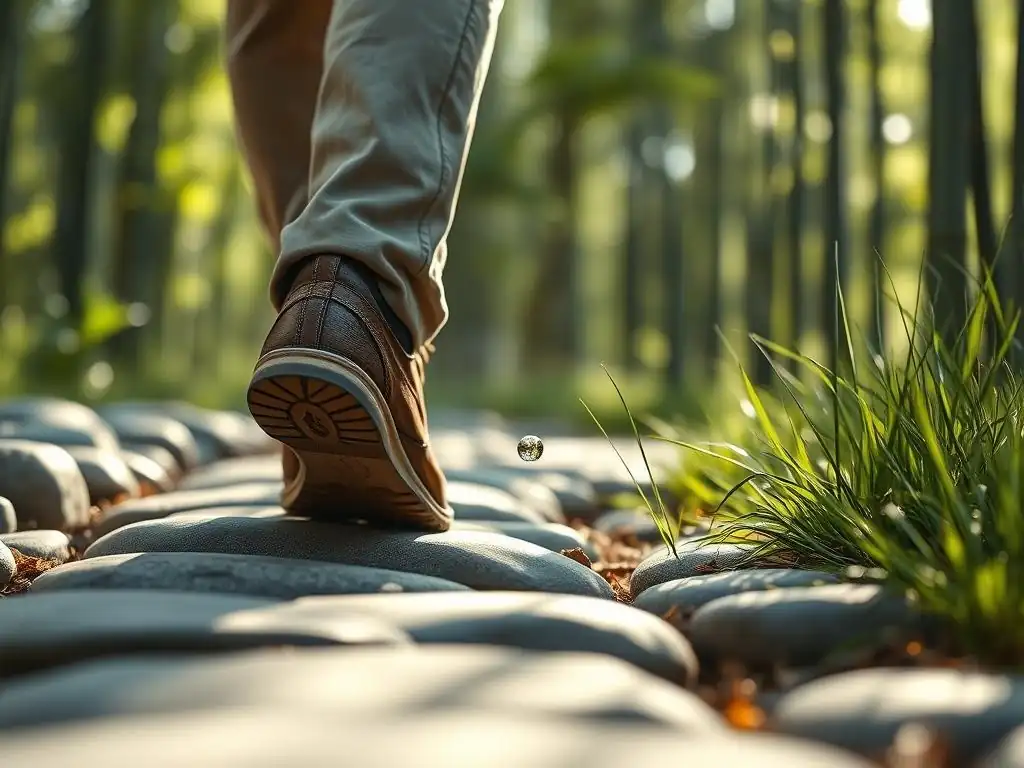
Starting walking meditation is straightforward. The core practice involves slowing down your usual walking pace and bringing conscious awareness to the physical sensations of movement. Here is a simple guide to get you started. Remember, progress is not measured by speed or distance, but by presence.
Step 1: Establishing a Mindful Posture for Walking
Begin by standing still at the start of your chosen path. Find a comfortable and balanced posture. Your feet can be hip-width apart. Allow your arms to hang naturally at your sides, or you might clasp your hands gently in front or behind you, whichever feels most comfortable and least distracting. Soften your gaze, looking slightly downwards a few feet ahead of you, or you may close your eyes for a moment if you feel steady.
Take a few deeper breaths, settling into your body. Feel the contact of your feet on the ground. Notice your weight distributed between both feet. Allow your shoulders to relax. The aim is a posture that is alert yet relaxed, ready to begin moving with awareness. There's no need for rigidity, just a sense of being present in your body before you take the first step.
Step 2: Focusing on Your Breath and Body Sensations
Before you begin walking, or as you take your first few slow steps, bring your attention to your breath. Notice the inhale and exhale without trying to change it. Simply observe its natural rhythm. Then, gently expand your awareness to include the sensations in your body.
As you walk, pay attention to the feeling of your feet making contact with the ground. Notice the pressure, the temperature, the texture. Feel the muscles engaging in your legs and feet as you lift one foot and then place it down. Become aware of the subtle shifts in weight. Notice the swing of your arms, the movement of your hips, the feeling of the air on your skin. This sensory focus serves as an anchor, helping to keep your mind from getting lost in thoughts, which is particularly helpful when practicing walking meditation for anxiety relief.
Step 3: Coordinating Breath with Your Steps
Once you are comfortable with focusing on body sensations, you can add an optional layer of focus by coordinating your breath with your steps. This provides another gentle rhythm to anchor your awareness. There's no single 'right' way to do this; find a pattern that feels natural for you.
A common approach is to inhale for a certain number of steps (e.g., two or three) and exhale for the same number. For instance, you might inhale as you take two steps, and exhale as you take the next two steps. Or, you might find it easier to simply be aware of the breath flowing in as you walk, and flowing out as you walk, without counting steps.
The key is to use the breath-step coordination as a gentle focus, not a rigid rule. If it feels forced or adds stress, simply return to focusing on the body sensations of walking.
Step 4: Redirecting Your Attention When Your Mind Wanders
It is completely natural for your mind to wander during walking meditation, especially when you're using walking meditation for anxiety relief and your mind might be prone to anxious thoughts. This is not a failure; it's an opportunity to practice mindfulness. The moment you notice your mind has drifted off into planning, worrying, or daydreaming, is a moment of awareness.
Gently acknowledge where your mind went without judgment. There's no need to criticize yourself. Simply say internally, "Thinking," or "Planning," and then, with kindness, gently guide your attention back to the sensations of walking – the feeling of your feet, the movement of your legs, your breath. Each time you do this, you are strengthening your capacity for focus and present moment awareness. This act of non-judgmental redirection is a core skill cultivated in mindfulness practice.
Step 5: Lengthening Your Mindful Walking Practice
As you become more comfortable with the basic steps, you may wish to gradually increase the duration of your walking meditation sessions. Start with 5-10 minutes, and slowly add a few minutes each week. You might find that you can comfortably walk mindfully for 15, 20, or even 30 minutes.
Listen to your body and your capacity. There's no pressure to walk for a long time; even a few minutes of mindful walking can be beneficial. As you lengthen your practice, you might notice deeper levels of relaxation and clarity. You can also explore different speeds – some traditions practice very slow walking, while others integrate mindfulness into a more natural pace. Find what feels right for you on any given day. The goal is sustainable practice that supports your well-being.
Techniques and Variations in Walking Meditation
Once you have a grasp of the basic walking meditation steps, you can explore different techniques and variations to keep your practice fresh and deepen your experience. These variations can help tailor the practice to your specific needs or environment, enhancing its effectiveness, particularly when using walking meditation for anxiety relief.
Formal Walking Meditation vs. Informal Walking Meditation
Formal walking meditation is a dedicated practice session, similar to a seated meditation session, where you set aside a specific amount of time solely for mindful walking. You might walk back and forth in a quiet space or follow a short, defined path, focusing deliberately on the sensations of walking, breath, or sounds. This dedicated time allows for deep immersion in the practice without other objectives. It's a structured way to build the foundational skills of mindful movement.
Informal walking meditation, on the other hand, involves bringing mindful awareness to walking that you are already doing as part of your daily routine. This could be walking to your car, walking down a hallway at work, walking the dog, or walking through a grocery store. The intention is to bring moments of presence to these ordinary activities.
You might choose to focus mindfully on your steps for just one minute during a longer walk. This informal practice helps integrate mindfulness into everyday life, making it a readily available tool for managing stress and anxiety throughout the day without needing to carve out extra time. Both formal and informal approaches are valuable and complement each other.
Walking Meditation with Nature: Enhancing the Experience
Practicing walking meditation in a natural environment can profoundly enhance the experience, offering additional sensory anchors and a sense of connection to the wider world. A park, garden, forest trail, or even a tree-lined street can provide a rich backdrop for mindful walking.
As you walk in nature, in addition to focusing on your steps and breath, gently open your awareness to the sensory input from your surroundings. Notice the colors of the leaves, the shapes of the trees, the feeling of the breeze on your skin. Listen to the sounds of birds, rustling leaves, or distant water. Smell the scent of soil, flowers, or pine needles.
Engage your senses fully, allowing the beauty and complexity of nature to draw you into the present moment. Many people find that walking meditation in nature is particularly effective for reducing feelings of stress and anxiety, as the natural world often has an inherently calming effect on the nervous system. A study published in Environmental Health Perspectives suggested that spending time in nature can lower cortisol levels, the body's primary stress hormone.
Incorporating Mantras or Affirmations into Your Walk
Another variation is to gently incorporate a mantra or affirmation into your walking meditation. A mantra is typically a sound, word, or phrase repeated silently or softly to aid concentration. An affirmation is a positive statement. This can provide an additional layer of focus and intention for your practice, particularly helpful when practicing walking meditation for anxiety relief.
You can coordinate the mantra or affirmation with your steps or breath. For example, you might silently repeat a simple phrase like "peace" with each step, or "calm body, calm mind" coordinated with your breath (e.g., "calm body" on the inhale/first few steps, "calm mind" on the exhale/next few steps). An affirmation for anxiety might be "I am safe" or "I am present."
Choose words that resonate with you and support your intention for the walk. If the mantra becomes another source of distraction or effort, simply return to focusing on your physical sensations. The mantra is a tool to aid presence, not a requirement.
Overcoming Challenges in Your Walking Meditation Practice

Like any new practice, you might encounter challenges when starting walking meditation. This is normal. Be patient and compassionate with yourself. Recognizing potential hurdles and having strategies to navigate them can help you maintain consistency and deepen your practice over time, ensuring that walking meditation for anxiety relief remains a supportive tool.
Dealing with Distractions During Walking Meditation
Distractions are perhaps the most common challenge in any meditation practice, including walking meditation. These can be external (sounds, sights, other people) or internal (thoughts, feelings, physical sensations unrelated to walking). When a distraction arises, the practice isn't about eliminating it, but about how you relate to it.
When you notice a distraction, gently acknowledge it without judgment. For example, if you hear a loud noise, simply note "Sound." If your mind drifts to a worry, note "Thinking."
Then, with kindness and patience, gently guide your attention back to your chosen anchor – whether that's the feeling of your feet on the ground, your breath, or a mantra. Think of your attention like a puppy; it will wander off, and your job is to gently bring it back, again and again, without scolding. Each time you redirect your attention, you are strengthening your capacity for focus and resilience against distractions, which is directly applicable to managing anxious thoughts.
Managing Physical Discomfort While Walking
While walking meditation is generally gentle, you might experience some physical discomfort, especially if you are new to walking or if you have existing physical conditions. This could be minor aches, fatigue, or restlessness. It's important to approach physical sensations with mindfulness and self-compassion.
Firstly, check your posture and pace. Are you walking too fast? Is your body tense? Can you soften your shoulders or relax your jaw? Adjust your pace to a comfortable speed that allows you to maintain awareness without strain. If you feel a specific discomfort, acknowledge it without immediately trying to make it go away.
Can you breathe into the sensation? Can you soften around it? If the discomfort is significant or persistent, it's important to listen to your body. It might be necessary to shorten your session, rest, or consult with a healthcare professional if you have concerns. Mindfulness includes listening wisely to the body's signals.
Staying Motivated with Your Mindful Walking Routine
Maintaining motivation for any new routine can be challenging, and walking meditation is no exception. Life happens, schedules get busy, and sometimes the desire to practice wanes. It's helpful to have strategies in place to support your consistency, especially when relying on walking meditation for anxiety relief.
Consider setting realistic goals for your practice – perhaps starting with just 5 minutes a few times a week. Schedule your walking meditation sessions in your calendar as you would any important appointment. Find a walking buddy, either in person or someone you check in with, for mutual support. Reflect on the benefits you've experienced, even small ones, and remind yourself why you started.
You can also vary your practice by trying different routes, times of day, or incorporating nature or mantras. If you miss a day (or several), don't dwell on it; simply acknowledge it and start again with your next step. Remember that consistency over time is more impactful than occasional long sessions.
- Set small, achievable goals.
- Schedule practice time.
- Reflect on benefits gained.
- Vary your routine.
- Be kind to yourself if you miss a session.
Integrating Walking Meditation into Daily Life for Sustained Anxiety Relief
The true power of walking meditation lies in its potential to be integrated beyond dedicated practice sessions, weaving moments of mindfulness into the fabric of your everyday life. This consistent, informal application can provide sustained support for managing anxiety.
Short Walking Meditation Breaks During the Day
One of the most accessible ways to integrate walking meditation is by taking short mindful walking breaks throughout your day. Instead of rushing from one task to the next or scrolling through your phone, dedicate 1-5 minutes to simply walk with awareness. This could be a walk to the water cooler, to the restroom, or just a few laps around your office or living room.
During these brief breaks, bring your attention fully to the act of walking. Notice the feeling of your feet, your breath, and the environment around you. Even these short bursts of mindful movement can help interrupt stress cycles, clear your head, and bring you back into the present moment. They offer mini-resets that can reduce accumulated tension and maintain a sense of calm, providing ongoing walking meditation for anxiety relief throughout the day. Try setting a gentle reminder to take a mindful walking break every couple of hours.
Using Walking Meditation to Transition Between Tasks
Walking meditation can also be a powerful tool for transitioning smoothly between different activities or states of mind. For example, taking a short mindful walk before starting a challenging task, after finishing a meeting, or upon arriving home from work can help you shift your focus and energy intentionally.
Instead of carrying the mental residue of the previous activity into the next, a transitional mindful walk allows you to release tension and ground yourself. As you walk, you can consciously let go of thoughts related to the previous task and set an intention for the next. This practice helps create clear boundaries between activities, reducing mental clutter and making you more present and effective in whatever you are doing next. It's a practical application of mindfulness that prevents the build-up of stress that can exacerbate anxiety.
Combining Walking Meditation with Other Mindfulness Practices
Walking meditation complements other mindfulness and well-being practices beautifully. You don't need to choose just one technique; combining them can create a more robust approach to managing anxiety and enhancing overall well-being.
Consider starting your day with a short seated meditation followed by a mindful walk. Or, use walking meditation as a way to prepare your mind and body for a seated practice if you find it difficult to settle initially. You can also combine mindful walking with deep breathing exercises or body scan techniques, bringing awareness to different parts of your body as you move.
Incorporating elements like journaling after your walk to reflect on your experience can also deepen the practice. Exploring different combinations allows you to build a personalized toolkit for walking meditation for anxiety relief and overall mental health.
- Combine with seated meditation.
- Integrate deep breathing.
- Follow with journaling or reflection.
Walking Meditation for Anxiety Relief: A Recap and Next Steps
Walking meditation offers a gentle yet effective path towards managing anxiety and cultivating inner peace. It's a practice that is accessible, adaptable, and can be woven into the rhythm of your daily life. By bringing mindful awareness to the simple act of walking, you create space from anxious thoughts and connect more deeply with the present moment.
Key Takeaways for Effective Walking Meditation
Remember the core principles: slow down your pace, bring attention to your physical sensations (feet, legs, breath), and gently redirect your attention when your mind wanders. Start small, perhaps just 5-10 minutes, and gradually increase your duration. Find a comfortable space and time that works for you. Setting a simple intention can help focus your practice. Be patient and compassionate with yourself; the journey of mindfulness is not about perfection, but about consistent, kind effort. The power of walking meditation for anxiety relief lies in its simplicity and accessibility.
Resources for Further Exploration of Walking Meditation Techniques
To deepen your understanding and practice of walking meditation, you can explore various resources. Many mindfulness centers and meditation apps offer guided walking meditations, which can be very helpful when you're starting out or exploring variations. Books on mindfulness and meditation often include chapters or sections specifically dedicated to walking meditation techniques.
Websites and online platforms focused on mental well-being frequently provide articles, videos, and courses on mindful walking. Exploring different teachers or traditions (such as Vipassanā or Zen, which incorporate walking meditation) can also offer new perspectives and techniques. Look for resources that resonate with you and support your learning style.
Embark on Your Mindful Journey Today
You have everything you need to begin your path with walking meditation right now – your body and the ability to walk. There's no need to wait for the perfect moment or location. Start with a few mindful steps wherever you are. Notice the simple miracle of movement. Embrace the practice with curiosity and kindness. Even a small commitment to mindful walking can begin to shift your relationship with anxiety and open the door to greater peace and presence in your life. Take that first conscious step forward today.
Frequently Asked Questions
What exactly is walking meditation, and how does it differ from regular walking?
Walking meditation is a form of meditation where you focus on the sensations of walking. Unlike regular walking, the goal isn't to reach a destination but to be present in the moment with each step. It's a mindfulness practice.
Can walking meditation really help with anxiety relief, as suggested?
Yes, studies suggest that walking meditation can significantly reduce anxiety. By focusing on the present moment and the physical sensations of walking, it helps quiet the racing thoughts often associated with anxiety.
How long should a beginner practice walking meditation to see any benefits?
Even short sessions can be beneficial. Start with just 10-15 minutes a day and gradually increase the duration as you become more comfortable. Consistency is key to experiencing long-term anxiety relief.
What's the best environment or location for practicing walking meditation?
Ideally, choose a quiet and peaceful location where you won't be easily distracted. A park, garden, or even a quiet room in your home can work well. The key is to minimize external interruptions.
Are there any specific techniques or tips to keep in mind while practicing walking meditation?
Focus on the sensation of your feet making contact with the ground. Notice the rhythm of your breath. If your mind wanders, gently bring your attention back to the present moment without judgment.
Final Reflection: Finding Stillness in Motion
The practice of walking meditation, once considered a niche spiritual practice, is experiencing a surge in popularity, offering a powerful antidote to the pervasive anxiety of modern life. Its accessibility and profound impact on mental well-being make it a vital tool for navigating the stresses of our increasingly fast-paced world. The simple act of mindful walking can be a transformative experience, offering a pathway to calm amidst the chaos.
The exploration of walking meditation's benefits for anxiety relief has been deeply personal for me. Witnessing its calming effect firsthand, and seeing its positive impact on others, underscores its importance. The journey of a thousand miles begins with a single step.
This ancient proverb perfectly encapsulates the essence of walking meditation – a journey inward, one mindful step at a time. The consistent practice fosters a sense of groundedness and presence that directly counters the anxieties that often stem from a disconnect with the present moment.
Now, I invite you to take that first step. Don't wait for the perfect moment or a perfectly quiet space. Begin today, even if it's just for five minutes. Embrace the gentle rhythm of your breath and the sensation of your feet on the ground. Allow the practice to unfold organically, noticing the subtle shifts in your body and mind. Walking meditation is not about achieving perfection; it's about cultivating a deeper connection with yourself and finding solace in the present moment. Let this practice become your sanctuary, a place of peace and calm amidst the storms of life.
Unveil Your Inner Peace: Start Your Walking Meditation Journey Today
Thanks for taking the time to explore the world of walking meditation with us! We hope you've gained a deeper understanding of its calming power and simple practice. Ready to step onto the path?
- Begin your first walking meditation session now. Find a quiet space, even just a few minutes, and try the techniques we've outlined. Notice the sensations in your body and the rhythm of your breath.
- Share your experience! Let us know in the comments how your first session felt. Connecting with others on their journeys can enhance your own practice.
- Explore additional resources. Search online for guided walking meditation audio or videos to deepen your understanding.
What small step will you take today to cultivate more mindfulness in your life?