
The Secret to Resolving Family Fights Without Yelling

Welcome to Mind Care Guide, a space dedicated to nurturing your mental well-being.
Feeling overwhelmed by family disagreements? You're not alone. Family conflicts are a common source of stress, but understanding effective family conflict resolution strategies can transform your home life. This article, "The Secret to Resolving Family Fights Without Yelling," offers practical insights to navigate these challenges. Curious about how to defuse tension and build stronger family bonds? Let's explore together...
The Secret to Resolving Sibling Rivalry Without Yelling
- Understanding Sibling Conflict and Its Impact
-
Effective Sibling Conflict Resolution Strategies: A Step-by-Step Guide
- Step 1: Active Listening and Empathy in Sibling Discussions
- Step 2: Identifying and Addressing Core Issues in Sibling Arguments
- Step 3: Developing Constructive Communication Skills for Siblings
- Step 4: Setting Boundaries and Expectations for Sibling Interactions
- Step 5: Seeking Parental Mediation for Complex Sibling Conflicts
- Practical Tips for Resolving Sibling Conflicts Peacefully
- Long-Term Sibling Conflict Resolution: Building Stronger Relationships
- Mastering Sibling Conflict Resolution Strategies for a Harmonious Home
-
Frequently Asked Questions
- How can I start implementing family conflict resolution strategies when my family is used to yelling?
- What are some effective communication techniques for resolving family arguments?
- How do I handle a family member who refuses to participate in conflict resolution?
- What resources are available if our family conflicts are too severe to resolve on our own?
- How important is it to address family conflicts proactively instead of ignoring them?
- Final Reflection: The Quiet Strength of Peaceful Resolution
- Unlock Your Family's Harmony: Start Communicating Differently Today!
Understanding Sibling Conflict and Its Impact
The Root Causes of Sibling Disputes: Identifying Triggers
Sibling disputes are a nearly universal experience in families, often stemming from a variety of underlying causes. One of the most common triggers is competition for parental attention. Children, especially younger ones, often perceive parental attention as a finite resource and vie for it through various means, leading to jealousy and conflict. Studies suggest that this competition can be particularly intense in families with children spaced closely in age, where developmental needs and interests may overlap significantly, increasing opportunities for friction over perceived favoritism or time spent with parents.
Another significant root cause involves differences in personality, temperament, and developmental stages. A highly energetic child might clash with a more reserved sibling, leading to arguments over activity choices or noise levels. Disagreements over possessions, such as toys, games, or shared spaces, are also frequent instigators of conflict. For instance, a 2019 survey indicated that disputes over sharing possessions are among the top three reasons for arguments between siblings under the age of 10. These seemingly minor skirmishes can escalate quickly if not managed effectively, highlighting the need for robust family conflict resolution strategies.
The Negative Effects of Yelling During Sibling Arguments
Yelling, while a common reaction to frustration during sibling conflicts, is counterproductive and can have detrimental effects on both the children involved and the family dynamic. When parents or siblings resort to yelling, it often escalates the conflict rather than resolving it. It teaches children that shouting is an acceptable way to handle disagreements, potentially leading to a cycle of loud, aggressive communication within the family. Furthermore, yelling can create a climate of fear or anxiety, making children feel unsafe to express their feelings or needs openly and honestly.
Beyond immediate effects, chronic exposure to yelling during family disputes can negatively impact children's emotional and psychological development. Research has linked frequent exposure to harsh verbal discipline, including yelling, to increased levels of anxiety, depression, and behavioral problems in children and adolescents. It undermines trust, erodes self-esteem, and can damage the sibling bond in the long term. Developing effective family conflict resolution strategies that move away from yelling is crucial for fostering a healthier emotional environment.
Why Peaceful Sibling Conflict Resolution Matters for Mental Well-being
Learning peaceful sibling conflict resolution strategies is not just about reducing noise levels; it's fundamentally important for the mental well-being of all family members. When siblings learn to navigate disagreements constructively, they develop essential life skills such as empathy, negotiation, compromise, and problem-solving. These skills are vital for healthy relationships throughout life, extending far beyond the family unit. A home environment where conflicts are resolved calmly and respectfully provides children with a sense of security and stability, which are foundational for positive mental health.
Furthermore, positive experiences with resolving disagreements can strengthen the sibling relationship, transforming it from a source of stress into a source of support. Siblings who feel heard and understood during conflicts are more likely to maintain close relationships into adulthood. Conversely, unresolved conflicts and chronic tension can contribute to stress, anxiety, and even depression for both children and parents. Implementing effective family conflict resolution strategies fosters a more harmonious home, reduces stress for everyone, and promotes long-term emotional health and resilience.
Effective Sibling Conflict Resolution Strategies: A Step-by-Step Guide
Step 1: Active Listening and Empathy in Sibling Discussions
Practicing Empathetic Communication: Understanding Each Other's Perspective
Empathetic communication is a cornerstone of effective family conflict resolution strategies. It involves making a conscious effort to understand the other person's feelings and perspective, even if you don't agree with them. During a sibling dispute, this means encouraging each child to truly listen when the other is speaking, without interrupting or formulating their own response. For example, if one sibling is upset because the other took their toy without asking, empathetic listening involves the toy-taker trying to understand why the first sibling is upset – perhaps it's not just about the toy, but about feeling disrespected or ignored.
To practice this, encourage siblings to use phrases like "So, if I understand correctly, you're feeling [emotion] because [reason]?" This validates the speaker's feelings and ensures the listener has accurately grasped the situation. It shifts the focus from winning the argument to understanding the other's experience. This approach is a vital component of successful family conflict resolution strategies, building bridges instead of walls between siblings.
Recognizing and Validating Feelings During Sibling Conflicts
Validating feelings does not mean agreeing with the behavior, but simply acknowledging that the emotion is real and understandable from the other person's point of view. When a sibling is expressing frustration, anger, or sadness during a conflict, a helpful response is to say something like, "I can see that you're really angry right now," or "It sounds like you feel really hurt by that." This simple act of recognition can significantly de-escalate the situation.
Validation helps siblings feel heard and respected, which is crucial for moving towards a resolution. It creates a safer space for them to express themselves honestly. For instance, in a fight over a shared video game, one sibling might feel it's unfair they never get enough turns. The other sibling could validate this by saying, "Okay, I hear you. You feel like you don't get a fair amount of time playing the game." This opens the door for discussing solutions, rather than getting stuck in accusations. This skill is fundamental to developing effective family conflict resolution strategies.
Step 2: Identifying and Addressing Core Issues in Sibling Arguments
Moving Beyond Surface-Level Arguments to Find Underlying Problems
Many sibling arguments are like icebergs: the visible part (the fight over a toy, who gets the front seat) is just the tip, while the real, underlying issues are hidden beneath the surface. Effective family conflict resolution strategies require looking past the immediate trigger to uncover the deeper needs, fears, or desires that are driving the conflict. For example, a fight over who gets to choose the TV show might not be about the show itself, but about a sibling feeling powerless or overlooked in family decisions.
Helping siblings identify these core issues involves asking open-ended questions that encourage reflection, such as "What were you hoping would happen?" or "What does it feel like when [this happens]?" This prompts them to think about their motivations and feelings beyond the immediate dispute. Unearthing these deeper issues allows for solutions that address the root cause, leading to more lasting peace rather than temporary truces. This analytical step is key in mastering comprehensive family conflict resolution strategies.
Sharing Toys: Identifying a Core Issue in a Sibling Fight
Consider a common scenario: two siblings fighting over a specific toy. On the surface, the issue is possession of the toy. However, probing deeper might reveal different core issues. Perhaps one sibling feels the toy is theirs and is upset about perceived theft or lack of respect for their belongings. The other sibling might want the toy not just to play with that specific item, but because they feel excluded from what the other sibling is doing, or they are seeking connection or attention.
Another underlying issue could be a feeling of scarcity – the belief that there aren't enough fun things or opportunities to go around. In this toy example, the core issue might be about boundaries ("Don't take my things without asking") or about inclusion and connection ("I want to play too") or even about control ("I want to choose what I do"). Identifying whether the fight is about ownership, inclusion, control, or something else entirely allows for targeted family conflict resolution strategies that address the actual need, rather than just mediating toy access.
Step 3: Developing Constructive Communication Skills for Siblings
Using "I" Statements to Express Needs and Feelings
A powerful tool in any family conflict resolution strategy is the use of "I" statements. Instead of blaming the other person ("You always take my stuff! "), an "I" statement focuses on the speaker's feelings and needs ("I feel frustrated when my things are taken without me being asked"). This shifts the focus from accusation to self-expression, making the other person less likely to become defensive and more open to listening.
Encourage siblings to structure their communication using this format: "I feel [emotion] when [specific behavior happens] because [reason]." For example, instead of "You're so mean for changing the channel," a sibling could say, "I feel disappointed when the channel is changed suddenly because I was really enjoying that show." Practicing "I" statements helps siblings articulate their internal experience clearly and respectfully, which is essential for navigating disagreements constructively.
Avoiding Blame and Criticism in Sibling Conversations
Blame and criticism are major roadblocks to effective communication and conflict resolution. When siblings blame or criticize each other ("It's your fault we're late," "You're so messy"), it triggers defensiveness and shuts down productive dialogue. It focuses on finding fault rather than finding solutions. Learning to avoid this negative language is a key aspect of developing positive family conflict resolution strategies.
Instead of focusing on what the other person did wrong, encourage siblings to focus on the problem itself and how it can be solved together. For example, instead of "You made a huge mess!" they could say, "The living room is very messy right now. How can we work together to clean it up?" This collaborative approach fosters teamwork and mutual respect, even in the midst of disagreement. Teaching siblings to communicate without blame is a long-term investment in their relationship and overall family harmony.
Step 4: Setting Boundaries and Expectations for Sibling Interactions
Establishing Clear Rules for Respectful Communication
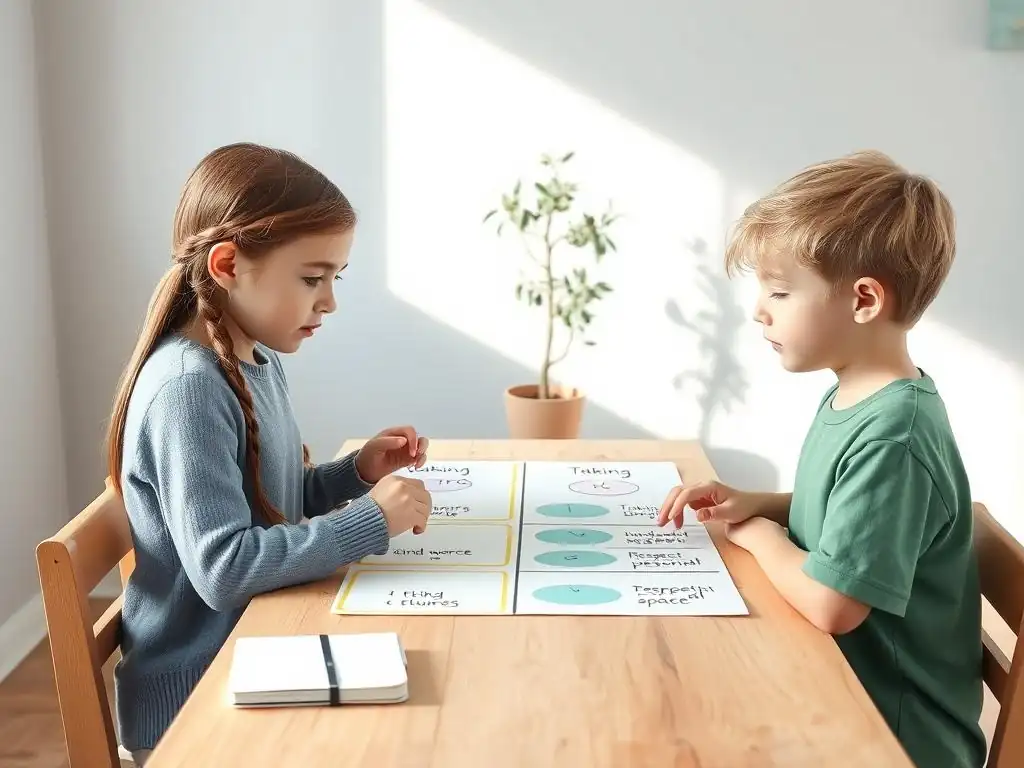
Clear boundaries and expectations are foundational for preventing frequent and intense sibling conflicts. Establishing rules about how siblings should treat each other, especially during disagreements, provides a framework for respectful interaction. Examples of such rules could include "No name-calling," "No hitting or physical aggression," "Listen when the other person is speaking," and "Speak in a calm voice."
These rules should be established proactively, ideally when everyone is calm, and reinforced consistently. Having explicit guidelines helps children understand what behavior is acceptable and unacceptable when they are upset. Posting these rules in a visible place can serve as a helpful reminder. Implementing and upholding these boundaries is a critical element of proactive family conflict resolution strategies.
No Borrowing Without Asking: Setting Boundaries During a Sibling Disagreement
Consider a situation where siblings frequently fight because one borrows the other's possessions without permission. A clear boundary, such as "You must ask permission before borrowing anything that belongs to your sibling," can significantly reduce this type of conflict. When a disagreement arises over this issue, the boundary provides a clear reference point for resolving the dispute.
For example, if one sibling takes a video game controller without asking and a fight ensues, the discussion can focus on the boundary that was crossed ("Remember our rule about borrowing?"). The resolution then involves acknowledging the boundary violation and discussing how to handle borrowing in the future (e.g., setting up a system for asking, agreeing on borrowing times). This specific example illustrates how setting clear boundaries serves as a powerful tool in everyday family conflict resolution strategies.
Step 5: Seeking Parental Mediation for Complex Sibling Conflicts
When to Consider Parental Intervention
While encouraging siblings to resolve their own minor disputes fosters independence and problem-solving skills, there are times when parental mediation is necessary and beneficial. Intervention is typically warranted when:
- The conflict is escalating rapidly and involves physical aggression or verbal abuse.
- Siblings are unable to find a resolution on their own despite trying.
- One sibling is significantly younger or less capable of articulating their needs than the other.
- The same conflict is recurring frequently without resolution.
- The emotional intensity is very high, and children are overwhelmed.
- There is a power imbalance, and one sibling is consistently being taken advantage of.
In these situations, stepping in is not enabling dependence but providing necessary support and guidance to navigate a situation beyond their current capabilities. Knowing when to intervene is a key skill for parents applying family conflict resolution strategies.
Facilitating Fair and Impartial Mediation
Effective parental mediation is not about deciding who is right or wrong, but about facilitating a process where siblings can communicate, understand each other, and work towards a mutually acceptable solution. Parents should act as neutral facilitators, ensuring each child has an opportunity to speak without interruption, helping them express their feelings and needs using "I" statements, and guiding them towards identifying the core issues.
A structured approach can be helpful:
- Set the stage: Gather everyone, state the purpose (to find a solution peacefully), and remind them of the rules (respectful language, no interrupting).
- Listen to each side: Allow each sibling to explain their perspective without interruption. Reflect back what you hear to ensure understanding ("So, you felt...").
- Identify the core issue: Help them articulate what the real problem is beneath the surface fight.
- Brainstorm solutions: Encourage siblings to come up with ideas for resolving the conflict. Write down all suggestions without judgment initially.
- Evaluate solutions: Discuss the pros and cons of each idea and help them choose a solution they can both agree on.
- Make a plan: Clearly state the agreed-upon solution and what each sibling will do.
- Follow up: Check in later to see how the plan is working.
This process models effective family conflict resolution strategies and empowers siblings to participate in finding solutions.
Practical Tips for Resolving Sibling Conflicts Peacefully
Creating a Safe and Supportive Environment for Sibling Discussions
A fundamental aspect of fostering peaceful family conflict resolution strategies is creating an environment where siblings feel safe to express themselves and work through disagreements. This means ensuring discussions happen in a calm space, free from distractions, and where children feel heard and respected. Parents play a crucial role by remaining calm themselves, even when the situation is tense, and by demonstrating patience.
It's also important to communicate that conflict is a normal part of relationships and that the goal isn't to never disagree, but to learn how to disagree constructively. This supportive atmosphere encourages siblings to approach conflict resolution as a collaborative effort rather than a battle to be won.
Taking a Break When Emotions Run High
When emotions are intense – when siblings are yelling, crying, or becoming physically aggressive – it's nearly impossible to have a productive conversation. One of the most practical family conflict resolution strategies is knowing when to pause. Encourage or require siblings to take a break, separating for a set amount of time (e.g., 10-15 minutes) to calm down.
This "cool-down" period allows the emotional intensity to subside, making it possible for the rational part of the brain to re-engage. When they reconvene, they are better equipped to listen, think clearly, and work towards a solution. It's important that the break isn't framed as a punishment but as a necessary step to regain control and prepare for constructive communication.
Focusing on Solutions, Not Blame
As mentioned earlier, focusing on blame keeps siblings stuck in the problem. Shifting the focus to finding solutions is a powerful way to move forward. Once the core issue has been identified, guide siblings to brainstorm possible ways to resolve it. Encourage creative thinking and emphasize that the best solutions are often those that meet at least some of the needs of both parties.
For example, if the fight is over choosing a game, solutions could include taking turns, playing a different game they both enjoy, or even flipping a coin if they can agree that's fair. The process of collaborative problem-solving teaches valuable negotiation skills and reinforces the idea that they are on the same team, working against the problem, not against each other. This solution-oriented mindset is a cornerstone of effective family conflict resolution strategies.
Forgiveness and Reconciliation: Moving Forward After a Sibling Fight
After a conflict has been resolved and a solution agreed upon, encouraging forgiveness and reconciliation is vital for healing the relationship. This doesn't necessarily mean forgetting what happened, but choosing to let go of resentment and repair the connection. Simple acts like a sincere apology ("I'm sorry I took your toy without asking") and acceptance ("Thank you for apologizing, I accept") can go a long way.
Parents can model and encourage this process, emphasizing the importance of rebuilding trust and maintaining a loving relationship despite disagreements. Reconciliation might involve spending positive time together after the conflict is resolved, reminding siblings of their bond and shared history. This final step in the resolution process helps ensure that conflicts don't leave lasting scars on the sibling relationship, reinforcing positive family conflict resolution strategies.
Long-Term Sibling Conflict Resolution: Building Stronger Relationships

Fostering Open Communication and Trust Between Siblings
Building strong, resilient sibling relationships that can weather future disagreements requires fostering an environment of open communication and trust over the long term. Encourage siblings to talk to each other regularly, not just when there's a problem, but about their day, their interests, and their feelings. This builds a foundation of understanding and connection.
Trust is built through consistent, positive interactions and feeling safe to be vulnerable with each other. When siblings know they can talk openly without fear of judgment or ridicule, they are more likely to approach conflicts from a place of understanding and cooperation. Parents can facilitate this by modeling open communication themselves and creating opportunities for siblings to connect and share. This ongoing effort is crucial for embedding effective family conflict resolution strategies into the family culture.
Practicing Patience and Understanding
Patience and understanding are virtues that are essential for both parents and siblings in managing ongoing relationships and conflicts. Siblings will make mistakes, disagreements will happen again, and progress in conflict resolution skills may be gradual. Approaching these moments with patience means recognizing that learning takes time and effort.
Encouraging understanding involves reminding siblings (and ourselves) that everyone has bad days, different perspectives, and is learning. It's about extending grace and empathy even when it's difficult. Practicing patience and understanding helps to lower the emotional temperature during conflicts and reinforces the idea that the relationship is more important than winning an argument. These qualities are invaluable components of successful family conflict resolution strategies.
Celebrating Sibling Strengths and Positive Interactions
While conflicts are inevitable, it's equally important to focus on and celebrate the positive aspects of the sibling relationship. Acknowledging and praising instances of cooperation, kindness, support, and successful shared activities reinforces positive interactions and strengthens their bond. Highlighting each sibling's unique strengths and how they complement each other can foster mutual appreciation.
For example, if siblings successfully work together on a project or comfort each other after a difficult day, point it out and praise their teamwork or empathy. Creating positive shared experiences, whether through family activities or simply encouraging them to play together, builds a reservoir of positive feelings that can help buffer against the inevitable conflicts. This positive reinforcement is a vital, often overlooked, aspect of comprehensive family conflict resolution strategies.
Mastering Sibling Conflict Resolution Strategies for a Harmonious Home
Recap of Key Techniques for Peaceful Sibling Discussions
Mastering sibling conflict resolution strategies involves a combination of proactive measures and effective in-the-moment techniques. Key takeaways include understanding the root causes of conflict (attention, possessions, personality differences), recognizing the harm of yelling, and committing to peaceful approaches for better mental well-being.
Essential techniques for resolving conflicts include:
- Active listening and empathy: Truly hearing and validating each other's feelings.
- Identifying core issues: Looking beyond the surface to understand underlying needs.
- Constructive communication: Using "I" statements and avoiding blame.
- Setting boundaries: Establishing clear rules for interaction.
- Parental mediation: Facilitating resolutions when siblings can't manage alone.
- Taking breaks: Stepping away when emotions are high.
- Focusing on solutions: Collaboratively finding ways to move forward.
- Forgiveness: Repairing the relationship after a disagreement.
These strategies, practiced consistently, form the foundation for a more peaceful and harmonious home environment.
Resources for Further Learning About Sibling Communication
Developing expertise in family conflict resolution strategies is an ongoing process. Numerous resources are available to deepen understanding and acquire more skills. Books on sibling relationships and parenting often offer practical advice and specific scenarios. Websites and organizations dedicated to child development and family dynamics provide articles, webinars, and workshops on effective communication and conflict management techniques.
Consulting with a family therapist or counselor can also provide tailored support for persistent or complex sibling conflicts. These professionals can offer personalized strategies and help families navigate challenging dynamics. Investing time in learning and practicing these skills is one of the most valuable things families can do to strengthen bonds and promote mental well-being.
Frequently Asked Questions
How can I start implementing family conflict resolution strategies when my family is used to yelling?
Start slowly by introducing the idea of calm communication. Suggest a "time-out" when emotions escalate to allow everyone to cool down before continuing the discussion.
What are some effective communication techniques for resolving family arguments?
Focus on active listening and "I" statements. Avoid blaming language and try to understand the other person's perspective, even if you disagree.
How do I handle a family member who refuses to participate in conflict resolution?
Acknowledge their feelings but maintain boundaries. You can still practice self-regulation and use calm communication on your end, even if they don't reciprocate.
What resources are available if our family conflicts are too severe to resolve on our own?
Consider seeking professional help from a therapist or counselor specializing in family dynamics. Many resources are available online and in your community.
How important is it to address family conflicts proactively instead of ignoring them?
Addressing conflicts early can prevent them from escalating into bigger problems. Open communication and early intervention are crucial for maintaining a healthy family dynamic.
Final Reflection: The Quiet Strength of Peaceful Resolution
The ability to navigate family conflict without resorting to yelling is not just a desirable skill; it's a fundamental cornerstone of healthy family dynamics. In a world increasingly characterized by instant communication and heightened emotional reactivity, the conscious choice to de-escalate conflict through calm dialogue is more crucial than ever. This quiet strength, cultivated through mindful communication and empathy, fosters stronger bonds and a more peaceful home environment.
The impact of unresolved family conflict reverberates through generations, shaping our understanding of relationships and influencing our own communication styles. The family is the first temple where we learn to love, to forgive, and to resolve conflicts peacefully. If this temple is fractured, it casts a long shadow on our lives.
The lessons learned within our families, whether positive or negative, profoundly shape our adult relationships and our capacity for empathy. This article's exploration of alternative conflict resolution strategies is not just about resolving immediate disputes; it's about building a legacy of peaceful communication and understanding.
Consider the power you hold in shaping the future of your family relationships. By actively choosing to implement even one of the strategies discussed – whether it's active listening, empathetic validation, or setting healthy boundaries – you are investing in a more harmonious and loving future. Don't underestimate the ripple effect of your actions. Embrace the challenge of peaceful communication, and watch as your family flourishes in the quiet strength of understanding and mutual respect.
Unlock Your Family's Harmony: Start Communicating Differently Today!
Thanks for taking the time to explore healthier ways to navigate family disagreements. You've learned valuable tools to foster understanding and connection. Now it's time to put them into practice!
- Implement one new communication strategy from the article this week. Even a small change can make a big difference. Try focusing on "I" statements during your next discussion.
- Share this article with a friend or family member who might benefit from these tips. Helping others is a great way to reinforce what you've learned.
- Consider joining our online forum (coming soon!) to connect with other parents and share your experiences and insights on resolving conflict peacefully. Let's build a supportive community together!
What's one small step you can take today to improve communication within your family?