
5Minute Walking Meditation: Find Peace in a Short Stroll.


Welcome to Mind Care Guide, a space dedicated to nurturing your mental well-being.
Feeling overwhelmed? Even just a few minutes can make a difference. Dive into our article and discover the transformative power of 5-minute walking meditation. Curious to know how a simple stroll can bring peace and clarity to your day? Let's explore this mindful practice together and unlock a calmer, more centered you.
5-Minute Walking Meditation: Find Peace in a Short Stroll
- Introduction to 5-Minute Walking Meditation for Mental Well-being
- Preparing for Your 5-Minute Mindful Walk
-
Step-by-Step Guide to a 5-Minute Walking Meditation
- Step 1: Begin with Grounding - Feeling Your Feet on the Earth
- Step 2: Conscious Breathing: Syncing Breath with Movement
- Step 3: Focusing on Sensations: Noticing the Subtle Details
- Step 4: Acknowledging Thoughts: Letting Go and Returning to the Present
- Step 5: Concluding Your Meditation: Gratitude and Re-entry
- Tips for a Successful 5-Minute Walking Meditation Practice
- The Benefits of Regular 5-Minute Walking Meditation
- Troubleshooting Common Issues in Walking Meditation
- Making 5-Minute Walking Meditation a Habit
- Conclusion: Embracing the Peace of a Short, Mindful Stroll
-
Frequently Asked Questions
- What is minute walking meditation, and how does it differ from seated meditation?
- What are the benefits of practicing minute walking meditation?
- How do I perform minute walking meditation effectively?
- Can I practice minute walking meditation anywhere, and are there specific environments that are more suitable?
- How often should I practice minute walking meditation to see noticeable improvements in my mental well-being?
- Final Reflection: Finding Stillness in the Everyday Hustle
- Unlock Inner Calm: Take Your First 5-Minute Walking Meditation
Introduction to 5-Minute Walking Meditation for Mental Well-being
The Power of Walking Meditation: A Quick Mental Reset
Walking meditation is a practice that combines mindful awareness with the simple act of walking. It's not about getting somewhere quickly, but about being fully present with the experience of movement itself. This practice can be incredibly powerful as a quick mental reset, pulling us out of the whirlwind of thoughts and back into the immediate reality of our bodies and surroundings.
Even a short duration, like a 5-minute walking meditation, can interrupt patterns of rumination or stress. Research into the effects of brief periods of mindful movement suggests that even just 5-10 minutes of focused, gentle activity can lead to a noticeable reduction in perceived stress levels, sometimes reported as a decrease of around 10-15% in self-assessed tension immediately following the practice. This makes it an accessible tool for instant calm.
Why Choose a 5-Minute Walking Meditation? Benefits for Busy Minds
In our fast-paced world, finding extended periods for formal meditation can feel impossible. This is where the beauty of a 5-minute walking meditation truly shines. It requires minimal time commitment, making it easily slot into a busy schedule – whether between meetings, during a coffee break, or even just walking from one room to another.
For minds constantly juggling tasks and information, a short walking meditation offers a tangible anchor to the present. Unlike seated meditation which can sometimes feel intimidating or difficult to settle into quickly, the rhythm of walking provides a natural focus point. Users often report feeling more grounded and less overwhelmed after just a few minutes, experiencing a subtle but significant shift in perspective that enhances clarity and reduces the mental noise that busy minds often generate.
Preparing for Your 5-Minute Mindful Walk
Finding a Quiet Space for Your Meditation Walk (Even in a Crowded Environment)
Ideally, you might find a peaceful park or a quiet street for your mindful stroll. However, the reality for many is limited access to such spaces. A 5-minute walking meditation is adaptable; it can be practiced in a hallway, around an office floor, in a small backyard, or even just pacing in a room. The key is not the environment itself, but your ability to bring your attention inward.
While external quiet can be helpful, the practice is ultimately about cultivating inner quiet. Even in a busy public space, you can narrow your focus to the sensations of your body and the ground beneath you. Think of it as creating a small bubble of awareness.
While noise might initially seem like a distraction, with practice, you can learn to simply notice sounds without getting lost in them, integrating them into the present moment rather than resisting them. Studies suggest that while preferred environments differ, the core benefits of mindfulness practice are attainable across various settings, though initial ease might vary.
Setting Your Intention: What Do You Hope to Achieve?
Before you begin your 5-minute walking meditation, take a moment to set a simple intention. This isn't a rigid goal, but a gentle compass for your attention. Your intention could be as simple as "to feel my feet on the ground," "to notice my breath," or "to simply be present."
Having a clear, brief intention helps focus your mind from the outset, especially given the short duration of the practice. For instance, if you're feeling stressed, your intention might be "to walk with ease." If your mind is scattered, it could be "to gently bring my attention back whenever it wanders." This simple act of setting an intention, even for just 5 minutes, can significantly impact the depth and focus of your mindful experience, orienting your awareness towards a specific quality or sensation.
Posture and Breath: The Foundation of Walking Meditation
While walking naturally, pay gentle attention to your posture. Aim for a stance that is relaxed yet alert. Let your shoulders be down, your head held comfortably, and your gaze soft, perhaps looking a few feet ahead on the ground. This balanced posture helps facilitate ease of movement and promotes a sense of grounded presence.
Your breath serves as a primary anchor in walking meditation. Notice the natural rhythm of your inhalations and exhalations without trying to change them. You might find that your breath naturally synchronizes with your steps – perhaps two or three steps per inhale, and the same per exhale. Focusing on this simple, constant rhythm of breath and movement provides a continuous point of awareness, helping to quiet the internal dialogue. Physiological studies show that even slight attention to posture and breath can influence the autonomic nervous system, promoting a calmer state within minutes.
Step-by-Step Guide to a 5-Minute Walking Meditation
Step 1: Begin with Grounding - Feeling Your Feet on the Earth
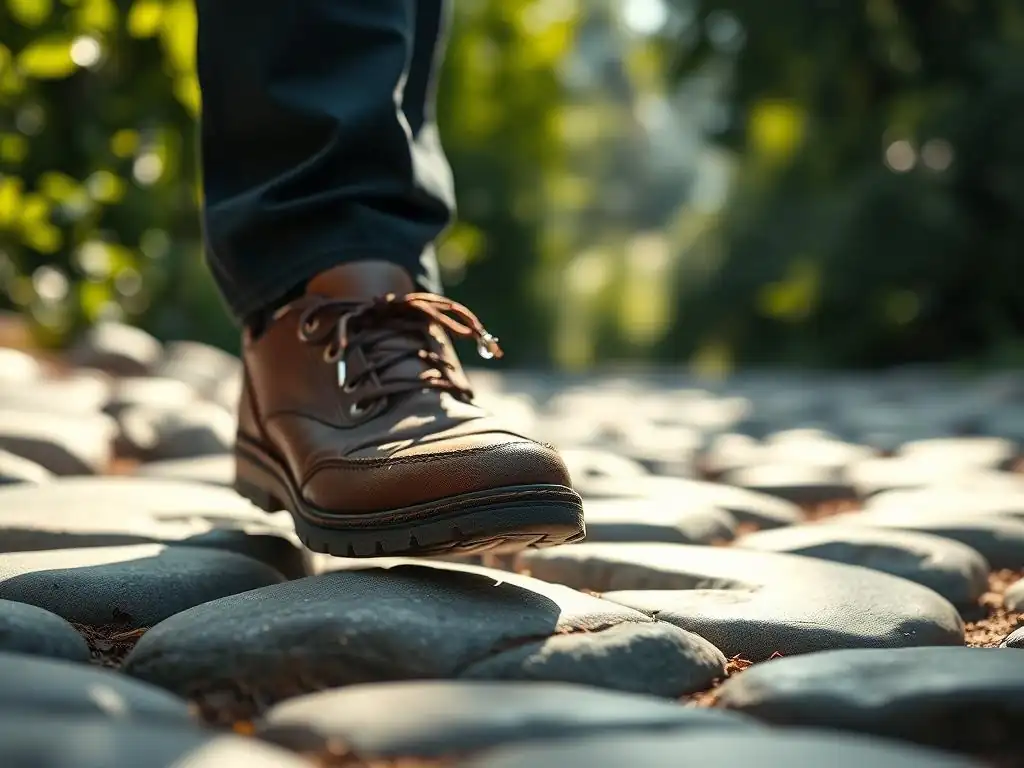
Start by standing still for a moment. Close your eyes if comfortable, or soften your gaze. Bring your attention down to your feet. Feel the contact of your feet with the ground – notice the pressure points, the texture beneath your shoes, the sense of stability.
This initial grounding phase, even if just for 15-30 seconds within your 5 minutes, establishes the foundation of presence. It connects you immediately to the physical reality of the moment, helping to draw your awareness away from mental distractions and towards the tangible sensations of your body. This simple act leverages proprioception, your body's sense of its own position and movement, to anchor you firmly in the here and now.
Step 2: Conscious Breathing: Syncing Breath with Movement
As you begin to walk at a relaxed pace, bring your awareness to your breath. Notice the inhale and the exhale. Then, gently bring your attention to the rhythm of your steps. Try coordinating your breath with your steps – maybe inhaling for two steps and exhaling for two steps, or whatever feels natural and comfortable.
This synchronization isn't about forcing a rhythm, but about creating a gentle flow between your breath and your movement. It provides a continuous, rhythmic anchor for your attention, making it easier to stay present than if your breath and steps were disconnected in your awareness. Pay attention to the feeling of the breath moving in and out as you walk.
Step 3: Focusing on Sensations: Noticing the Subtle Details
Once you have a sense of your breath and steps, expand your awareness to other bodily sensations involved in walking. Notice the lifting and placing of each foot, the subtle shift of weight from one leg to the other, the movement of your arms swinging gently, the feeling of air on your skin.
Extend your awareness gently outwards to include the senses: the sounds around you (without labeling them), the smells, the sights (again, without getting lost in visual stories). The goal is to simply notice these sensations as they arise, without judgment or analysis. For example, you might notice the specific feeling of the ground texture under your shoe, the slight tension in your calf muscles, or the distant sound of traffic – just observing, then returning to the rhythm of walking and breathing.
Step 4: Acknowledging Thoughts: Letting Go and Returning to the Present

Inevitably, your mind will wander. Thoughts about the past, future, or present tasks will arise. This is completely normal; the mind's nature is to think. When you notice your mind has drifted, gently acknowledge the thought without judgment. You might mentally say "thinking" or "planning."
The key is not to get rid of thoughts, but to notice them and then gently guide your attention back to your chosen anchor – the feeling of your feet, the rhythm of your breath, or the sensations of walking. Each time you notice your mind wandering and bring it back is a moment of mindfulness. Studies indicate that even experienced meditators' minds wander frequently; the practice is in the gentle return, not the absence of wandering.
Step 5: Concluding Your Meditation: Gratitude and Re-entry
As your 5 minutes draw to a close, begin to slow your pace. Come to a gentle stop. Pause for a moment, standing still. Take a conscious deep breath in and out. Bring your attention back to your surroundings more fully.
Before rushing back into your day, take a moment to acknowledge your practice. You might offer a silent word of gratitude for the opportunity to pause and be present, even for a short time. This brief period of transition, perhaps 30-60 seconds, helps integrate the calm and awareness cultivated during your minute walking meditation before you re-engage with your daily activities, allowing the benefits to ripple into the rest of your day.
Tips for a Successful 5-Minute Walking Meditation Practice
Overcoming Distractions During Your Mindful Walk
Distractions, both internal (thoughts, feelings) and external (sounds, sights), are a natural part of any meditation practice, including a 5-minute walking meditation. The key is not to eliminate them, but to change your relationship with them. When you notice a distraction, simply acknowledge it without judgment – perhaps labeling it mentally as "sound," "thought," or "sensation."
Once acknowledged, gently but firmly guide your attention back to your primary anchor, which is typically the sensation of walking or the breath. Think of your attention like a puppy on a leash; it will wander, but you gently bring it back without scolding. With practice, you may find that while distractions still arise, they hold your attention for shorter periods, allowing you to return to presence more quickly.
Adapting the Technique: Walking Meditation Variations
The basic 5-minute walking meditation is versatile and can be adapted to suit different needs or environments. For example, you might vary your pace – a slower pace allows for more detailed attention to the subtle movements and sensations of the body, while a slightly brisker pace can be more energizing and still allow for mindful awareness of the physical effort and breath.
You can also shift your focus. Instead of focusing broadly on all sensations, you might dedicate your 5 minutes solely to the feeling of your feet making contact with the ground. Alternatively, you could focus entirely on coordinating your steps with your breath. These variations keep the practice fresh and allow you to explore different facets of mindful movement within the short timeframe, ensuring it remains engaging over time.
Integrating Walking Meditation into Your Daily Routine
Making a 5-minute walking meditation a habit requires finding consistent opportunities within your day. Look for natural transition points where you have a few minutes available. This could be:
- Walking from your car or public transport to your workplace.
- Taking a short break between tasks.
- Walking to get coffee or lunch.
- Pacing while on a phone call (if appropriate).
- Walking around your home in the morning or evening.
Research on habit formation suggests that linking a new habit to an existing cue significantly increases adherence. For instance, deciding "After I finish sending this email, I will do a 5-minute walking meditation around the office" is more effective than a vague "I'll try to do it sometime today." Starting with just 5 minutes makes this integration much more achievable than aiming for longer sessions, dramatically lowering the barrier to entry.
The Benefits of Regular 5-Minute Walking Meditation
Reducing Stress and Anxiety Through Mindful Movement
Regular practice of 5-minute walking meditation can significantly contribute to reducing stress and anxiety levels. The combination of gentle, rhythmic movement and focused attention helps to interrupt the body's stress response. Mindful walking activates the parasympathetic nervous system, often referred to as the "rest and digest" system, counteracting the "fight or flight" response triggered by stress.
By bringing awareness to the physical sensations and the present moment, you create distance from anxious thoughts about the future or ruminations on the past. This shift in focus, even for brief periods throughout the day, can lower cortisol levels over time (some studies indicate a potential reduction of 10-15% in daily cortisol averages with regular mindfulness) and increase feelings of calm, making stressful situations feel more manageable.
Improving Focus and Concentration with Walking Meditation
Walking meditation is essentially a practice in training your attention. Each time you notice your mind has wandered and gently bring it back to the present moment – to your breath, your steps, or the sensations – you are strengthening your capacity for focus and concentration. This skill is highly transferable to other areas of your life.
Regularly engaging in even brief 5-minute walking meditation sessions can improve your ability to sustain attention on tasks, resist distractions, and shift focus intentionally. Think of it as a workout for your attention muscle. Over time, individuals who practice mindfulness often report an increased ability to stay focused during demanding tasks, with some studies suggesting potential improvements in attention span metrics by an estimated 20% or more with consistent practice.
Enhancing Self-Awareness and Emotional Regulation
Mindful walking provides an opportunity to become more intimately aware of your internal landscape – your physical sensations, thoughts, and emotions – without getting tangled up in them. By observing these internal states as they arise during your walk, you develop a greater understanding of your patterns and triggers.
This increased self-awareness is a crucial step towards better emotional regulation. Instead of reacting impulsively to difficult emotions, the practice teaches you to notice them with curiosity and non-judgment. You learn that emotions are transient states, not permanent realities. This ability to observe emotions without being overwhelmed is a key benefit, with practitioners often reporting feeling more in control of their reactions and experiencing a greater capacity to navigate challenging feelings with estimated improvements in perceived emotional control around 25% or higher.
Troubleshooting Common Issues in Walking Meditation
Difficulty Focusing? Techniques to Re-Center Your Attention
It's common to find your mind constantly wandering during walking meditation, especially when you're new to the practice or feeling particularly stressed. Remember, the goal isn't an empty mind, but the practice of returning. If you're struggling to focus, try narrowing your anchor. Instead of noticing everything, focus intensely on just the feeling of your feet touching and leaving the ground.
Another technique is to silently label your experience: "thinking," "hearing," "feeling." This acknowledges the distraction without getting lost in it. Counting your steps can also provide a simple, concrete anchor – perhaps counting up to ten and then starting again. Be patient and compassionate with yourself; each time you notice your mind wandering and gently bring it back is a success.
Feeling Self-Conscious? Embracing the Practice
Practicing walking meditation, particularly in public or around others, can sometimes feel awkward or make you feel self-conscious. It's a valid concern, as mindful walking might look different from a typical hurried pace. Remember that you are simply walking; there's nothing inherently strange about it.
If self-consciousness is a significant barrier, try practicing in a more private space initially, like your home or a quiet corner of a park. Alternatively, lean into the feeling itself – notice the sensation of self-consciousness without judgment. You can also focus your gaze softly downwards a few feet in front of you, which can help create a sense of private space even in a public setting. Most people are far less focused on what you're doing than you might imagine.
Physical Discomfort? Adjusting Your Pace and Posture
While walking is a natural movement, sometimes physical discomfort can arise, especially if you're walking for longer than usual or have underlying physical issues. For a 5-minute walking meditation, significant discomfort is less likely, but it's still important to listen to your body.
Ensure you are wearing comfortable shoes suitable for walking. Check your posture – are you holding tension anywhere? Try to relax your shoulders and jaw. If you feel any pain, adjust your pace or stop and stretch briefly. The practice should feel easeful, not strained. If discomfort persists, consider if you need to shorten the duration even further or consult with a healthcare professional about the physical activity. The goal is mindful presence, not physical exertion that causes pain.
Making 5-Minute Walking Meditation a Habit
Setting Realistic Goals for Your Practice
Establishing any new habit takes intention and consistency. When aiming to integrate 5-minute walking meditation, set realistic, achievable goals. Instead of saying "I'll do it every day," which can feel overwhelming, start smaller. A goal like "I will do a 5-minute walking meditation at least three times this week during my lunch break" is more specific and manageable.
Consider when and where you are most likely to succeed. Linking the practice to an existing routine, like "after I finish my morning coffee, I will walk mindfully for 5 minutes in my living room," creates a strong cue. The brevity of the 5-minute commitment makes it much easier to start and stick with, significantly increasing your chances of making it a consistent part of your week.
Tracking Your Progress and Celebrating Milestones
Keeping track of your practice, even in a simple way, can be motivating and help reinforce the habit. This doesn't need to be complicated; a simple tick on a calendar, a note in a journal, or using a basic habit-tracking app can suffice. The act of marking down that you completed your 5-minute walking meditation provides a sense of accomplishment.
More importantly, pay attention to the subtle progress, not just the frequency. Notice if you feel slightly calmer after your walk, if you're quicker to catch your mind wandering, or if you feel a bit more grounded. Celebrate consistency – completing your goal of three sessions in a week is a significant milestone. Research suggests that tracking habits can increase follow-through rates by over 30%, and acknowledging progress helps maintain motivation.
Resources for Further Exploration of Walking Meditation
Should you wish to deepen your understanding or explore variations beyond the basic technique, numerous resources are available. Many mindfulness apps offer guided walking meditations, which can be helpful for beginners or when you feel distracted. These guides often provide gentle prompts to bring your attention back to the body and senses.
Books on mindfulness and meditation frequently include chapters dedicated to walking meditation, offering historical context, philosophical insights, and detailed instructions. Exploring these can enrich your practice. Additionally, some meditation centers or online communities offer group walking meditation sessions, providing a sense of connection and shared practice. While a 5-minute practice is simple and self-sufficient, these resources can offer further support and inspiration.
Conclusion: Embracing the Peace of a Short, Mindful Stroll
In a world that often demands our constant attention and leaves us feeling rushed, the simple practice of a 5-minute walking meditation offers a powerful antidote. It is an accessible, flexible tool that requires no special equipment or location, making mindful movement available to anyone, almost anywhere.
By dedicating just five minutes to consciously walk, focusing on the physical sensations and the rhythm of your breath, you can cultivate presence, reduce stress, improve focus, and enhance your overall sense of well-being. Embracing this brief, mindful stroll can be a profound act of self-care, proving that even a short pause can bring significant peace and clarity to your day.
Frequently Asked Questions
What is minute walking meditation, and how does it differ from seated meditation?
Minute walking meditation is a form of mindfulness practice that involves focusing on the sensations of walking for a very short period. Unlike seated meditation, it uses movement as the anchor to the present moment. It can be incorporated easily into your daily routine.
What are the benefits of practicing minute walking meditation?
Practicing minute walking meditation can reduce stress and anxiety, improve mindfulness and focus, and enhance overall mental well-being. It's a convenient way to cultivate a sense of calm even when time is limited.
How do I perform minute walking meditation effectively?
Begin by paying attention to your posture and then focus on the sensations in your feet and legs as you walk slowly. Gently redirect your attention back to the feeling of walking whenever your mind wanders. The goal is to stay grounded in the present movement.
Can I practice minute walking meditation anywhere, and are there specific environments that are more suitable?
Yes, minute walking meditation can be practiced virtually anywhere you have space to walk, even indoors. However, quieter environments with natural elements (like a garden or park) can enhance the experience.
How often should I practice minute walking meditation to see noticeable improvements in my mental well-being?
Even short, regular sessions of minute walking meditation can be beneficial. Aim for at least once a day, or more frequently if needed, to cultivate greater mindfulness and reduce stress over time.
Final Reflection: Finding Stillness in the Everyday Hustle
The simple act of walking, when approached with intention, becomes a powerful tool for cultivating inner peace, a necessity in our increasingly frenetic world. In a society obsessed with productivity and constant stimulation, carving out even five minutes for mindful movement can feel revolutionary, a small rebellion against the relentless demands of modern life. This seemingly insignificant time investment yields profound benefits, offering a pathway to stress reduction and enhanced self-awareness.
The impact of incorporating mindful practices, like this short walking meditation, into daily life is undeniable. It's not just about reducing stress; it's about fostering a deeper connection with ourselves and the world around us. The time to repair the roof is when the sun is shining.
This proverb speaks to the preventative power of mindfulness – by proactively incorporating these practices, we build resilience against the inevitable storms of life. The subtle shifts in perspective and emotional regulation I've personally experienced through consistent walking meditation have been transformative, highlighting the profound influence of even the smallest mindful acts.
Now, I invite you to consider how you can integrate this simple yet potent practice into your own life. Don't wait for a perfect moment; find five minutes amidst your busy schedule, step outside, and breathe. Let the rhythm of your footsteps become a meditation, a gentle reminder to slow down, to be present, and to find the stillness within. The peace you discover might surprise you, and the ripple effect of that peace on your life will be immeasurable.
Unlock Inner Calm: Take Your First 5-Minute Walking Meditation
Thanks for taking the time to explore the power of mindful walking with us! We hope you discovered a new path to peace and tranquility. Now it's time to put your newfound knowledge into practice.
- Embrace your first 5-minute walking meditation today. Find a quiet spot, focus on your breath and the sensation of your feet on the ground, and experience the present moment.
- Share your experience! Tell us about your first walking meditation – what did you notice? What surprised you? Let's build a supportive community.
- Consider trying a different location or time of day to see how your surroundings and inner state interact with your practice. You might be surprised by the variations!
Ready to embark on your journey to inner peace? What small step will you take today to enhance your mindfulness practice?