
Deepen Your Practice: Essential Tips for Effective Mindful Walking.

Welcome to Mind Care Guide, a sanctuary for your mental well-being.
Feeling overwhelmed by anxiety? You're not alone. Discover the power of mindful walking and how it can become a potent tool for anxiety relief. Our latest article, "Deepen Your Practice: Essential Tips for Effective Mindful Walking," offers practical guidance to help you find peace and calm with each step. Ready to begin your journey towards a more tranquil mind? Let's walk together...
- Mindful Walking for Anxiety Relief: Deepen Your Practice
- Preparing for Your Mindful Walking Practice
-
Essential Tips for Effective Mindful Walking Meditation
- Tip 1: Focus on the Sensation of Your Feet on the Ground
- Tip 2: Pay Attention to Your Breath During Mindful Walking
- Tip 3: Observe Your Thoughts Without Judgment During Walking Meditation
- Tip 4: Expand Your Awareness to Your Surroundings (Gently)
- Tip 5: Practice Mindful Walking with Open Eyes: Enhancing Awareness
- Overcoming Challenges in Mindful Walking for Anxiety
- Integrating Mindful Walking into Your Daily Routine for Long-Term Anxiety Relief
- Advanced Techniques for Deeper Mindful Walking
- Mindful Walking and Anxiety Relief: A Recap
-
Frequently Asked Questions
- How can mindful walking specifically help with anxiety?
- What are some key techniques to deepen my mindful walking practice?
- How often should I practice mindful walking to experience anxiety relief?
- What if my mind wanders during mindful walking? Is it still effective?
- Are there any specific environments that are better for mindful walking?
- Final Reflection: The Path to Peace Through Mindful Walking
- Unlock the Power of Mindful Walking: Start Your Journey Today!
Mindful Walking for Anxiety Relief: Deepen Your Practice
What is Mindful Walking Meditation?
Mindful walking meditation is a practice that involves intentionally bringing your full attention to the experience of walking. Unlike casual strolling or walking for exercise, the primary goal is not to reach a destination or burn calories, but to cultivate presence and awareness in each step. It's a form of moving meditation that anchors you to the present moment through the sensations of your body and the environment around you. This practice can be particularly effective for those seeking mindful walking anxiety relief, offering a tangible way to step out of swirling thoughts and into immediate physical reality.
This technique can be performed anywhere you can walk slowly and safely, whether it's a short path in your backyard, a park loop, or even a long hallway indoors. The key is to slow down, pay attention to the simple act of putting one foot in front of the other, and observe whatever arises in your awareness without judgment. It’s a portable mindfulness practice, accessible to most people regardless of fitness level, making it a powerful tool for managing stress and finding anxiety relief through mindful walking.
How Mindful Walking Reduces Anxiety: The Science Behind It
The effectiveness of mindful walking in reducing anxiety stems from its impact on both the mind and body. From a physiological perspective, gentle rhythmic movement like walking can help regulate the nervous system. Studies on exercise and anxiety consistently show that even moderate activity can lower stress hormones like cortisol and adrenaline. Combining this physical effect with mindfulness amplifies the benefit; the intentional focus on the present moment interrupts the cycle of anxious rumination, which often involves dwelling on past worries or future fears.
Neuroscientifically, mindful walking engages areas of the brain associated with attention and emotional regulation, such as the prefrontal cortex, while potentially reducing activity in the amygdala, the brain's fear center. By shifting focus from internal worry to external or bodily sensations, you train your brain to disengage from anxious thought patterns. Research suggests that regular mindfulness practices, including walking meditation, can lead to structural changes in the brain over time, potentially increasing resilience to stress and improving mood regulation, thereby providing long-term mindful walking anxiety relief.
Mindful Walking vs. Traditional Walking: Key Differences
While both mindful walking and traditional walking involve putting one foot in front of the other, their intentions and practices differ significantly. Traditional walking is often goal-oriented – getting to work, running errands, or achieving a specific fitness target like steps or distance. The mind is typically engaged in planning, problem-solving, listening to podcasts, or social interaction. The focus is external or cognitive, not on the internal experience of walking itself.
Mindful walking, conversely, is process-oriented. The purpose is the walking itself and the cultivation of awareness within that process. The pace is usually slower, deliberate, and the attention is directed inward towards bodily sensations (feet touching the ground, leg movement) and outward towards immediate, non-judgmental observation of the environment (sights, sounds, smells). This intentional shift in focus is what makes it a meditative practice and a distinct method for achieving mindful walking anxiety relief compared to simply going for a walk.
Preparing for Your Mindful Walking Practice
Choosing the Right Environment for Mindful Walking
Selecting an appropriate environment is crucial for establishing a calm and focused mindful walking practice, especially when the goal is mindful walking anxiety relief. Ideally, choose a place that feels safe, relatively quiet, and free from major distractions. A park path, a quiet street in your neighborhood, a garden, or even a spacious room indoors can work. The key is to minimize external demands and potential interruptions that might pull your attention away from the practice.
Consider the time of day as well. Early mornings or late evenings might offer more solitude. If noise is unavoidable, recognize that part of the practice is observing all sensations, including sounds, without getting lost in them. For many, a natural setting like a park or trail can be particularly soothing, offering gentle sensory input like rustling leaves or birdsong that can aid in grounding and enhance the experience of mindful walking for anxiety relief.
Setting Intentions for Your Mindful Walk: Focus on Anxiety Reduction
Before you begin your mindful walk, take a moment to set a clear intention. This isn't about setting a goal to "eliminate" anxiety, but rather about approaching the practice with a specific focus. Your intention might be to simply be present with each step, to notice sensations without judgment, or specifically, to offer kindness and awareness to any feelings of anxiety that arise. Stating your intention silently, such as "I intend to walk mindfully and observe my experience with compassion," helps orient your mind towards the purpose of the walk.
Focusing your intention on anxiety reduction means acknowledging that you are using this time as a tool for self-care and regulation. It frames the walk not just as an activity, but as a deliberate practice aimed at finding relief. This conscious decision to engage in mindful walking for anxiety relief can strengthen your commitment and help you stay present even when distractions arise. It's a gentle reminder of why you are walking mindfully.
Proper Posture and Breathing Techniques for Mindful Walking
While mindful walking is a gentle practice, mindful attention to your posture and breath can significantly enhance its effectiveness, particularly for mindful walking anxiety relief. Stand or walk with your spine gently lengthened, shoulders relaxed, and head balanced comfortably. Avoid slouching or tensing up. Let your arms swing naturally by your sides. This relaxed yet upright posture allows for easier breathing and a greater sense of ease in the body, which is beneficial when dealing with physical manifestations of anxiety.
As you walk, bring your awareness to your breath. You don't need to force or control it, just observe its natural rhythm. Notice the inhale and the exhale. Perhaps coordinate your breath with your steps – maybe two or three steps per inhale and the same per exhale. When anxiety is present, breathing often becomes shallow and rapid. Gently focusing on your breath during the walk can help slow it down, signaling to your nervous system that you are safe and promoting a sense of calm that supports mindful walking anxiety relief.
Essential Tips for Effective Mindful Walking Meditation

Tip 1: Focus on the Sensation of Your Feet on the Ground
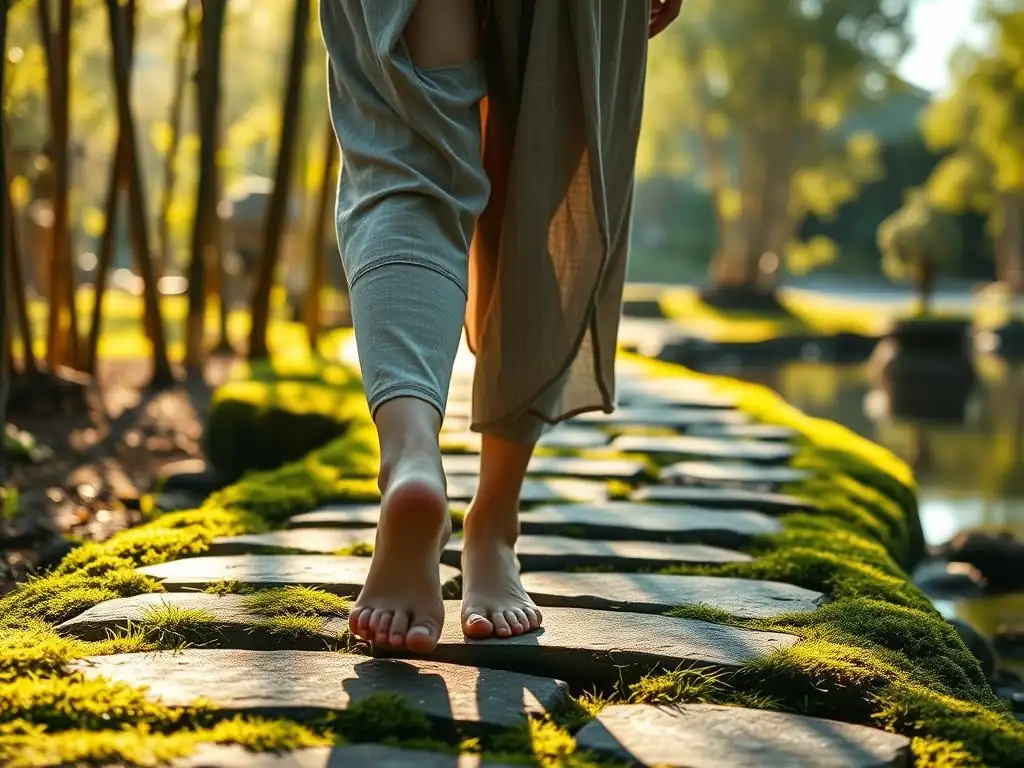
One of the most fundamental anchors in mindful walking meditation is the sensation of your feet touching the ground. As you walk, bring your attention fully to this physical experience. Notice the feeling of your heel lifting off the ground, the foot rolling through the step, the ball of your foot making contact, and finally, the heel settling down. Pay attention to the pressure, the texture (if walking on grass, pavement, etc. ), and the temperature. This simple focus provides a powerful anchor to the present moment.
This practice is particularly useful for mindful walking anxiety relief because it immediately pulls your awareness out of abstract, worrying thoughts and into tangible, physical reality. When your mind is consumed by "what ifs," shifting attention to the concrete sensation of your feet grounding you can be incredibly calming. It's a constant, accessible point of focus throughout your walk, allowing you to repeatedly return to the present moment whenever your mind wanders.
Tip 2: Pay Attention to Your Breath During Mindful Walking
Your breath is another vital anchor for cultivating presence during mindful walking. While focusing on your feet, also gently bring awareness to your breathing. Notice the air entering and leaving your body. Is it shallow or deep? Fast or slow? Again, there's no need to change your breath, just observe it as it naturally is. You can synchronize your breath with your steps, perhaps inhaling for a few steps and exhaling for the same number, creating a gentle rhythm.
Paying attention to your breath while walking mindfully helps to soothe the nervous system, which is often activated during periods of anxiety. A conscious awareness of the breath can help regulate its pace and depth, promoting relaxation. This combined focus on breath and movement is a core element of mindful walking anxiety relief, providing a dual anchor that keeps you grounded and present. When thoughts of worry arise, you can gently redirect your attention back to the simple, repetitive rhythm of your breath and steps.
Tip 3: Observe Your Thoughts Without Judgment During Walking Meditation
During your mindful walk, thoughts will inevitably arise – this is a natural function of the mind. The practice isn't about stopping thoughts, but about changing your relationship with them. As thoughts appear, notice them without getting swept away or judging them as "good" or "bad." You might label them mentally, perhaps "planning thought," "worry thought," or "memory," and then gently let them go, returning your attention to your primary anchors: your feet and breath.
This non-judgmental observation is crucial for mindful walking anxiety relief. Anxiety is often fueled by getting entangled in negative thought spirals. By practicing observing thoughts as transient mental events rather than absolute truths or urgent demands, you create distance from them. Imagine thoughts are like leaves floating down a stream; you see them, acknowledge them, but don't try to grab onto them. You simply return your focus to the experience of walking.
Tip 4: Expand Your Awareness to Your Surroundings (Gently)
Once you feel grounded by focusing on your feet and breath, you can gently expand your awareness to include your surroundings. This isn't about getting lost in external stimuli, but about observing the environment with a soft, open attention. Notice the sights – the colors of leaves, the patterns of pavement, the shapes of buildings. Notice the sounds – distant traffic, birds singing, your own footsteps. Notice smells – damp earth, blooming flowers, city air.
This expanded awareness connects you to the world outside your internal anxious narrative. It helps to broaden your perspective and reminds you that you are part of a larger, constantly changing environment. When seeking mindful walking anxiety relief, engaging with your surroundings in this gentle, non-analytical way can provide a refreshing shift in focus, preventing the practice from becoming too internally focused and potentially leading back to rumination. It's about being in the environment, not just moving through it.
Tip 5: Practice Mindful Walking with Open Eyes: Enhancing Awareness
Unlike some forms of seated meditation where closing the eyes is common, mindful walking is typically practiced with eyes open. This is essential for safety, especially if walking outdoors, but it also serves a meditative purpose: integrating mindfulness into everyday activity. Keeping your eyes open allows you to engage with the visual aspect of your surroundings, as mentioned in Tip 4, which can further anchor you in the present moment.
Maintaining an open, soft gaze allows you to observe without staring or getting fixated on any one thing. It's a relaxed way of taking in the visual field. This practice trains your ability to be mindful while interacting with the world, a critical skill for managing anxiety in daily life. Practicing mindful walking anxiety relief with open eyes helps bridge the gap between formal meditation practice and applying mindfulness in real-world situations.
Overcoming Challenges in Mindful Walking for Anxiety
Dealing with Distractions During Mindful Walking Meditation
Distractions are a normal part of any mindfulness practice, including mindful walking meditation, especially when you're seeking mindful walking anxiety relief. These can be external, like traffic noise or other people, or internal, like intrusive thoughts, worries, or physical discomfort. The key is not to eliminate distractions, but to gently acknowledge them without judgment and return your attention to your chosen anchors (feet, breath, surroundings). Think of it as a bicep curl for your attention muscle – each time you notice you've been distracted and gently redirect your focus, you strengthen your ability to stay present.
If a distraction is particularly persistent, you might briefly acknowledge it more fully, perhaps saying to yourself, "There is the sound of a siren," or "I'm noticing a thought about work." Then, consciously and kindly, guide your awareness back to the sensation of your feet or the rhythm of your breath. Remember that wandering is part of the process; the practice is in the returning. Be patient and compassionate with yourself, recognizing that every moment of returning is a success.
Managing Restlessness and Physical Discomfort While Walking
Sometimes, physical sensations like restlessness, stiffness, or minor discomfort can arise during mindful walking, which can be particularly challenging when trying to find mindful walking anxiety relief, as anxiety often manifests physically. Instead of ignoring or fighting these sensations, try to bring mindful awareness to them. Notice where the sensation is located in your body, its quality (e.g., tingling, ache, tightness), and its intensity. Breathe into the sensation without trying to make it go away.
If the discomfort is significant or increases, it's important to listen to your body. You might need to adjust your pace, modify your posture, or even pause your walk. However, for typical restlessness or mild discomfort, simply observing it with curiosity and acceptance can often reduce its intensity and prevent it from becoming a major distraction. This practice of being present with physical sensations builds tolerance for discomfort, a useful skill for managing the physical symptoms of anxiety.
Addressing Negative Thoughts and Emotions That Arise
During mindful walking, you might become aware of negative thoughts or difficult emotions, such as fear, sadness, or frustration, especially if you are practicing for mindful walking anxiety relief. When these arise, the practice is to meet them with awareness and compassion, rather than pushing them away or getting lost in them. Acknowledge the thought or emotion – perhaps name it silently, "There is fear," or "I'm noticing sadness." Then, allow yourself to feel the physical sensations associated with that emotion in your body, without judgment.
After acknowledging and feeling the sensation, gently guide your attention back to your walking anchors. It's like giving the thought or emotion a brief moment of recognition before shifting your focus back to the present moment experience of walking. This process teaches you that you can experience difficult internal states without being consumed by them. Regularly practicing this during mindful walking can build your capacity to navigate challenging thoughts and emotions with greater ease and less reactivity, significantly contributing to long-term anxiety relief.
Integrating Mindful Walking into Your Daily Routine for Long-Term Anxiety Relief

Starting Small: Short Mindful Walking Sessions
Integrating mindful walking into your daily life for long-term anxiety relief doesn't require hours of dedicated time. Begin with short sessions, perhaps just 5 or 10 minutes. Even a brief period of mindful walking can help interrupt anxious thought patterns and bring a sense of calm. You can practice while walking to get the mail, moving between rooms in your house, or taking a short break during your workday. The key is consistency, not duration.
Committing to short, manageable sessions makes the practice less daunting and increases the likelihood that you will stick with it. As you become more comfortable and experience the benefits of mindful walking anxiety relief, you can gradually increase the length of your walks. Starting small builds momentum and makes mindful walking a sustainable habit rather than an overwhelming task.
Scheduling Mindful Walking for Consistent Anxiety Management
Consistency is key to reaping the full benefits of mindful walking for anxiety relief. Try to schedule your mindful walks, just as you would any other important appointment. This could be first thing in the morning, during your lunch break, or in the evening to unwind. Finding a regular time slot helps establish the practice as a non-negotiable part of your routine. Even on busy days, aim for that short 5-minute walk.
Using reminders, whether on your phone or a written schedule, can help ensure you don't forget. Consider pairing your mindful walk with an existing habit, like doing it immediately after finishing your first cup of coffee or before starting dinner. Making it a regular, scheduled activity reinforces its importance for your mental well-being and ensures you consistently engage in this valuable practice for managing anxiety.
Combining Mindful Walking with Other Mindfulness Practices
Mindful walking anxiety relief can be enhanced by integrating it with other mindfulness techniques. For example, you might start your day with a short seated meditation to cultivate stillness and focus, and then transition to a mindful walk to bring that awareness into movement. Or, combine your walk with mindful breathing exercises, intentionally focusing on deep, calming breaths throughout your stroll.
Other complementary practices could include mindful eating before or after your walk, or a body scan meditation. The goal is to build a comprehensive mindfulness toolkit. Mindful walking serves as a dynamic component, helping you practice presence while engaging with the world. By combining it with other methods, you strengthen your overall capacity for mindfulness and resilience, providing a more robust approach to long-term anxiety management.
Advanced Techniques for Deeper Mindful Walking
Walking Meditation with Mantras or Affirmations
Adding a mantra or affirmation can deepen your mindful walking practice, particularly if you are working on specific aspects of mindful walking anxiety relief. A mantra is typically a word or phrase that you repeat silently or softly with each step or breath. For anxiety, this could be a simple calming word like "peace," "calm," or "ease." An affirmation could be a phrase like "I am safe," "I am breathing," or "I am here now."
Coordinate the repetition of your mantra or affirmation with your steps or breath. For instance, repeat "peace" on the inhale and "calm" on the exhale, or say "I am" on the left step and "safe" on the right step. This provides another anchor for your attention, helping to quiet the anxious mind and reinforcing positive or calming states. It's a way to actively infuse your walk with intention and positive reinforcement.
Mindful Walking in Nature: Connecting with the Environment
Taking your mindful walk into nature can significantly enhance the practice and its benefits for mindful walking anxiety relief. Natural environments, such as forests, parks, or trails, offer a rich sensory experience that can be deeply grounding and restorative. The sights of trees and plants, the sounds of water or birds, the smells of earth and foliage, and the feeling of varied terrain underfoot provide abundant anchors for your attention.
Walking mindfully in nature encourages a sense of connection to something larger than oneself, which can help put anxious thoughts into perspective. Pay attention to the details – the intricate patterns of leaves, the texture of bark, the way light filters through branches. This focused observation of the natural world can draw your mind away from internal worries and foster a sense of awe and tranquility, amplifying the anxiety-reducing effects of the walk.
Varying Your Pace and Terrain for Enhanced Awareness
While a slow, consistent pace is often recommended for beginners, experimenting with varying your pace and the terrain you walk on can introduce new dimensions to your mindful walking practice. Try walking very slowly, noticing the minute adjustments your body makes for balance. Then, try a slightly brisker pace while maintaining your focus on breath and physical sensations. How does the feeling of your feet on the ground change? How does your breath adapt?
Similarly, walking on different surfaces – grass, gravel, sand, pavement – provides varied sensory input. Each step feels different, requiring slightly different muscular engagement and providing unique tactile sensations. Exploring these variations challenges your awareness and prevents the practice from becoming monotonous. It encourages you to stay fully present and adaptable, skills that are highly beneficial for navigating the unpredictable nature of anxiety.
Mindful Walking and Anxiety Relief: A Recap
Key Takeaways for a Successful Mindful Walking Practice
Successfully integrating mindful walking for anxiety relief hinges on a few key principles. First, approach the practice with a clear intention, focusing on cultivating presence and observing your experience without judgment. Second, utilize your senses – the feel of your feet on the ground, the rhythm of your breath, and the gentle observation of your surroundings – as anchors to the present moment. Third, treat distractions, whether internal thoughts or external stimuli, not as failures but as opportunities to practice gently returning your attention.
Consistency, even in short durations (e.g., 5-10 minutes daily), is more impactful than infrequent long walks. Start small, schedule your walks, and be patient and compassionate with yourself throughout the process. Remember that mindful walking is a skill that develops over time with practice. It offers a tangible, accessible way to step out of anxious rumination and into the grounding reality of your body and the present moment.
Resources for Continued Learning and Support for Anxiety
For those seeking continued support and deeper understanding of mindful walking anxiety relief and broader mental wellness, numerous resources are available. Exploring guided walking meditations, often found through mindfulness apps or websites, can be very helpful, providing structure and verbal cues. Many books delve into the practice of walking meditation and its benefits for stress and anxiety.
Additionally, consider exploring other mindfulness resources, such as mindfulness-based stress reduction (MBSR) programs or mindfulness-based cognitive therapy (MBCT), which often incorporate walking meditation as part of a broader curriculum. If anxiety is significantly impacting your life, seeking support from a mental health professional, such as a therapist or counselor, is highly recommended. They can provide personalized strategies and support alongside your mindfulness practices. Remember, mindful walking is a powerful tool, but it is one part of a holistic approach to managing anxiety and enhancing overall well-being.
Frequently Asked Questions
How can mindful walking specifically help with anxiety?
Mindful walking helps with anxiety by bringing your attention to the present moment, focusing on the sensations of walking, and reducing ruminating thoughts that often fuel anxiety. This practice cultivates a sense of calm and awareness.
What are some key techniques to deepen my mindful walking practice?
Focus on your breath, paying attention to the movement of your body, and engaging all your senses. Also, try setting specific intentions before each walk.
How often should I practice mindful walking to experience anxiety relief?
Consistency is key! Aim for at least 15-20 minutes of mindful walking several times a week. Regular practice yields the best results for reducing anxiety.
What if my mind wanders during mindful walking? Is it still effective?
It's normal for your mind to wander. Gently redirect your attention back to your breath or the sensations of walking without judgment. The practice is about returning your focus, not eliminating thoughts.
Are there any specific environments that are better for mindful walking?
While any environment can work, nature settings like parks or forests can be particularly beneficial. The natural surroundings enhance the sensory experience and contribute to a sense of peace.
Final Reflection: The Path to Peace Through Mindful Walking
The simple act of walking, when infused with mindful awareness, becomes a powerful antidote to the anxieties of modern life. It's a readily accessible tool, requiring no special equipment or extensive training, yet offering profound benefits for mental and physical well-being. This accessibility makes mindful walking a vital practice for navigating the increasingly stressful demands of our world.
The impact of mindful walking extends far beyond the individual. By cultivating inner peace and reducing stress, we contribute to a more compassionate and resilient society. As Thich Nhat Hanh wisely said, Walk as if you are kissing the Earth with your feet.
This simple act, imbued with mindfulness, becomes a profound expression of gratitude and connection, not only to ourselves but to the world around us. It's a practice that ripples outwards, influencing our interactions with others and our overall approach to life.
Now, consider your own journey. What small steps can you take today to incorporate mindful walking into your daily routine? Perhaps it's a five-minute walk around the block, focusing on the sensation of your feet on the ground. Or maybe it's a longer walk in nature, paying attention to the sights, sounds, and smells around you. No matter the length or location, the key is to be present, to breathe deeply, and to allow yourself to simply be. Embrace the path to peace; it begins with one mindful step.
Unlock the Power of Mindful Walking: Start Your Journey Today!
Thanks for taking the time to explore the world of mindful walking with us! We hope you gained valuable insights into how this simple practice can transform your wellbeing. Ready to integrate this into your life?
- Begin your mindful walk now! Even 5 minutes can make a difference. Find a quiet space, focus on your breath and the sensations in your feet, and simply be present.
- Share your experience! Tell us about your mindful walk on our social media – did you notice anything new about yourself or your surroundings?
- Challenge yourself to walk mindfully daily this week. Track your progress and reflect on how it impacts your stress levels and overall mood.
What unique benefits of mindful walking will you discover on your personal journey?