
DeskFriendly Mindfulness: Simple Body Scan Techniques for Office Workers


Welcome to Mind Care Guide, your sanctuary for nurturing mental well-being. Feeling overwhelmed by the daily grind? We understand. In this article, we'll explore how a simple office worker body scan meditation can be your secret weapon against stress and burnout. Discover how to cultivate calm and focus, even amidst the chaos of the workplace. Intrigued? Let's begin your journey towards a more mindful and balanced workday...
Mindfulness at Work: Body Scan Techniques for Enhanced Well-being
- Introduction to Body Scan Meditation for Professionals
- Benefits of Workplace Body Scan Meditation
- How to Perform a Body Scan Meditation at Your Desk
- Variations of Body Scan Techniques for Different Work Styles
- Common Challenges and Solutions in Workplace Body Scan Practice
- The Science Behind Body Scan Meditation and Mental Clarity
- Tips for Maintaining a Consistent Body Scan Practice
- Conclusion: Integrating Body Scan for a More Mindful Workday
-
Frequently Asked Questions
- What exactly is body scan meditation, and how does it relate to office workers?
- How can body scan meditation improve the mental well-being of office workers?
- How often should an office worker practice body scan meditation for noticeable benefits?
- Are there any specific variations of body scan meditation that are better suited for the office environment?
- What are some common challenges office workers might face when starting body scan meditation, and how can they overcome them?
- Final Reflection: Cultivating Calm Amidst the Chaos
- Unleash Your Inner Calm: Integrate Mindfulness into Your Day
Introduction to Body Scan Meditation for Professionals
The Importance of Mindfulness in High-Stress Work Environments
The modern workplace, particularly for office workers, is often characterized by tight deadlines, constant digital interruptions, and demanding workloads. This relentless pace can lead to significant stress, burnout, and decreased overall well-being. Cultivating mindfulness offers a powerful antidote, enabling individuals to navigate these pressures with greater calm and clarity. It's not about eliminating stress entirely, but rather changing our relationship with it, fostering resilience in the face of daily challenges. Research consistently shows that incorporating mindfulness practices can lead to tangible improvements in managing the emotional and cognitive toll of demanding jobs, helping professionals stay grounded amidst the chaos.
Furthermore, the cumulative effect of unmanaged workplace stress can impact not only individual health but also team dynamics and organizational productivity. A study published in the Journal of Occupational Health Psychology indicated that employees reporting high levels of stress were significantly more likely to experience burnout and decreased job satisfaction.
Introducing simple, accessible techniques like an Office worker body scan meditation directly addresses this by providing a tool individuals can use throughout their day to reconnect with themselves, release tension, and reset their mental state. This proactive approach to mental well-being in the office setting is becoming increasingly recognized as essential, not just beneficial.
Understanding Body Scan Meditation: A Practical Overview
Body scan meditation is a foundational mindfulness practice that involves systematically bringing your attention to different parts of your body, noticing physical sensations without judgment. It's a process of grounding oneself in the present moment through the direct experience of the body. Unlike some meditation forms that focus solely on breath or visualization, the body scan deliberately moves awareness through the entire physical form, from head to toe or vice versa. This deliberate focus helps to interrupt the cycle of rumination and worry that often occupies the mind, especially during stressful workdays.
For the office worker, body scan meditation is particularly valuable because it can be done discreetly and without needing special equipment or a dedicated space. It's a portable tool for self-awareness. The core principle is simple observation: noticing tingling, pressure, warmth, coolness, or absence of sensation, and simply acknowledging it without trying to change or analyze it.
This practice helps to develop a heightened awareness of physical tension that might be held unknowingly – in the shoulders, neck, or jaw – common areas of stress accumulation for those sitting at a desk for extended periods. Regular practice, even for short durations, trains the mind to observe rather than react, a crucial skill for navigating complex professional interactions and tasks.
Benefits of Workplace Body Scan Meditation
Reducing Workplace Stress and Anxiety
Implementing an Office worker body scan meditation practice can significantly impact stress and anxiety levels. By directing attention away from stressful thoughts and towards physical sensations, the body scan helps to activate the parasympathetic nervous system, promoting a state of relaxation. This shift from the 'fight or flight' response to a calmer state is measurable, often resulting in reduced heart rate and lower levels of stress hormones like cortisol. Many individuals report feeling noticeably calmer and more centered after even a brief desk body scan session during a busy workday.
Empirical evidence supports these subjective reports. A meta-analysis of studies on mindfulness-based interventions, including body scan, found consistent evidence for their effectiveness in reducing symptoms of anxiety and depression in various populations, including working professionals. For example, a study conducted with employees in a demanding industry found that participants who engaged in regular mindfulness practices, such as body scanning, reported an average reduction in perceived stress by approximately 20% over an eight-week period compared to a control group. This highlights the practical benefits for managing the daily pressures faced by office workers.
Improving Focus and Productivity
Distractions are a constant challenge in the modern office, from email notifications to colleague interruptions. Body scan meditation helps to train the mind to focus and return attention when it wanders, a skill directly transferable to work tasks. By practicing sustained attention on bodily sensations during the scan, individuals strengthen their ability to concentrate on their work, leading to improved productivity and reduced errors. It's like a mental workout that builds the muscle of focus.
Consider the experience of navigating complex spreadsheets or writing detailed reports; a wandering mind can easily derail progress. Incorporating a quick 5-minute desk body scan before diving into a challenging task can help clear mental clutter and sharpen attention.
Research from cognitive psychology indicates that mindfulness training can enhance executive functions, including attention control and working memory. A study involving professionals in a tech company demonstrated that employees who practiced daily mindfulness, including elements of body scanning, reported a 15% increase in their ability to stay focused on tasks and a decrease in multitasking, suggesting a direct link between this practice and enhanced workplace productivity.
Enhancing Body Awareness and Comfort During Work Hours
Sitting at a desk for prolonged periods can lead to various physical discomforts, such as tension in the neck, shoulders, back, and hips. An Office worker body scan meditation encourages individuals to become more attuned to these physical sensations as they arise, rather than ignoring them until they become painful. This increased body awareness allows for proactive adjustments in posture, taking micro-breaks, or stretching, thereby preventing discomfort from escalating into chronic pain. It fosters a more mindful relationship with the physical body throughout the workday.
By regularly checking in with the body through a brief scan, professionals can identify areas of tension they might not otherwise notice. For instance, someone might realize they are clenching their jaw or hunching their shoulders while concentrating intensely. This simple awareness, cultivated through the body scan, empowers them to consciously release the tension or change their position.
This enhanced self-awareness not only improves physical comfort but also reinforces the mind-body connection, contributing to overall well-being. Many individuals who practice desk body scan report feeling more comfortable in their bodies by the end of the day compared to when they didn't engage in the practice.
How to Perform a Body Scan Meditation at Your Desk

Preparing for Your Body Scan: Creating a Mindful Space
Even in a busy office environment, you can create a small, temporary mindful space for your body scan. The first step is to minimize potential interruptions. This might involve closing your office door if you have one, putting on noise-canceling headphones (even if you aren't playing anything), or simply letting colleagues know you need a few minutes of uninterrupted time. It's helpful to adjust your chair so your feet are flat on the floor and your back is supported.
Next, consider your digital environment. Close unnecessary tabs on your computer and silence notifications on your phone and desktop. While complete isolation might not be possible, these small actions signal to your mind and body that you are dedicating this short period to inward focus. Having a consistent ritual, like taking a deep breath before you begin or setting a gentle timer, can also help train your mind to transition into the practice more easily each time you decide to do an Office worker body scan meditation.
Step-by-Step Guide to Body Scan Meditation
Performing a body scan meditation at your desk is straightforward. It typically involves systematically bringing awareness to different parts of your body.
-
Step 1: Finding a Comfortable and Supported Posture
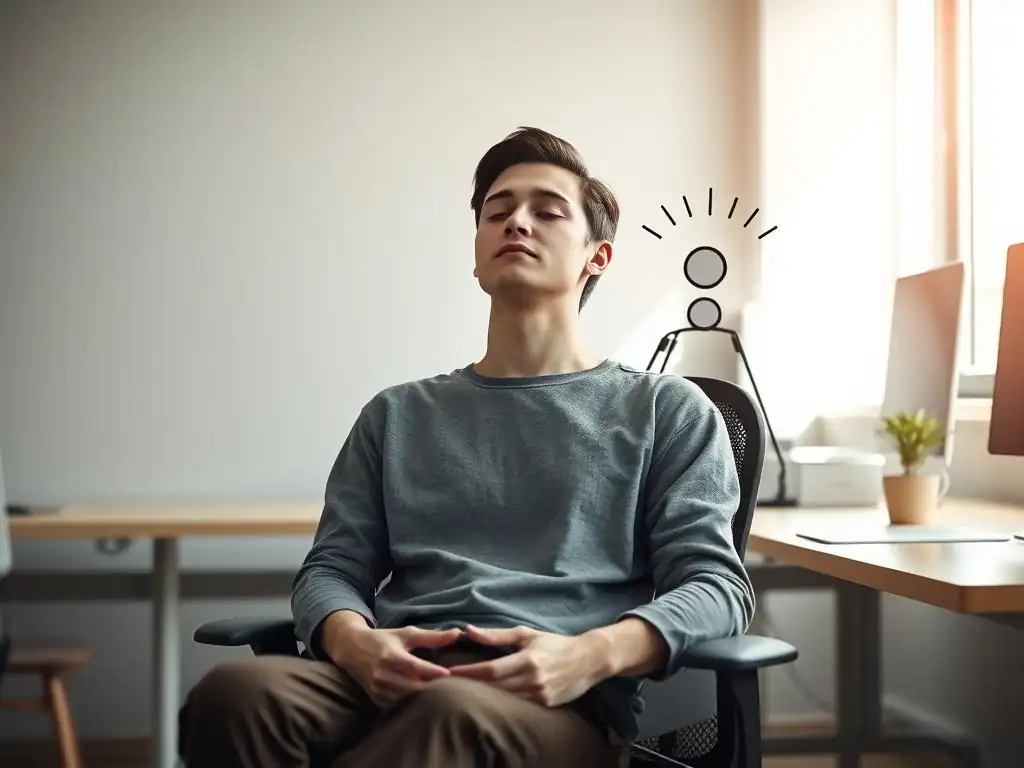
Sit upright in your chair with your feet flat on the floor. Let your hands rest comfortably in your lap or on your desk. Ensure your back is supported, and your shoulders are relaxed, not slouched or tense. Allow your eyes to gently close if comfortable, or keep them softly focused on a point in front of you.
-
Step 2: Focusing on Your Breath as an Anchor
Take a few deep breaths, inhaling deeply through your nose and exhaling slowly through your mouth. Feel the sensation of the breath entering and leaving your body. This helps to settle your mind and bring you into the present moment before you begin the scan. Don't try to change your breath, just notice its natural rhythm.
-
Step 3: Systematically Scanning Your Body for Sensations
Begin by bringing your attention to your feet. Notice any sensations there – warmth, coolness, tingling, pressure against your shoes or the floor. Simply observe. Then, slowly move your awareness up your body: to your ankles, lower legs, knees, thighs, and hips. Spend a few moments in each area, noticing whatever is present. Continue moving up through your torso (pelvis, abdomen, lower back, upper back, chest), then to your fingers, hands, wrists, forearms, elbows, upper arms, and shoulders. Finally, bring awareness to your neck, jaw, face, and the top of your head.
-
Step 4: Observing Sensations Without Reaction
As you scan each area, your task is simply to notice the physical sensations without judging them or trying to fix them. If you encounter discomfort or pain, simply acknowledge it with kindness. If your mind wanders (which it will! ), gently guide your attention back to the body part you were scanning. There's no right or wrong way to feel; the goal is awareness.
-
Step 5: Gently Returning to the Present Moment
Once you have scanned your entire body, take a moment to feel the sense of your body as a whole, sitting in the chair. Notice your connection to the chair and the floor. Take another deep breath. When you feel ready, gently open your eyes and bring your awareness back to your surroundings, feeling refreshed and more present.
Variations of Body Scan Techniques for Different Work Styles
Quick 3-Minute Body Scan for Time-Constrained Schedules
For the busy office worker who feels they have no time for meditation, a condensed 3-minute body scan can be incredibly effective. The principle remains the same: bring attention systematically to the body. However, instead of lingering on each small area, you might focus on larger regions: feet and legs, torso, arms and hands, head and neck. Dedicate about 30-45 seconds to each major section. This rapid scan still provides a valuable opportunity to check in with your physical state, release obvious tension, and anchor yourself in the present moment before diving back into tasks.
This short version is particularly useful before important meetings, after a stressful phone call, or when transitioning between different types of work. It serves as a mental palate cleanser. Even this brief practice has been shown in some studies to reduce immediate stress responses and improve focus for the subsequent activity. For instance, participants in a study who performed a 3-minute mindfulness exercise before a cognitive task showed improved performance compared to those who did not, demonstrating that even micro-doses of an Office worker body scan meditation can yield benefits.
Utilizing Guided Body Scan Meditation Apps and Resources
Many excellent apps and online resources offer guided body scan meditations, varying in length from a few minutes to 30 minutes or more. Using a guided meditation can be particularly helpful for beginners, as the narrator prompts you to move your attention through the body, making it easier to stay focused and understand the process. Popular apps often include specific sessions tailored for stress reduction, focus, or sleep, many of which can be adapted for a desk setting.
These resources provide structure and support, allowing the office worker to simply listen and follow along. Some apps even offer short "mindful breaks" specifically designed for the workday, often incorporating elements of a body scan. While free resources are available, subscription services often provide a wider variety of guides and lengths. Choosing a guide with a voice and pacing you find calming can enhance the experience and make your Office worker body scan meditation practice more consistent.
Adapting Body Scan for Different Work Environments (Remote, Hybrid, In-Office)
The beauty of the body scan is its adaptability. For remote workers, the flexibility of their environment might allow for slightly longer or more frequent sessions. They might choose to do a body scan while taking a walking break (a mindful walk focusing on the sensations of movement) or simply sitting comfortably in their home office. The principles of minimizing distraction and finding comfort remain key.
For those in hybrid or traditional in-office settings, discretion might be a factor. A desk body scan can be done with eyes open, softly focused on the desk, making it less noticeable. Using noise-canceling headphones is effective in open-plan offices. The core practice of internal awareness doesn't require external signs. The key is to find a few minutes where you feel relatively undisturbed, whether that's before starting work, during a lunch break, or for a brief pause in the afternoon slump. The practice is internal and portable, making an Office worker body scan meditation accessible wherever you are.
Common Challenges and Solutions in Workplace Body Scan Practice
Managing Distractions and Interruptions
One of the most frequent challenges when attempting an Office worker body scan meditation is dealing with distractions, both internal (wandering thoughts) and external (noise, colleagues). It's important to understand that the goal isn't to eliminate distractions, but to become aware of them and gently redirect your attention back to the body scan.
When your mind wanders to a pending email or a meeting later in the day, simply notice the thought without judgment. Acknowledge it ("Ah, thinking about the meeting") and then deliberately guide your attention back to the part of the body you were scanning. Treat external noise the same way – notice it, but don't get caught up in reacting to it; return your focus inward.
Think of it as mental bicep curls; each time you notice distraction and return, you strengthen your ability to focus. Setting clear boundaries before starting, like putting up a "Do Not Disturb" sign or using headphones, can help minimize external interruptions, creating a more conducive environment for your desk body scan.
Addressing Physical Discomfort and Tension
During a body scan, you might encounter areas of physical discomfort or significant tension, which can be unsettling. The empathetic approach here is crucial. Instead of tensing up or wishing the discomfort away, try approaching it with curiosity and kindness. Notice the quality of the sensation – is it sharp, dull, throbbing? Where exactly is it located?
You can gently breathe into the area of discomfort, imagining your breath bringing ease there, without forcing the sensation to change. Sometimes, simply acknowledging the discomfort without resistance can lessen its intensity. If the pain is significant or worsens, it's important to listen to your body and adjust your posture or conclude the scan. The body scan is a tool for awareness and acceptance, not a substitute for addressing underlying physical issues. For persistent discomfort identified during your Office worker body scan meditation, consider consulting a healthcare professional.
Integrating Body Scan into Your Daily Work Routine
Making body scan meditation a consistent practice amidst a busy work schedule can be challenging. The key is integration, not addition of another overwhelming task. Start small, perhaps with just 3-5 minutes once or twice a day. Identify specific moments in your workday when a body scan would be most beneficial – maybe before starting your most challenging task, right after lunch to combat the afternoon slump, or before leaving work to transition home.
-
- [ ] Schedule a 5-minute body scan in your calendar.
-
- [ ] Set a reminder on your phone for a mid-morning or afternoon practice.
-
- [ ] Pair the practice with an existing habit, like doing a quick scan right after finishing your first cup of coffee or before opening your email in the morning.
Consistency over duration is more impactful. Even a brief, regular desk body scan is more beneficial than occasional long sessions. Celebrate small successes and be patient with yourself; building a new habit takes time and repetition. Framing it as a tool for enhanced well-being and performance, rather than just another item on your to-do list, can also increase motivation for regular Office worker body scan meditation.
The Science Behind Body Scan Meditation and Mental Clarity
Research on Mindfulness and Cognitive Function
Scientific research has increasingly explored the impact of mindfulness practices, including body scan meditation, on brain function and cognitive abilities relevant to the workplace. Studies using fMRI imaging have shown that regular mindfulness meditation can lead to structural changes in the brain, including increased gray matter density in areas associated with learning, memory, emotional regulation, and self-referential processing, such as the hippocampus and prefrontal cortex.
Furthermore, research indicates that mindfulness training can improve attention span, working memory capacity, and cognitive flexibility – skills critical for problem-solving and adapting to change in a professional setting. For example, a study published in Psychological Science found that just two weeks of mindfulness training improved GRE reading comprehension scores and reduced mind wandering in students. While not specific to office workers, these findings underscore the potential for a regular desk body scan practice to enhance the cognitive functions necessary for performing demanding work tasks effectively and with greater mental clarity.
How Body Scan Promotes Relaxation and Reduces Reactivity
The body scan is particularly effective at promoting relaxation and reducing reactivity to stressful stimuli. By systematically bringing awareness to physical sensations without judgment, individuals learn to tolerate discomfort and difficult emotions rather than immediately reacting to them. This practice helps to interrupt the automatic stress response loop, where a perceived threat (like a demanding email) triggers physiological changes (increased heart rate, muscle tension) and reactive behaviors (sending an angry reply).
Through repeated practice of observing sensations in the body during an Office worker body scan meditation, the connection between physical sensations and emotional states becomes clearer. This awareness allows for a pause between the stimulus and the response. Instead of reacting impulsively to stress or frustration, an individual can notice the physical tension or emotional surge and consciously choose a more skillful response. This reduced reactivity contributes significantly to maintaining composure during challenging work situations and fosters a greater sense of control over one's emotional state throughout the workday.
Tips for Maintaining a Consistent Body Scan Practice
Scheduling Dedicated Time for Meditation
One of the most effective ways to ensure consistency with your Office worker body scan meditation is to treat it like any other important appointment and schedule dedicated time for it. Even 5-10 minutes blocked off in your calendar can make a significant difference. This prevents the practice from being squeezed out by urgent tasks.
Consider when you feel the most need for a mental reset during the day. Is it mid-morning when tasks start piling up? Or maybe right after lunch when energy dips? Choose a time that feels realistic and sustainable within your workday structure. Setting a recurring calendar event or a reminder on your phone can serve as a helpful prompt, transforming the intention to practice into a concrete action. Remember, consistency is more impactful than duration, so prioritize making the time, even if it's brief.
Cultivating a Supportive Mindset
Approaching your Office worker body scan meditation practice with a supportive and compassionate mindset is crucial for long-term consistency. Avoid self-criticism if your mind wanders frequently or if you miss a session. Mindfulness is a practice, not a performance. There will be days when it feels easy and days when it feels challenging.
Embrace the learning process. Each time you notice your mind has drifted and gently guide it back, you are strengthening your mindfulness muscle. View the body scan not as another item on your to-do list to be completed perfectly, but as a gift of self-care you are giving yourself. Frame it as a tool to support your well-being and effectiveness at work. This positive and empathetic internal dialogue makes it more likely that you will return to the practice even after encountering difficulties or lapses.
Recognizing and Celebrating the Positive Impacts
To stay motivated, actively notice and celebrate the positive impacts that your desk body scan practice has on your workday. Pay attention to how you feel after a session – perhaps a little calmer, more focused, or less physically tense. Over time, observe broader changes: Are you reacting less impulsively to stressful emails? Do you feel more present in meetings? Is your concentration improving?
Keeping a brief journal or simply taking a moment to acknowledge these positive changes can reinforce the value of the practice and encourage you to continue. Sharing your positive experiences (appropriately) with a supportive colleague or friend might also provide external encouragement. Recognizing the tangible benefits, whether it's feeling slightly less stressed or noticing improved focus for just an hour, provides powerful intrinsic motivation to maintain your Office worker body scan meditation routine.
Conclusion: Integrating Body Scan for a More Mindful Workday
The Transformative Power of Simple Mindfulness Techniques
The demands of the modern office environment can be relentless, but integrating simple mindfulness techniques like the body scan offers a practical path to greater well-being and effectiveness. This accessible practice requires no special equipment and can be performed right at your desk, providing an immediate opportunity to ground yourself amidst the busyness. By systematically bringing awareness to physical sensations, the Office worker body scan meditation helps to interrupt cycles of stress and worry, fostering a state of calm and presence.
The cumulative effect of regular desk body scan sessions extends beyond momentary relaxation. It trains the mind to focus, improves body awareness to prevent discomfort, reduces emotional reactivity, and enhances cognitive function. Even short, consistent practice can lead to noticeable improvements in managing stress, increasing productivity, and cultivating a more positive relationship with your work environment and your physical self. This simple yet profound technique empowers office workers to navigate their demanding days with greater ease, clarity, and resilience.
Resources for Continued Mindfulness Practice in the Workplace
For those interested in deepening their Office worker body scan meditation practice and exploring other mindfulness techniques suitable for the workplace, numerous resources are available. Many websites dedicated to mental health and mindfulness offer free guided meditations, including body scans of various lengths. Educational platforms often provide introductory courses on mindfulness tailored for professionals, explaining the principles and offering practical exercises.
Additionally, many organizations are now recognizing the value of workplace mindfulness and may offer internal programs or access to external resources. Exploring these options can provide structured learning and support. Remember, starting is the most important step. Begin with a short, simple desk body scan today and gradually explore resources that resonate with you to continue integrating mindfulness into your professional life for enhanced well-being.
Frequently Asked Questions
What exactly is body scan meditation, and how does it relate to office workers?
Body scan meditation is a mindfulness technique that involves focusing attention on different parts of the body. It's particularly useful for office workers as it can be practiced discreetly at their desks to reduce stress and improve focus.
How can body scan meditation improve the mental well-being of office workers?
It can significantly improve mental well-being by reducing stress and anxiety, increasing self-awareness, and promoting a sense of calm. Regular practice can help office workers manage the demands of their job more effectively.
How often should an office worker practice body scan meditation for noticeable benefits?
While benefits can be felt even after a single session, aim for at least 10-15 minutes daily. Consistent practice will lead to more sustained improvements in mental well-being and stress management.
Are there any specific variations of body scan meditation that are better suited for the office environment?
Yes, there are modified versions that can be done sitting in a chair, focusing on breath and body sensations without requiring lying down. These are perfect for quick mindfulness breaks at the desk.
What are some common challenges office workers might face when starting body scan meditation, and how can they overcome them?
Common challenges include distractions and difficulty focusing. Overcome this by starting with shorter sessions, using headphones to block out noise, and gently redirecting attention back to the body when the mind wanders.
Final Reflection: Cultivating Calm Amidst the Chaos
The relentless pace of modern office life often leaves us feeling depleted and disconnected, yet the simple act of incorporating mindfulness, specifically through body scan meditation, offers a powerful antidote. This practice, far from being a luxury, is a crucial tool for enhancing well-being and productivity in today's demanding work environment. The techniques explored in this article – from mindful breathing to focused attention on physical sensations – are not esoteric practices, but readily accessible methods to reclaim a sense of presence and calm amidst the daily grind.
The impact of consistent mindfulness practice extends far beyond the immediate feeling of relaxation. It cultivates a deeper self-awareness, fostering resilience in the face of stress and improving our ability to navigate challenging situations with greater clarity and compassion. The time to repair the roof is when the sun is shining.
This proverb perfectly encapsulates the preventative power of mindfulness; by proactively nurturing our mental and physical well-being, we build a stronger foundation to withstand the inevitable storms of workplace pressures.
Now, consider how you might integrate even one of these body scan techniques into your daily routine. Perhaps dedicate five minutes before your lunch break to a focused breathing exercise, or incorporate a brief body scan during a lull in your workday. You don't need a dedicated meditation room or hours of free time; even small, consistent efforts can yield significant benefits. Embrace the opportunity to cultivate a more mindful and balanced approach to your work life – your well-being, and your productivity, will thank you for it.
Unleash Your Inner Calm: Integrate Mindfulness into Your Day
Thanks for taking the time to explore simple ways to incorporate mindfulness into your workday! We hope you found practical techniques to combat stress and boost your focus. Now, let's put these tools into action:
- Prioritize your well-being: Start your day with a 5-minute body scan, focusing on your breath and physical sensations. Notice how it affects your energy levels throughout the morning.
- Share the calm: Tell a colleague about the benefits of body scans, or simply encourage them to take a short break for some deep breathing.
- Elevate your experience: Experiment with different body scan techniques – perhaps focus on your hands or feet – and track how your attention shifts.
Ready to transform your workday, one mindful breath at a time? What small change will you implement today to cultivate more calm and focus?